

96
3 – Transport in ionic solids
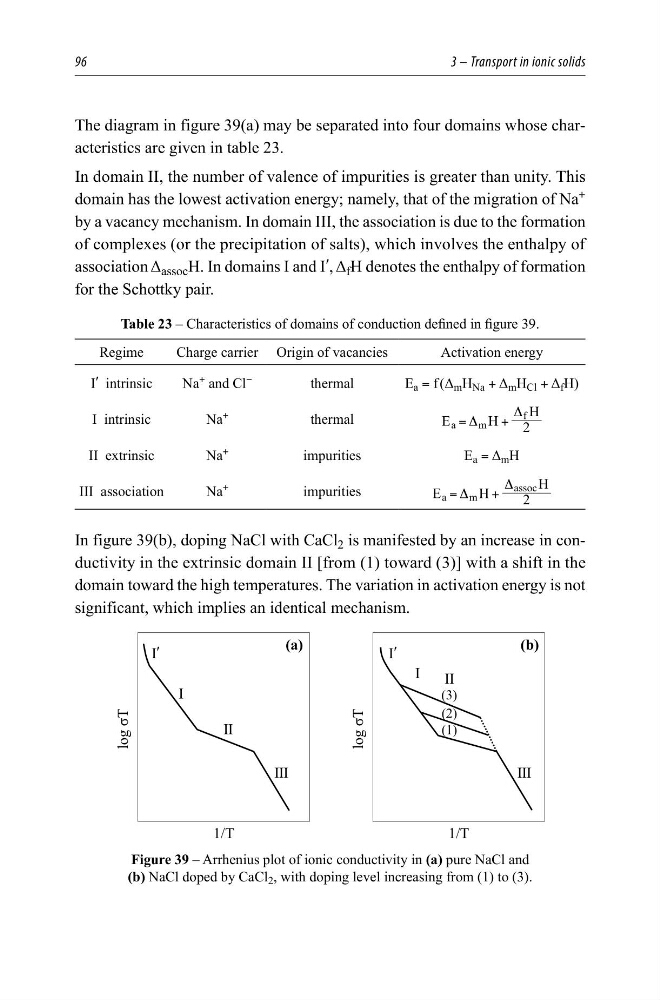
The diagram in figure 39(a) may be separated into four domains whose characteristics are given in table 23.
In domain II, the number of valence of impurities is greater than unity. This
domain has the lowest activation energy; namely, that of the migration of Na
+
by a vacancy mechanism. In domain III, the association is due to the formation
of complexes (or the precipitation of salts), which involves the enthalpy of
association Δ assoc H. In domains I and I ′ , Δ f H denotes the enthalpy of formation
for the Schottky pair.
Table 23 – Characteristics of domains of conduction defined in figure 39.
Regime
Charge carrier Origin of vacancies
Activation energy
I′ intrinsic
Na
+
and Cl
−
thermal
E a = f (Δ m H Na + Δ m H Cl + Δ f H)
I intrinsic
Na
+
thermal
E
H
2
H
a
m
f
Δ
Δ
=
+
II extrinsic
Na
+
impurities
E a = Δ m H
III association
Na
+
impurities
E
H
2
H
a
m
assoc
Δ
Δ
=
+
In figure 39(b), doping NaCl with CaCl 2 is manifested by an increase in conductivity in the extrinsic domain II [from (1) toward (3)] with a shift in the
domain toward the high temperatures. The variation in activation energy is not
significant, which implies an identical mechanism.
E
D
7
7
,,,
,,
,,,
,,
, ƍ
,
,ƍ
,
ORJı7
ORJı7
Figure 39 – Arrhenius plot of ionic conductivity in (a) pure NaCl and
(b) NaCl doped by CaCl 2 , with doping level increasing from (1) to (3).
3 – Transport in ionic solids
The diagram in figure 39(a) may be separated into four domains whose characteristics are given in table 23.
In domain II, the number of valence of impurities is greater than unity. This
domain has the lowest activation energy; namely, that of the migration of Na
+
by a vacancy mechanism. In domain III, the association is due to the formation
of complexes (or the precipitation of salts), which involves the enthalpy of
association Δ assoc H. In domains I and I ′ , Δ f H denotes the enthalpy of formation
for the Schottky pair.
Table 23 – Characteristics of domains of conduction defined in figure 39.
Regime
Charge carrier Origin of vacancies
Activation energy
I′ intrinsic
Na
+
and Cl
−
thermal
E a = f (Δ m H Na + Δ m H Cl + Δ f H)
I intrinsic
Na
+
thermal
E
H
2
H
a
m
f
Δ
Δ
=
+
II extrinsic
Na
+
impurities
E a = Δ m H
III association
Na
+
impurities
E
H
2
H
a
m
assoc
Δ
Δ
=
+
In figure 39(b), doping NaCl with CaCl 2 is manifested by an increase in conductivity in the extrinsic domain II [from (1) toward (3)] with a shift in the
domain toward the high temperatures. The variation in activation energy is not
significant, which implies an identical mechanism.
E
D
7
7
,,,
,,
,,,
,,
, ƍ
,
,ƍ
,
ORJı7
ORJı7
Figure 39 – Arrhenius plot of ionic conductivity in (a) pure NaCl and
(b) NaCl doped by CaCl 2 , with doping level increasing from (1) to (3).