

�
�
�
�
�
�
and
x
Ij is the paraxial ray slope in the Gaussian image plane.
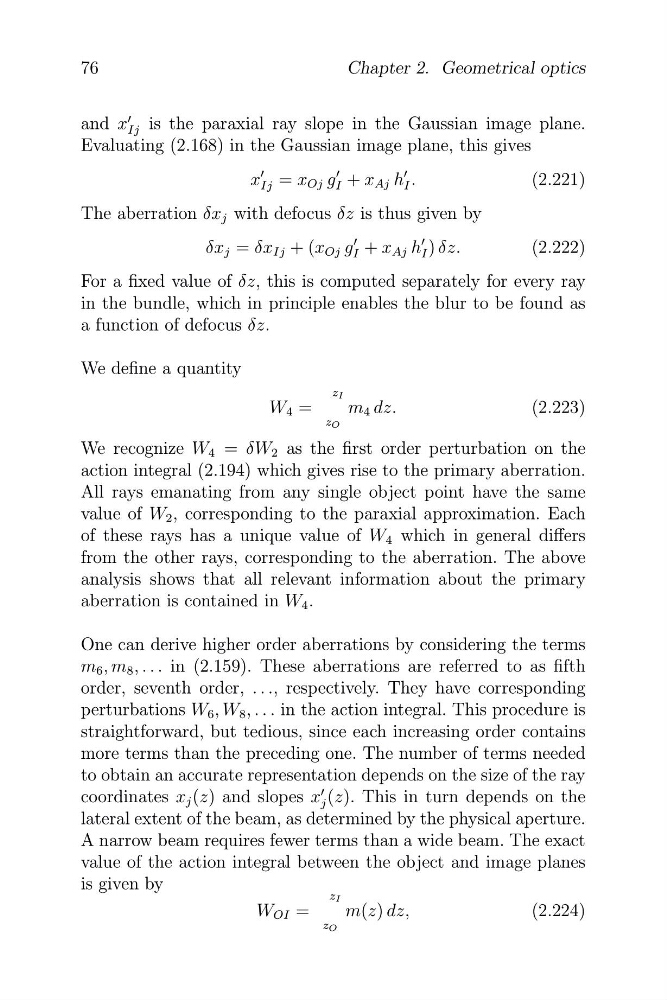
Evaluating (2.168) in the Gaussian image plane, this gives
x Ij = x Oj g I + x Aj h I .
The aberration δx j with defocus δz is thus given by
I + x Aj h
(2.221)
(2.222)
δx j = δx Ij + (x Oj g
� ) δz.
I
For a fixed value of δz, this is computed separately for every ray
in the bundle, which in principle enables the blur to be found as
a function of defocus δz.
We define a quantity
z I
W 4 =
m 4 dz.
(2.223)
z O
We recognize W 4 = δW 2 as the first order perturbation on the
action integral (2.194) which gives rise to the primary aberration.
All rays emanating from any single object point have the same
value of W 2 , corresponding to the paraxial approximation. Each
of these rays has a unique value of W 4 which in general differs
from the other rays, corresponding to the aberration. The above
analysis shows that all relevant information about the primary
aberration is contained in W 4 .
One can derive higher order aberrations by considering the terms
m 6 , m 8 , . . . in (2.159). These aberrations are referred to as fifth
order, seventh order, . . ., respectively. They have corresponding
perturbations W 6 , W 8 , . . . in the action integral. This procedure is
straightforward, but tedious, since each increasing order contains
more terms than the preceding one. The number of terms needed
to obtain an accurate representation depends on the size of the ray
coordinates x j (z) and slopes x j (z). This in turn depends on the
lateral extent of the beam, as determined by the physical aperture.
A narrow beam requires fewer terms than a wide beam. The exact
value of the action integral between the object and image planes
is given by
z I
W OI =
m(z) dz,
(2.224)
z O
76
Chapter 2. Geometrical optics
�
�
�
�
�
and
x
Ij is the paraxial ray slope in the Gaussian image plane.
Evaluating (2.168) in the Gaussian image plane, this gives
x Ij = x Oj g I + x Aj h I .
The aberration δx j with defocus δz is thus given by
I + x Aj h
(2.221)
(2.222)
δx j = δx Ij + (x Oj g
� ) δz.
I
For a fixed value of δz, this is computed separately for every ray
in the bundle, which in principle enables the blur to be found as
a function of defocus δz.
We define a quantity
z I
W 4 =
m 4 dz.
(2.223)
z O
We recognize W 4 = δW 2 as the first order perturbation on the
action integral (2.194) which gives rise to the primary aberration.
All rays emanating from any single object point have the same
value of W 2 , corresponding to the paraxial approximation. Each
of these rays has a unique value of W 4 which in general differs
from the other rays, corresponding to the aberration. The above
analysis shows that all relevant information about the primary
aberration is contained in W 4 .
One can derive higher order aberrations by considering the terms
m 6 , m 8 , . . . in (2.159). These aberrations are referred to as fifth
order, seventh order, . . ., respectively. They have corresponding
perturbations W 6 , W 8 , . . . in the action integral. This procedure is
straightforward, but tedious, since each increasing order contains
more terms than the preceding one. The number of terms needed
to obtain an accurate representation depends on the size of the ray
coordinates x j (z) and slopes x j (z). This in turn depends on the
lateral extent of the beam, as determined by the physical aperture.
A narrow beam requires fewer terms than a wide beam. The exact
value of the action integral between the object and image planes
is given by
z I
W OI =
m(z) dz,
(2.224)
z O
76
Chapter 2. Geometrical optics