

75
2.5. Axial symmetry
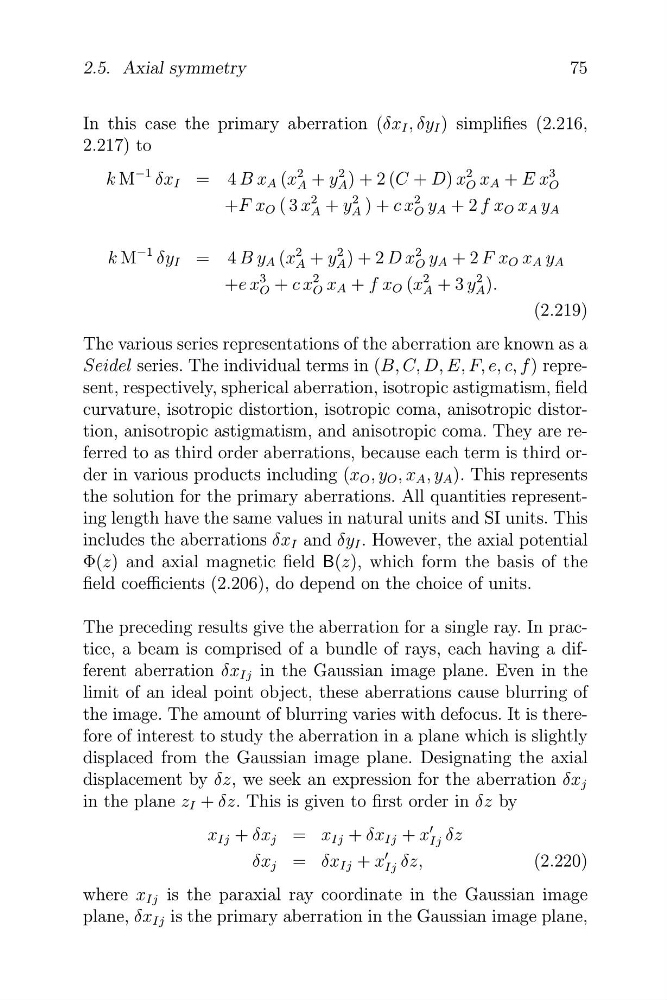
In this case the primary aberration (δx I , δy I ) simplifies (2.216,
2.217) to
A ) + 2 (C + D) x O x A + E x
2
2
k M
−1 δx I = 4 B x A (x A + y
2
3
O
+F x O ( 3 x A + y
2
2
A ) + c x O y A + 2 f x O x A y A
2
2
2
A ) + 2 D x
O + c x O x A + f x O (x A + 3 y A ).
(2.219)
2
2
3
k M
−1 δy I = 4 B y A (x A + y
2
+e x
2
+ 2 F x
y
x y
A
O A A
O
The various series representations of the aberration are known as a
Seidel series. The individual terms in (B, C, D, E, F, e, c, f ) represent, respectively, spherical aberration, isotropic astigmatism, field
curvature, isotropic distortion, isotropic coma, anisotropic distortion, anisotropic astigmatism, and anisotropic coma. They are referred to as third order aberrations, because each term is third order in various products including (x O , y O , x A , y A ). This represents
the solution for the primary aberrations. All quantities representing length have the same values in natural units and SI units. This
includes the aberrations δx I and δy I . However, the axial potential
Φ(z) and axial magnetic field B(z), which form the basis of the
field coefficients (2.206), do depend on the choice of units.
The preceding results give the aberration for a single ray. In practice, a beam is comprised of a bundle of rays, each having a different aberration δx Ij in the Gaussian image plane. Even in the
limit of an ideal point object, these aberrations cause blurring of
the image. The amount of blurring varies with defocus. It is therefore of interest to study the aberration in a plane which is slightly
displaced from the Gaussian image plane. Designating the axial
displacement by δz, we seek an expression for the aberration δx j
in the plane z I + δz. This is given to first order in δz by
x Ij + δx j = x Ij + δx Ij + x I
�
j δz
δx j = δx Ij + x
�
Ij δz,
(2.220)
where x Ij is the paraxial ray coordinate in the Gaussian image
plane, δx Ij is the primary aberration in the Gaussian image plane,
2.5. Axial symmetry
In this case the primary aberration (δx I , δy I ) simplifies (2.216,
2.217) to
A ) + 2 (C + D) x O x A + E x
2
2
k M
−1 δx I = 4 B x A (x A + y
2
3
O
+F x O ( 3 x A + y
2
2
A ) + c x O y A + 2 f x O x A y A
2
2
2
A ) + 2 D x
O + c x O x A + f x O (x A + 3 y A ).
(2.219)
2
2
3
k M
−1 δy I = 4 B y A (x A + y
2
+e x
2
+ 2 F x
y
x y
A
O A A
O
The various series representations of the aberration are known as a
Seidel series. The individual terms in (B, C, D, E, F, e, c, f ) represent, respectively, spherical aberration, isotropic astigmatism, field
curvature, isotropic distortion, isotropic coma, anisotropic distortion, anisotropic astigmatism, and anisotropic coma. They are referred to as third order aberrations, because each term is third order in various products including (x O , y O , x A , y A ). This represents
the solution for the primary aberrations. All quantities representing length have the same values in natural units and SI units. This
includes the aberrations δx I and δy I . However, the axial potential
Φ(z) and axial magnetic field B(z), which form the basis of the
field coefficients (2.206), do depend on the choice of units.
The preceding results give the aberration for a single ray. In practice, a beam is comprised of a bundle of rays, each having a different aberration δx Ij in the Gaussian image plane. Even in the
limit of an ideal point object, these aberrations cause blurring of
the image. The amount of blurring varies with defocus. It is therefore of interest to study the aberration in a plane which is slightly
displaced from the Gaussian image plane. Designating the axial
displacement by δz, we seek an expression for the aberration δx j
in the plane z I + δz. This is given to first order in δz by
x Ij + δx j = x Ij + δx Ij + x I
�
j δz
δx j = δx Ij + x
�
Ij δz,
(2.220)
where x Ij is the paraxial ray coordinate in the Gaussian image
plane, δx Ij is the primary aberration in the Gaussian image plane,