

2.5.6 Spherical aberration
In the case where the object is on the optic axis, we have x Oj = 0.
In this case, the primary aberration in the Gaussian image plane
reduces to (2.216, 2.217)
4 B M
δx Ij
A + y A ) x Aj .
=
(x
2
2
(2.225)
k
77
2.5. Axial symmetry
where m(z) is the sum of all terms in the infinite series (2.159).
In principle, all relevant information about the optical system is
contained in W in the limit of geometrical optics. This fact will
prove to be highly useful in the analysis to come.
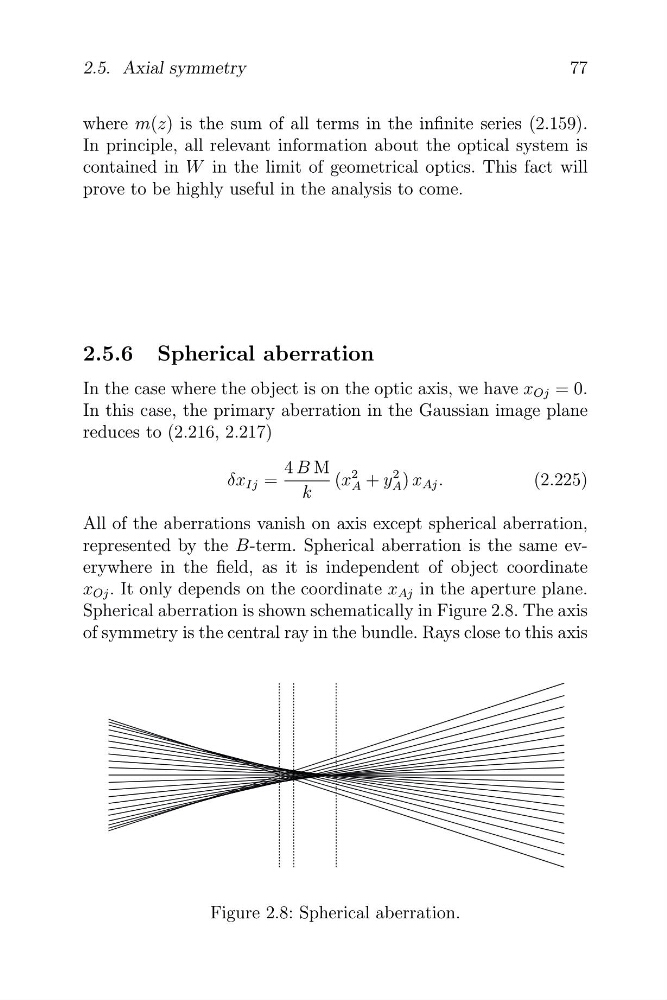
All of the aberrations vanish on axis except spherical aberration,
represented by the B-term. Spherical aberration is the same everywhere in the field, as it is independent of object coordinate
x Oj . It only depends on the coordinate x Aj in the aperture plane.
Spherical aberration is shown schematically in Figure 2.8. The axis
of symmetry is the central ray in the bundle. Rays close to this axis
Figure 2.8: Spherical aberration.
In the case where the object is on the optic axis, we have x Oj = 0.
In this case, the primary aberration in the Gaussian image plane
reduces to (2.216, 2.217)
4 B M
δx Ij
A + y A ) x Aj .
=
(x
2
2
(2.225)
k
77
2.5. Axial symmetry
where m(z) is the sum of all terms in the infinite series (2.159).
In principle, all relevant information about the optical system is
contained in W in the limit of geometrical optics. This fact will
prove to be highly useful in the analysis to come.
All of the aberrations vanish on axis except spherical aberration,
represented by the B-term. Spherical aberration is the same everywhere in the field, as it is independent of object coordinate
x Oj . It only depends on the coordinate x Aj in the aperture plane.
Spherical aberration is shown schematically in Figure 2.8. The axis
of symmetry is the central ray in the bundle. Rays close to this axis
Figure 2.8: Spherical aberration.