

�
�
�
�
70
Chapter 2. Geometrical optics
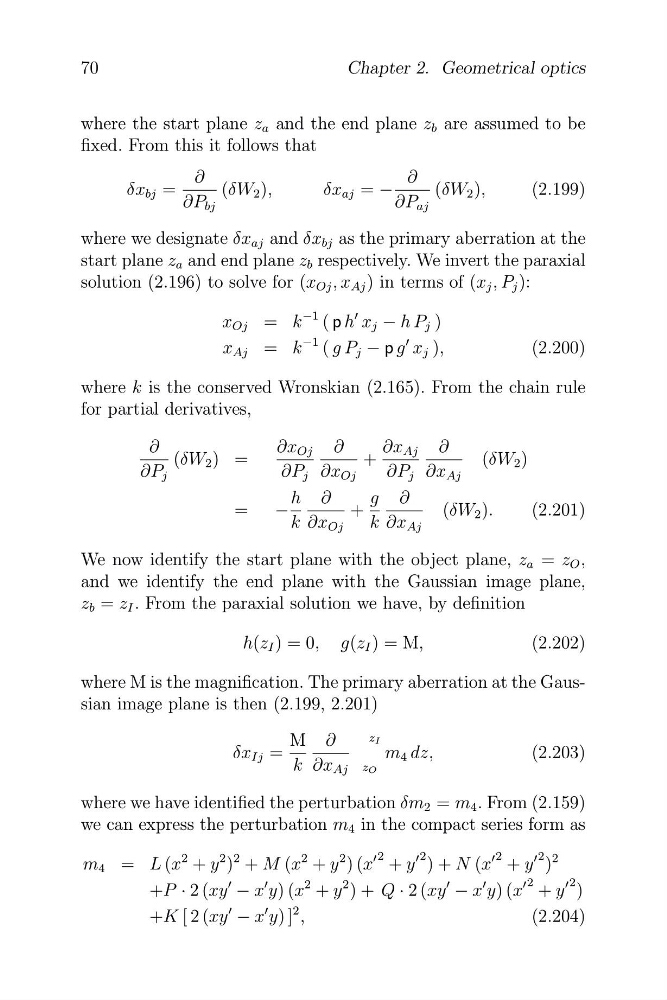
where the start plane z a and the end plane z b are assumed to be
fixed. From this it follows that
∂
∂
δx bj =
(δW 2 ),
δx aj = −
(δW 2 ),
(2.199)
∂P bj
∂P aj
where we designate δx aj and δx bj as the primary aberration at the
start plane z a and end plane z b respectively. We invert the paraxial
solution (2.196) to solve for (x Oj , x Aj ) in terms of (x j , P j ):
x Oj = k
−1 ( p h
� x j − h P j )
x Aj = k
−1 ( g P j − p g
� x j ),
(2.200)
where k is the conserved Wronskian (2.165). From the chain rule
for partial derivatives,
∂
∂x Oj ∂
∂x Aj ∂
(δW 2 ) =
+
(δW 2 )
∂P j
∂P j ∂x Oj
∂P j ∂x Aj
h ∂
g ∂
= −
+
(δW 2 ).
(2.201)
k ∂x Oj k ∂x Aj
We now identify the start plane with the object plane, z a = z O ,
and we identify the end plane with the Gaussian image plane,
z b = z I . From the paraxial solution we have, by definition
h(z I ) = 0, g(z I ) = M,
(2.202)
where M is the magnification. The primary aberration at the Gaussian image plane is then (2.199, 2.201)
M ∂
z I
δx Ij =
m 4 dz,
(2.203)
k ∂x Aj z O
where we have identified the perturbation δm 2 = m 4 . From (2.159)
we can express the perturbation m 4 in the compact series form as
2
2
� 2
� 2
� 2
� 2
m 4 = L (x + y
2 )
2 + M (x + y
2 ) (x + y ) + N (x + y )
2
�
2
�
� 2
� 2
+P · 2 (xy
� − x y) (x + y
2 ) + Q · 2 (xy
� − x y) (x + y )
+K [ 2 (xy
� − x
� y) ]
2 ,
(2.204)
�
�
�
70
Chapter 2. Geometrical optics
where the start plane z a and the end plane z b are assumed to be
fixed. From this it follows that
∂
∂
δx bj =
(δW 2 ),
δx aj = −
(δW 2 ),
(2.199)
∂P bj
∂P aj
where we designate δx aj and δx bj as the primary aberration at the
start plane z a and end plane z b respectively. We invert the paraxial
solution (2.196) to solve for (x Oj , x Aj ) in terms of (x j , P j ):
x Oj = k
−1 ( p h
� x j − h P j )
x Aj = k
−1 ( g P j − p g
� x j ),
(2.200)
where k is the conserved Wronskian (2.165). From the chain rule
for partial derivatives,
∂
∂x Oj ∂
∂x Aj ∂
(δW 2 ) =
+
(δW 2 )
∂P j
∂P j ∂x Oj
∂P j ∂x Aj
h ∂
g ∂
= −
+
(δW 2 ).
(2.201)
k ∂x Oj k ∂x Aj
We now identify the start plane with the object plane, z a = z O ,
and we identify the end plane with the Gaussian image plane,
z b = z I . From the paraxial solution we have, by definition
h(z I ) = 0, g(z I ) = M,
(2.202)
where M is the magnification. The primary aberration at the Gaussian image plane is then (2.199, 2.201)
M ∂
z I
δx Ij =
m 4 dz,
(2.203)
k ∂x Aj z O
where we have identified the perturbation δm 2 = m 4 . From (2.159)
we can express the perturbation m 4 in the compact series form as
2
2
� 2
� 2
� 2
� 2
m 4 = L (x + y
2 )
2 + M (x + y
2 ) (x + y ) + N (x + y )
2
�
2
�
� 2
� 2
+P · 2 (xy
� − x y) (x + y
2 ) + Q · 2 (xy
� − x y) (x + y )
+K [ 2 (xy
� − x
� y) ]
2 ,
(2.204)