

69
2.5. Axial symmetry
ray, which can be solved in principle, but is only accurate for rays
near the optic axis. The next step is to solve for the aberrations.
This requires the next approximation beyond the paraxial approximation. The following analysis closely follows that of Glaser [33],
and in addition properly includes the effects of special relativity.
This is also treated in detail by Rose [75].
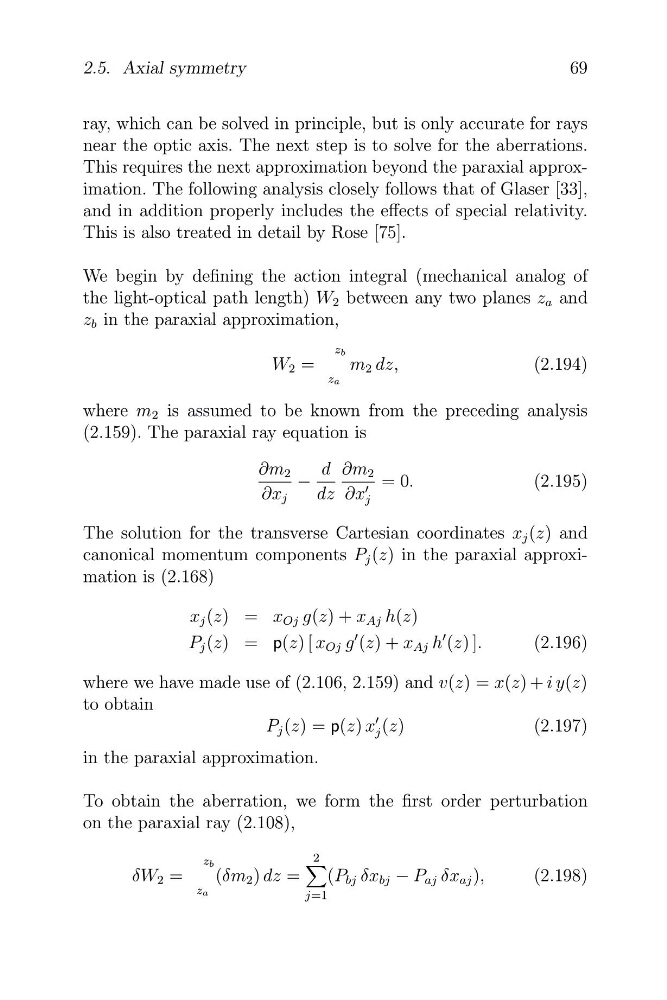
We begin by defining the action integral (mechanical analog of
the light-optical path length) W 2 between any two planes z a and
z b in the paraxial approximation,
z b
W 2 =
m 2 dz,
(2.194)
za
where m 2 is assumed to be known from the preceding analysis
(2.159). The paraxial ray equation is
∂m 2
d ∂m 2
−
= 0.
(2.195)
∂x j
dz ∂x
�
j
The solution for the transverse Cartesian coordinates x j (z) and
canonical momentum components P j (z) in the paraxial approximation is (2.168)
x j (z) = x Oj g(z) + x Aj h(z)
P j (z) = p(z) [ x Oj g
� (z) + x Aj h
� (z) ].
(2.196)
where we have made use of (2.106, 2.159) and v(z) = x(z) + i y(z)
to obtain
P j (z) = p(z) x
� (z)
(2.197)
j
in the paraxial approximation.
To obtain the aberration, we form the first order perturbation
on the paraxial ray (2.108),
2
z b
4
δW 2 =
(δm 2 ) dz =
(P bj δx bj − P aj δx aj ),
(2.198)
za
j=1
2.5. Axial symmetry
ray, which can be solved in principle, but is only accurate for rays
near the optic axis. The next step is to solve for the aberrations.
This requires the next approximation beyond the paraxial approximation. The following analysis closely follows that of Glaser [33],
and in addition properly includes the effects of special relativity.
This is also treated in detail by Rose [75].
We begin by defining the action integral (mechanical analog of
the light-optical path length) W 2 between any two planes z a and
z b in the paraxial approximation,
z b
W 2 =
m 2 dz,
(2.194)
za
where m 2 is assumed to be known from the preceding analysis
(2.159). The paraxial ray equation is
∂m 2
d ∂m 2
−
= 0.
(2.195)
∂x j
dz ∂x
�
j
The solution for the transverse Cartesian coordinates x j (z) and
canonical momentum components P j (z) in the paraxial approximation is (2.168)
x j (z) = x Oj g(z) + x Aj h(z)
P j (z) = p(z) [ x Oj g
� (z) + x Aj h
� (z) ].
(2.196)
where we have made use of (2.106, 2.159) and v(z) = x(z) + i y(z)
to obtain
P j (z) = p(z) x
� (z)
(2.197)
j
in the paraxial approximation.
To obtain the aberration, we form the first order perturbation
on the paraxial ray (2.108),
2
z b
4
δW 2 =
(δm 2 ) dz =
(P bj δx bj − P aj δx aj ),
(2.198)
za
j=1