

�
�
�
� �
= p
1
� �
+ 2 p v ¯ v
ρ
−1 Φ
��
+ −
1
4
p
+
(1 + Φ) −
1
8
p
−1 B
2 ¯
v v
(1 + Φ) 2
1 −1 (Φ
IV
1 −3 (Φ
��
+[ p
+ ρ
�� ) (1 + Φ) − p
+ ρ)
2
64
32
1
1
−3 B
4
+ p
−1 B B
�� −
p
32
128
−
1 p
−3 (Φ
�� + ρ) (1 + Φ) B
2 ] ¯
v
2 v
2
32
1 −1 B
2
� �
+ − 8
1 p
−1 (Φ
�� + ρ) (1 + Φ) − 16 p
v v
¯ v ¯ v
� 2 � 2
+ −
1
8
p v ¯ v
1
1 B
��
+ −
1 p
−2 B
3 − p
−2 (Φ
�� + ρ) (1 + Φ) B +
32
16
32
· i (¯
� v − ¯
� ) ¯
v v
v
v v
+ −
1
8
B
v
v v
� ) ¯
v
i (¯ v − ¯
v
−
1
2
−1 B
2
�
32
[ i ( ¯ v − ¯
+
p
v
v v
� ) ]
+ . . . .
(2.193)
68
Chapter 2. Geometrical optics
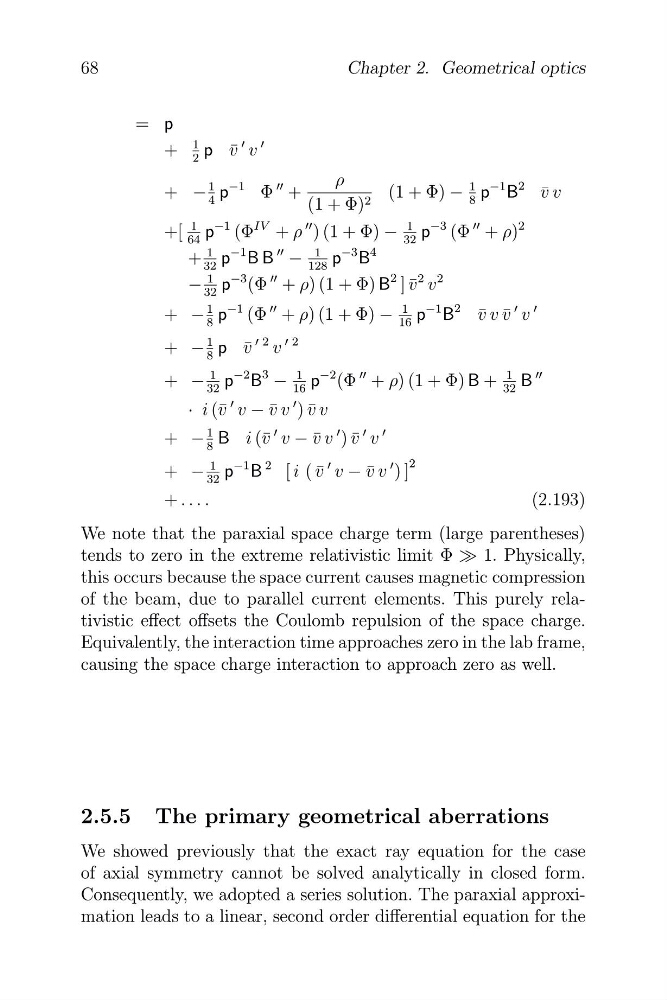
We note that the paraxial space charge term (large parentheses)
tends to zero in the extreme relativistic limit Φ � 1. Physically,
this occurs because the space current causes magnetic compression
of the beam, due to parallel current elements. This purely relativistic effect offsets the Coulomb repulsion of the space charge.
Equivalently, the interaction time approaches zero in the lab frame,
causing the space charge interaction to approach zero as well.
2.5.5 The primary geometrical aberrations
We showed previously that the exact ray equation for the case
of axial symmetry cannot be solved analytically in closed form.
Consequently, we adopted a series solution. The paraxial approximation leads to a linear, second order differential equation for the
�
�
� �
= p
1
� �
+ 2 p v ¯ v
ρ
−1 Φ
��
+ −
1
4
p
+
(1 + Φ) −
1
8
p
−1 B
2 ¯
v v
(1 + Φ) 2
1 −1 (Φ
IV
1 −3 (Φ
��
+[ p
+ ρ
�� ) (1 + Φ) − p
+ ρ)
2
64
32
1
1
−3 B
4
+ p
−1 B B
�� −
p
32
128
−
1 p
−3 (Φ
�� + ρ) (1 + Φ) B
2 ] ¯
v
2 v
2
32
1 −1 B
2
� �
+ − 8
1 p
−1 (Φ
�� + ρ) (1 + Φ) − 16 p
v v
¯ v ¯ v
� 2 � 2
+ −
1
8
p v ¯ v
1
1 B
��
+ −
1 p
−2 B
3 − p
−2 (Φ
�� + ρ) (1 + Φ) B +
32
16
32
· i (¯
� v − ¯
� ) ¯
v v
v
v v
+ −
1
8
B
v
v v
� ) ¯
v
i (¯ v − ¯
v
−
1
2
−1 B
2
�
32
[ i ( ¯ v − ¯
+
p
v
v v
� ) ]
+ . . . .
(2.193)
68
Chapter 2. Geometrical optics
We note that the paraxial space charge term (large parentheses)
tends to zero in the extreme relativistic limit Φ � 1. Physically,
this occurs because the space current causes magnetic compression
of the beam, due to parallel current elements. This purely relativistic effect offsets the Coulomb repulsion of the space charge.
Equivalently, the interaction time approaches zero in the lab frame,
causing the space charge interaction to approach zero as well.
2.5.5 The primary geometrical aberrations
We showed previously that the exact ray equation for the case
of axial symmetry cannot be solved analytically in closed form.
Consequently, we adopted a series solution. The paraxial approximation leads to a linear, second order differential equation for the