

�
�
65
2.5. Axial symmetry
area in polar coordinates, this becomes
µ 0
r
B θ (r) =
j(r 1 ) r 1 dr 1 .
(2.177)
r 0
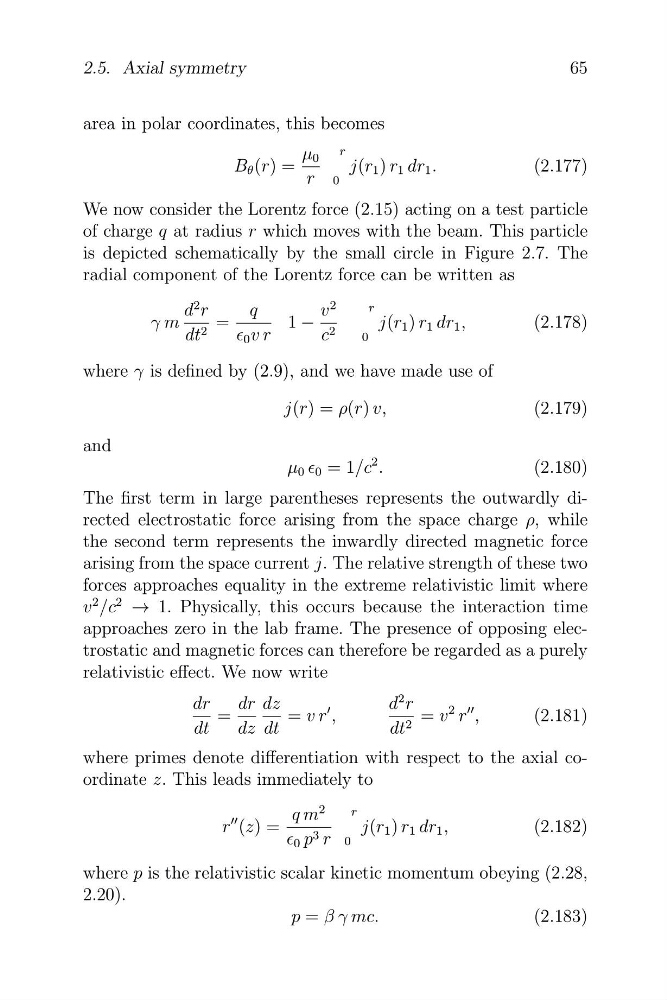
We now consider the Lorentz force (2.15) acting on a test particle
of charge q at radius r which moves with the beam. This particle
is depicted schematically by the small circle in Figure 2.7. The
radial component of the Lorentz force can be written as
d
2
2
r
q
v
r
γ m
=
1 −
j(r 1 ) r 1 dr 1 ,
(2.178)
dt 2
f 0 v r
c 2 0
where γ is defined by (2.9), and we have made use of
j(r) = ρ(r) v,
(2.179)
and
µ 0 f 0 = 1/c
2 .
(2.180)
The first term in large parentheses represents the outwardly directed electrostatic force arising from the space charge ρ, while
the second term represents the inwardly directed magnetic force
arising from the space current j. The relative strength of these two
forces approaches equality in the extreme relativistic limit where
v
2 /c
2 → 1. Physically, this occurs because the interaction time
approaches zero in the lab frame. The presence of opposing electrostatic and magnetic forces can therefore be regarded as a purely
relativistic effect. We now write
dr
dr dz
d
2 r
�
2 ��
=
= v r ,
= v r ,
(2.181)
dt
dz dt
dt 2
where primes denote differentiation with respect to the axial coordinate z. This leads immediately to
2
r
r
�� (z) =
q m
j(r 1 ) r 1 dr 1 ,
(2.182)
f 0 p 3 r 0
where p is the relativistic scalar kinetic momentum obeying (2.28,
2.20).
p = β γ mc.
(2.183)
�
65
2.5. Axial symmetry
area in polar coordinates, this becomes
µ 0
r
B θ (r) =
j(r 1 ) r 1 dr 1 .
(2.177)
r 0
We now consider the Lorentz force (2.15) acting on a test particle
of charge q at radius r which moves with the beam. This particle
is depicted schematically by the small circle in Figure 2.7. The
radial component of the Lorentz force can be written as
d
2
2
r
q
v
r
γ m
=
1 −
j(r 1 ) r 1 dr 1 ,
(2.178)
dt 2
f 0 v r
c 2 0
where γ is defined by (2.9), and we have made use of
j(r) = ρ(r) v,
(2.179)
and
µ 0 f 0 = 1/c
2 .
(2.180)
The first term in large parentheses represents the outwardly directed electrostatic force arising from the space charge ρ, while
the second term represents the inwardly directed magnetic force
arising from the space current j. The relative strength of these two
forces approaches equality in the extreme relativistic limit where
v
2 /c
2 → 1. Physically, this occurs because the interaction time
approaches zero in the lab frame. The presence of opposing electrostatic and magnetic forces can therefore be regarded as a purely
relativistic effect. We now write
dr
dr dz
d
2 r
�
2 ��
=
= v r ,
= v r ,
(2.181)
dt
dz dt
dt 2
where primes denote differentiation with respect to the axial coordinate z. This leads immediately to
2
r
r
�� (z) =
q m
j(r 1 ) r 1 dr 1 ,
(2.182)
f 0 p 3 r 0
where p is the relativistic scalar kinetic momentum obeying (2.28,
2.20).
p = β γ mc.
(2.183)