

64
Chapter 2. Geometrical optics
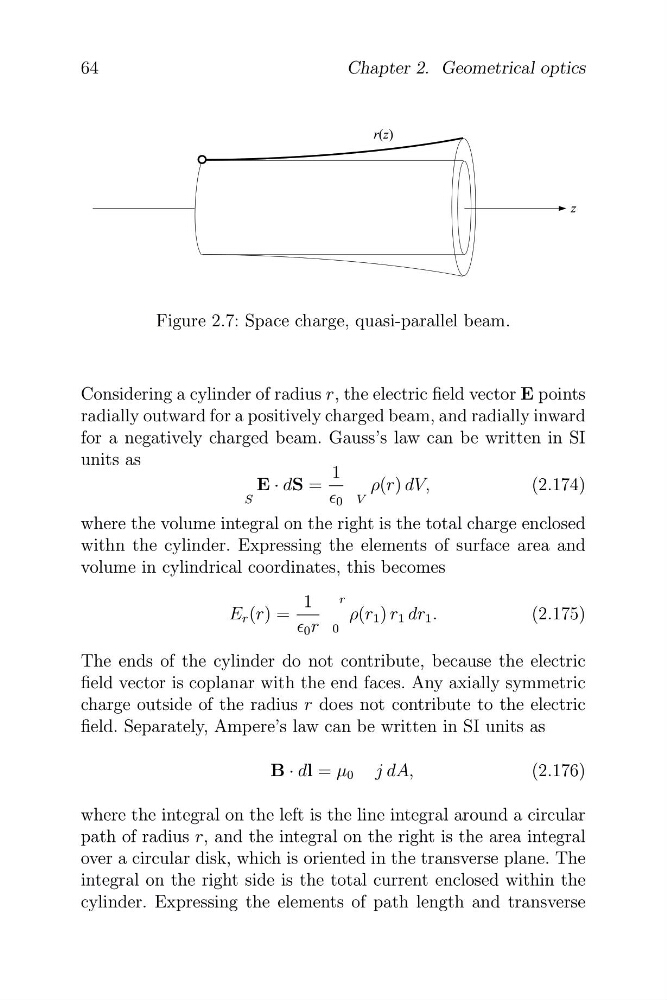
Figure 2.7: Space charge, quasi-parallel beam.
Considering a cylinder of radius r, the electric field vector E points
radially outward for a positively charged beam, and radially inward
for a negatively charged beam. Gauss’s law can be written in SI
units as
1
E · dS =
ρ(r) dV,
(2.174)
S
f 0 V
where the volume integral on the right is the total charge enclosed
withn the cylinder. Expressing the elements of surface area and
volume in cylindrical coordinates, this becomes
r
1
E r (r) =
ρ(r 1 ) r 1 dr 1 .
(2.175)
f 0 r 0
The ends of the cylinder do not contribute, because the electric
field vector is coplanar with the end faces. Any axially symmetric
charge outside of the radius r does not contribute to the electric
field. Separately, Ampere’s law can be written in SI units as
B · dl = µ 0 j dA,
(2.176)
where the integral on the left is the line integral around a circular
path of radius r, and the integral on the right is the area integral
over a circular disk, which is oriented in the transverse plane. The
integral on the right side is the total current enclosed within the
cylinder. Expressing the elements of path length and transverse
Chapter 2. Geometrical optics
Figure 2.7: Space charge, quasi-parallel beam.
Considering a cylinder of radius r, the electric field vector E points
radially outward for a positively charged beam, and radially inward
for a negatively charged beam. Gauss’s law can be written in SI
units as
1
E · dS =
ρ(r) dV,
(2.174)
S
f 0 V
where the volume integral on the right is the total charge enclosed
withn the cylinder. Expressing the elements of surface area and
volume in cylindrical coordinates, this becomes
r
1
E r (r) =
ρ(r 1 ) r 1 dr 1 .
(2.175)
f 0 r 0
The ends of the cylinder do not contribute, because the electric
field vector is coplanar with the end faces. Any axially symmetric
charge outside of the radius r does not contribute to the electric
field. Separately, Ampere’s law can be written in SI units as
B · dl = µ 0 j dA,
(2.176)
where the integral on the left is the line integral around a circular
path of radius r, and the integral on the right is the area integral
over a circular disk, which is oriented in the transverse plane. The
integral on the right side is the total current enclosed within the
cylinder. Expressing the elements of path length and transverse