

�
�
66
Chapter 2. Geometrical optics
The momentum p is constant to first order in this approximation.
The momentum p is related to the kinetic energy T and relativistic
beam voltage V
∗ by (2.96). The equation (2.182) can be regarded
as a general differential-integral equation for the trajectory r(z)
for a quasi-parallel beam in the first-order (paraxial) continuum
approximation. It is possible in principle to solve this equation for
the trajectory r(z) of the test particle. This trajectory is shown
schematically as the bold curve in Figure 2.7. This curve traces
out the envelope of the expanding beam.
In order to gain a further appreciation of the physical significance
of this, we consider the special case where the current density j is
constant within the volume of the beam. We can write j(r) = j 0 ,
independent of radius r. We further assume that the effect is weak,
such that the expansion of the beam is small relative to the beam
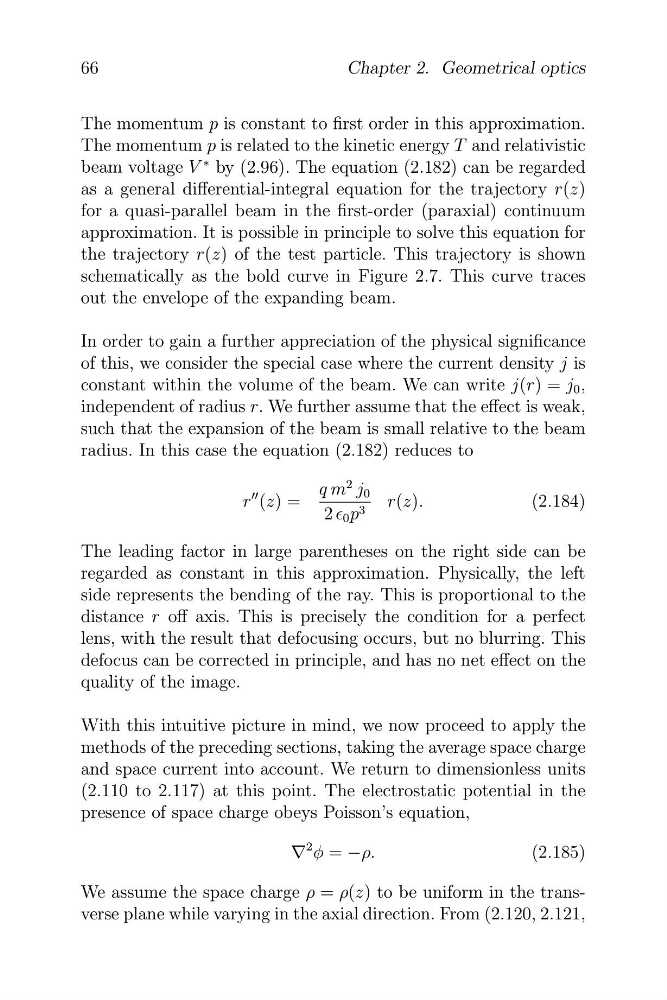
radius. In this case the equation (2.182) reduces to
2 j 0
r
�� (z) =
q m
r(z).
(2.184)
2 f 0 p 3
The leading factor in large parentheses on the right side can be
regarded as constant in this approximation. Physically, the left
side represents the bending of the ray. This is proportional to the
distance r off axis. This is precisely the condition for a perfect
lens, with the result that defocusing occurs, but no blurring. This
defocus can be corrected in principle, and has no net effect on the
quality of the image.
With this intuitive picture in mind, we now proceed to apply the
methods of the preceding sections, taking the average space charge
and space current into account. We return to dimensionless units
(2.110 to 2.117) at this point. The electrostatic potential in the
presence of space charge obeys Poisson’s equation,
v
2 φ = −ρ.
(2.185)
We assume the space charge ρ = ρ(z) to be uniform in the transverse plane while varying in the axial direction. From (2.120, 2.121,
�
66
Chapter 2. Geometrical optics
The momentum p is constant to first order in this approximation.
The momentum p is related to the kinetic energy T and relativistic
beam voltage V
∗ by (2.96). The equation (2.182) can be regarded
as a general differential-integral equation for the trajectory r(z)
for a quasi-parallel beam in the first-order (paraxial) continuum
approximation. It is possible in principle to solve this equation for
the trajectory r(z) of the test particle. This trajectory is shown
schematically as the bold curve in Figure 2.7. This curve traces
out the envelope of the expanding beam.
In order to gain a further appreciation of the physical significance
of this, we consider the special case where the current density j is
constant within the volume of the beam. We can write j(r) = j 0 ,
independent of radius r. We further assume that the effect is weak,
such that the expansion of the beam is small relative to the beam
radius. In this case the equation (2.182) reduces to
2 j 0
r
�� (z) =
q m
r(z).
(2.184)
2 f 0 p 3
The leading factor in large parentheses on the right side can be
regarded as constant in this approximation. Physically, the left
side represents the bending of the ray. This is proportional to the
distance r off axis. This is precisely the condition for a perfect
lens, with the result that defocusing occurs, but no blurring. This
defocus can be corrected in principle, and has no net effect on the
quality of the image.
With this intuitive picture in mind, we now proceed to apply the
methods of the preceding sections, taking the average space charge
and space current into account. We return to dimensionless units
(2.110 to 2.117) at this point. The electrostatic potential in the
presence of space charge obeys Poisson’s equation,
v
2 φ = −ρ.
(2.185)
We assume the space charge ρ = ρ(z) to be uniform in the transverse plane while varying in the axial direction. From (2.120, 2.121,