

�
�
41
2.3. Conservation laws
The functions V, W, X, and Y represent a way to describe the optical coupling between the space (x a , P a ) and the space (x b , P b )
in an infinitesimal region surrounding a ray.
Problem
Show that the functions V, W, X, and Y all lead to the same Lagrange invariant.
2.3.2 Liouville’s theorem and brightness conservation
The motion of a particle can be considered to trace out a trajectory
in a six-dimensional space, for which the coordinates are labeled
by the three position components of x and the three canonical momentum components of P. This is called phase space. The reader
is referred to Goldstein et. al. [35] for background and further
details.
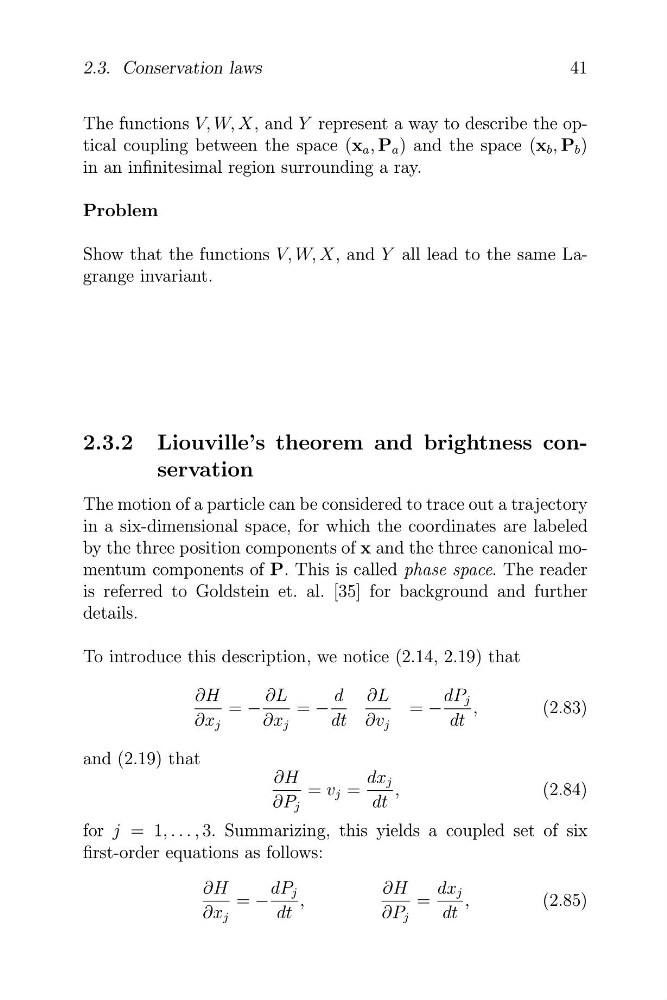
To introduce this description, we notice (2.14, 2.19) that
∂H
∂L
d ∂L
dP j
= −
= −
= −
,
(2.83)
∂x j
∂x j
dt ∂v j
dt
and (2.19) that
∂H
dx j
= v j =
,
(2.84)
∂P j
dt
for j = 1, . . . , 3. Summarizing, this yields a coupled set of six
first-order equations as follows:
∂H
dP j
∂H
dx j
= −
,
=
,
(2.85)
∂x j
dt
∂P j
dt
�
41
2.3. Conservation laws
The functions V, W, X, and Y represent a way to describe the optical coupling between the space (x a , P a ) and the space (x b , P b )
in an infinitesimal region surrounding a ray.
Problem
Show that the functions V, W, X, and Y all lead to the same Lagrange invariant.
2.3.2 Liouville’s theorem and brightness conservation
The motion of a particle can be considered to trace out a trajectory
in a six-dimensional space, for which the coordinates are labeled
by the three position components of x and the three canonical momentum components of P. This is called phase space. The reader
is referred to Goldstein et. al. [35] for background and further
details.
To introduce this description, we notice (2.14, 2.19) that
∂H
∂L
d ∂L
dP j
= −
= −
= −
,
(2.83)
∂x j
∂x j
dt ∂v j
dt
and (2.19) that
∂H
dx j
= v j =
,
(2.84)
∂P j
dt
for j = 1, . . . , 3. Summarizing, this yields a coupled set of six
first-order equations as follows:
∂H
dP j
∂H
dx j
= −
,
=
,
(2.85)
∂x j
dt
∂P j
dt