

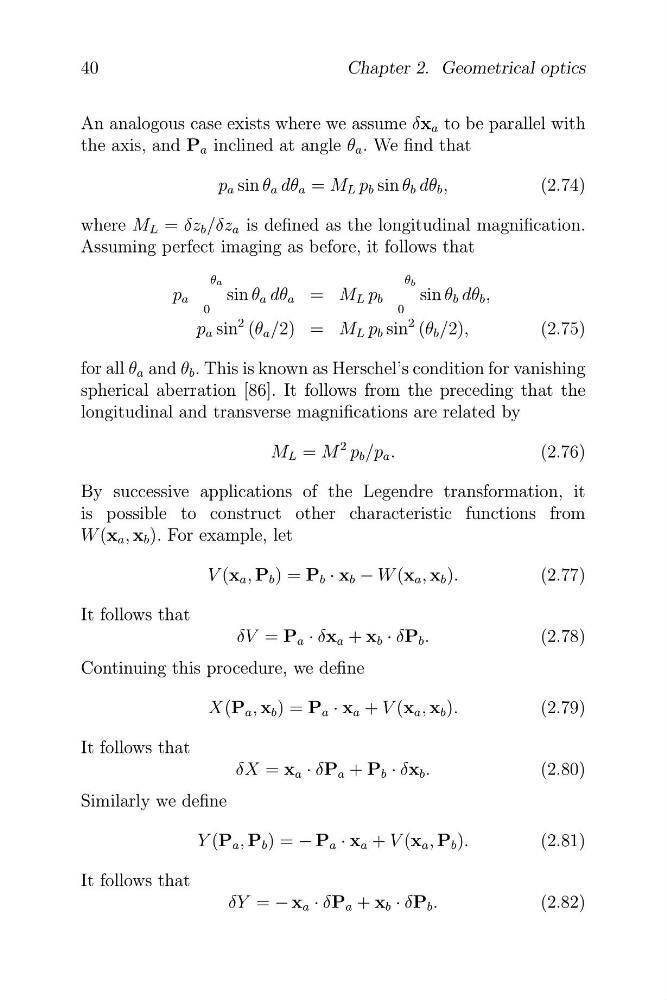
An analogous case exists where we assume δx a to be parallel with
the axis, and P a inclined at angle θ a . We find that
p a sin θ a dθ a = M L p b sin θ b dθ b ,
(2.74)
where M L = δz b /δz a is defined as the longitudinal magnification.
Assuming perfect imaging as before, it follows that
θa
θ b
p a
sin θ a dθ a = M L p b
sin θ b dθ b ,
0
0
p a sin
2 (θ a /2) = M L p b sin
2 (θ b /2),
(2.75)
for all θ a and θ b . This is known as Herschel’s condition for vanishing
spherical aberration [86]. It follows from the preceding that the
longitudinal and transverse magnifications are related by
M L = M
2 p b /p a .
(2.76)
By successive applications of the Legendre transformation, it
is possible to construct other characteristic functions from
W (x a , x b ). For example, let
V (x a , P b ) = P b · x b − W (x a , x b ).
(2.77)
It follows that
δV = P a · δx a + x b · δP b .
(2.78)
Continuing this procedure, we define
X(P a , x b ) = P a · x a + V (x a , x b ).
(2.79)
It follows that
δX = x a · δP a + P b · δx b .
(2.80)
Similarly we define
Y (P a , P b ) = − P a · x a + V (x a , P b ).
(2.81)
It follows that
δY = − x a · δP a + x b · δP b .
(2.82)
40
Chapter 2. Geometrical optics
the axis, and P a inclined at angle θ a . We find that
p a sin θ a dθ a = M L p b sin θ b dθ b ,
(2.74)
where M L = δz b /δz a is defined as the longitudinal magnification.
Assuming perfect imaging as before, it follows that
θa
θ b
p a
sin θ a dθ a = M L p b
sin θ b dθ b ,
0
0
p a sin
2 (θ a /2) = M L p b sin
2 (θ b /2),
(2.75)
for all θ a and θ b . This is known as Herschel’s condition for vanishing
spherical aberration [86]. It follows from the preceding that the
longitudinal and transverse magnifications are related by
M L = M
2 p b /p a .
(2.76)
By successive applications of the Legendre transformation, it
is possible to construct other characteristic functions from
W (x a , x b ). For example, let
V (x a , P b ) = P b · x b − W (x a , x b ).
(2.77)
It follows that
δV = P a · δx a + x b · δP b .
(2.78)
Continuing this procedure, we define
X(P a , x b ) = P a · x a + V (x a , x b ).
(2.79)
It follows that
δX = x a · δP a + P b · δx b .
(2.80)
Similarly we define
Y (P a , P b ) = − P a · x a + V (x a , P b ).
(2.81)
It follows that
δY = − x a · δP a + x b · δP b .
(2.82)
40
Chapter 2. Geometrical optics