

�
�
�
�
∞
∞
1
i(kxx � +ky y � )
dk x
dk y e
,
(A.23)
(2π) 2 −∞
−∞
e obtain, reversing the order of integrations
1
�
i(kxx +ky y
∞
dk x
∞
dk y e
� ) f ˜ (k x , k y )
(2π) 2 −∞
−∞
∞
∞
∞
1
� )
−ikx(x−x
=
dx
dy f (x, y)
dk x e
−∞
−∞
2π −∞
1
∞
−iky (y−y � )
·
dk y e
2π −∞
= f (x
� , y
� ),
(A.24)
here we again have made use of the Dirac delta function. We
hus obtain
1
f (x, y) =
∞
dk x
∞
dk y e
i(kxx+ky y) f ˜ (k x , k y ).
(A.25)
(2π) 2 −∞
−∞
his represents the inverse Fourier transform in two Cartesian diensions.
e now investigate what happens when we set one of the transorm variable components k y equal to zero,
f ˜ (k x , 0) =
∞
dx e
−ikxx
∞
dy f (x, y).
(A.26)
−∞
−∞
e define the projection f p (x) by integrating over one coordinate
s follows:
∞
f p (x) =
dy f (x, y),
(A.27)
−∞
rom which it follows that
f ˜ (k x , 0) = f ˜ p (k x ).
(A.28)
n words, setting one component of the transform variable to zero
s equivalent to integrating over that degree of freedom in direct
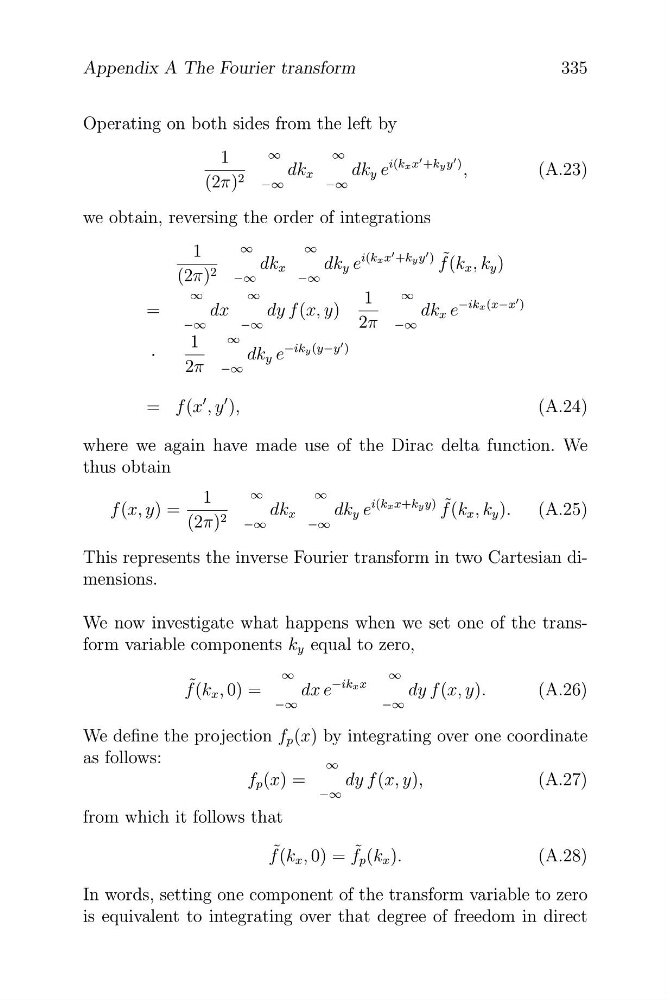
Operating on both sides from the left by
w
w
t
T
m
W
f
W
a
f
I
i
335
Appendix A The Fourier transform
�
�
�
∞
∞
1
i(kxx � +ky y � )
dk x
dk y e
,
(A.23)
(2π) 2 −∞
−∞
e obtain, reversing the order of integrations
1
�
i(kxx +ky y
∞
dk x
∞
dk y e
� ) f ˜ (k x , k y )
(2π) 2 −∞
−∞
∞
∞
∞
1
� )
−ikx(x−x
=
dx
dy f (x, y)
dk x e
−∞
−∞
2π −∞
1
∞
−iky (y−y � )
·
dk y e
2π −∞
= f (x
� , y
� ),
(A.24)
here we again have made use of the Dirac delta function. We
hus obtain
1
f (x, y) =
∞
dk x
∞
dk y e
i(kxx+ky y) f ˜ (k x , k y ).
(A.25)
(2π) 2 −∞
−∞
his represents the inverse Fourier transform in two Cartesian diensions.
e now investigate what happens when we set one of the transorm variable components k y equal to zero,
f ˜ (k x , 0) =
∞
dx e
−ikxx
∞
dy f (x, y).
(A.26)
−∞
−∞
e define the projection f p (x) by integrating over one coordinate
s follows:
∞
f p (x) =
dy f (x, y),
(A.27)
−∞
rom which it follows that
f ˜ (k x , 0) = f ˜ p (k x ).
(A.28)
n words, setting one component of the transform variable to zero
s equivalent to integrating over that degree of freedom in direct
Operating on both sides from the left by
w
w
t
T
m
W
f
W
a
f
I
i
335
Appendix A The Fourier transform