

�
�
327
5.6. Space charge limited emission
using the WKB approximation.
4. The present analysis assumes two linearly independent eigenfunctions u ± (x). The eigenfunction u + (x) represents a wave that
is everywhere right-propagating. The eigenfunction u − (x) represents a wave that is everywhere left-propagating. This leads to the
form (5.105) for the transmission probability D(W ). An earlier
formulation by Kemble [52] assumes a different pair of linearly independent eigenfunctions f u (x) and f v (x). The eigenfunction f u (x)
represents a wave that is left-propagating to the left of the barrier (reflected wave), and right-propagating to the right of the
barrier (transmitted wave). The eigenfunction f v (x) represents a
wave that is right-propagating to the left of the barrier (incident
wave), and left-propagating to the right of the barrier (no wave).
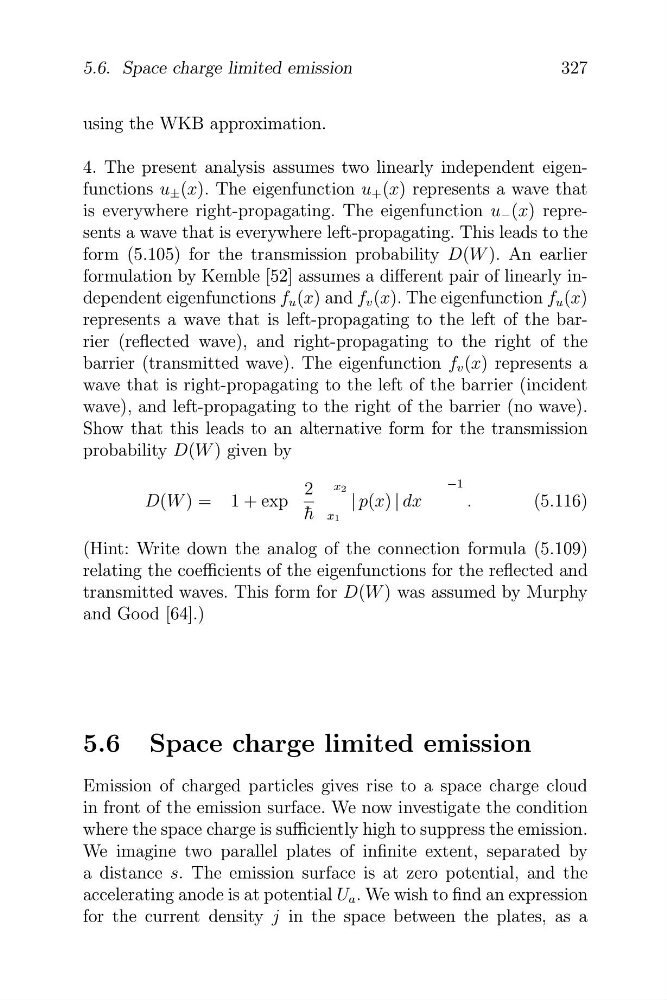
Show that this leads to an alternative form for the transmission
probability D(W ) given by
−1
2 x 2
D(W ) = 1 + exp
| p(x) | dx
.
(5.116)
h ¯ x 1
(Hint: Write down the analog of the connection formula (5.109)
relating the coefficients of the eigenfunctions for the reflected and
transmitted waves. This form for D(W ) was assumed by Murphy
and Good [64].)
5.6 Space charge limited emission
Emission of charged particles gives rise to a space charge cloud
in front of the emission surface. We now investigate the condition
where the space charge is sufficiently high to suppress the emission.
We imagine two parallel plates of infinite extent, separated by
a distance s. The emission surface is at zero potential, and the
accelerating anode is at potential U a . We wish to find an expression
for the current density j in the space between the plates, as a
�
327
5.6. Space charge limited emission
using the WKB approximation.
4. The present analysis assumes two linearly independent eigenfunctions u ± (x). The eigenfunction u + (x) represents a wave that
is everywhere right-propagating. The eigenfunction u − (x) represents a wave that is everywhere left-propagating. This leads to the
form (5.105) for the transmission probability D(W ). An earlier
formulation by Kemble [52] assumes a different pair of linearly independent eigenfunctions f u (x) and f v (x). The eigenfunction f u (x)
represents a wave that is left-propagating to the left of the barrier (reflected wave), and right-propagating to the right of the
barrier (transmitted wave). The eigenfunction f v (x) represents a
wave that is right-propagating to the left of the barrier (incident
wave), and left-propagating to the right of the barrier (no wave).
Show that this leads to an alternative form for the transmission
probability D(W ) given by
−1
2 x 2
D(W ) = 1 + exp
| p(x) | dx
.
(5.116)
h ¯ x 1
(Hint: Write down the analog of the connection formula (5.109)
relating the coefficients of the eigenfunctions for the reflected and
transmitted waves. This form for D(W ) was assumed by Murphy
and Good [64].)
5.6 Space charge limited emission
Emission of charged particles gives rise to a space charge cloud
in front of the emission surface. We now investigate the condition
where the space charge is sufficiently high to suppress the emission.
We imagine two parallel plates of infinite extent, separated by
a distance s. The emission surface is at zero potential, and the
accelerating anode is at potential U a . We wish to find an expression
for the current density j in the space between the plates, as a