

�
�
�
�
for a detailed and current discussion. The transmission probability
D(W ) is
1/2 κ
3/4
16 m
D(W ) = exp
v(y)
(5.114)
3/2
3 ¯
hF 1/4 y
for energies 0 ≤ W ≤ W m . The transmission probability for energies W ≥ W m is D(W ) = 1, which the reader can easily verify by
applying the above procedure.
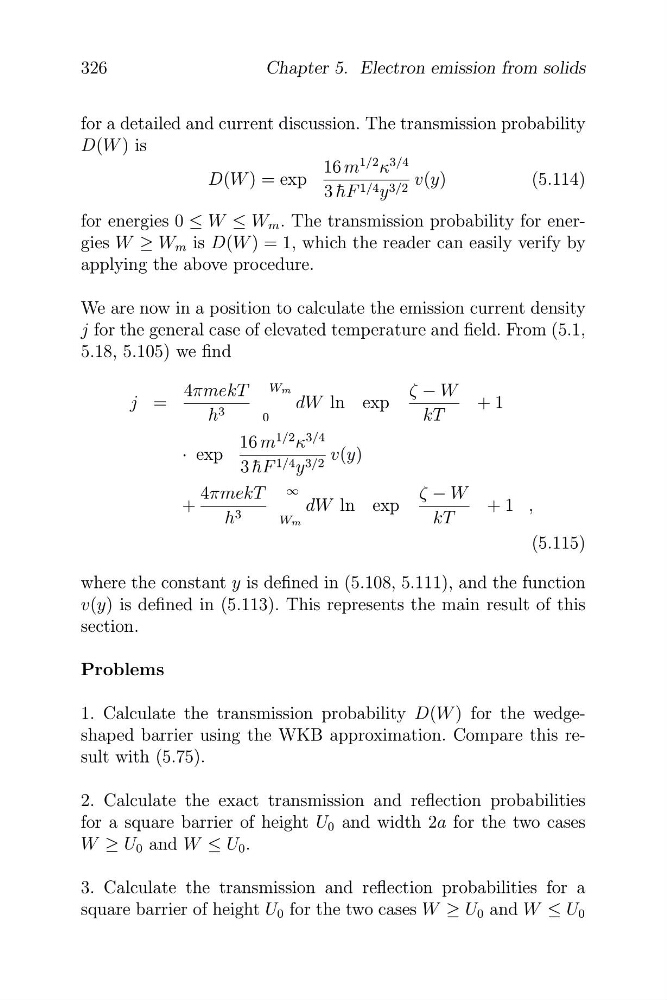
We are now in a position to calculate the emission current density
j for the general case of elevated temperature and field. From (5.1,
5.18, 5.105) we find
Wm
4πmekT
ζ − W
j =
dW ln exp
+ 1
h 3
0
kT
1/2 κ
3/4
16 m
· exp
v(y)
3 ¯
hF 1/4 y 3/2
4πmekT ∞
ζ − W
+
dW ln exp
+ 1 ,
h 3
Wm
kT
(5.115)
where the constant y is defined in (5.108, 5.111), and the function
v(y) is defined in (5.113). This represents the main result of this
section.
326
Chapter 5. Electron emission from solids
Problems
1. Calculate the transmission probability D(W ) for the wedgeshaped barrier using the WKB approximation. Compare this result with (5.75).
2. Calculate the exact transmission and reflection probabilities
for a square barrier of height U 0 and width 2a for the two cases
W ≥ U 0 and W ≤ U 0 .
3. Calculate the transmission and reflection probabilities for a
square barrier of height U 0 for the two cases W ≥ U 0 and W ≤ U 0
�
�
�
for a detailed and current discussion. The transmission probability
D(W ) is
1/2 κ
3/4
16 m
D(W ) = exp
v(y)
(5.114)
3/2
3 ¯
hF 1/4 y
for energies 0 ≤ W ≤ W m . The transmission probability for energies W ≥ W m is D(W ) = 1, which the reader can easily verify by
applying the above procedure.
We are now in a position to calculate the emission current density
j for the general case of elevated temperature and field. From (5.1,
5.18, 5.105) we find
Wm
4πmekT
ζ − W
j =
dW ln exp
+ 1
h 3
0
kT
1/2 κ
3/4
16 m
· exp
v(y)
3 ¯
hF 1/4 y 3/2
4πmekT ∞
ζ − W
+
dW ln exp
+ 1 ,
h 3
Wm
kT
(5.115)
where the constant y is defined in (5.108, 5.111), and the function
v(y) is defined in (5.113). This represents the main result of this
section.
326
Chapter 5. Electron emission from solids
Problems
1. Calculate the transmission probability D(W ) for the wedgeshaped barrier using the WKB approximation. Compare this result with (5.75).
2. Calculate the exact transmission and reflection probabilities
for a square barrier of height U 0 and width 2a for the two cases
W ≥ U 0 and W ≤ U 0 .
3. Calculate the transmission and reflection probabilities for a
square barrier of height U 0 for the two cases W ≥ U 0 and W ≤ U 0