

�
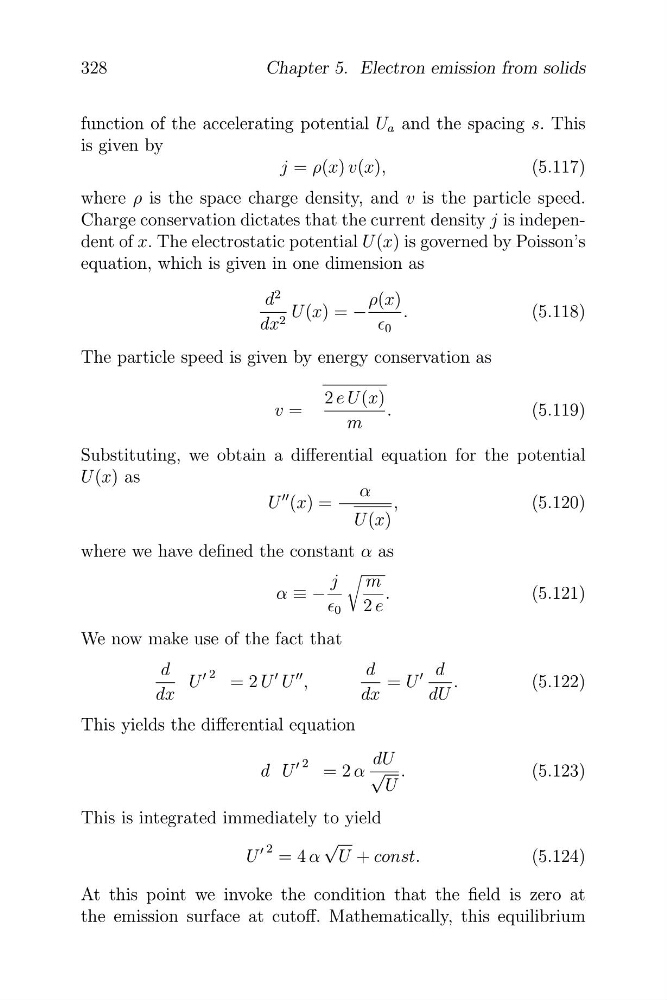
function of the accelerating potential U a and the spacing s. This
is given by
j = ρ(x) v(x),
(5.117)
where ρ is the space charge density, and v is the particle speed.
Charge conservation dictates that the current density j is independent of x. The electrostatic potential U (x) is governed by Poisson’s
equation, which is given in one dimension as
d
2
ρ(x)
U (x) = −
.
(5.118)
dx 2
f 0
The particle speed is given by energy conservation as
2 e U (x)
v =
.
(5.119)
m
Substituting, we obtain a differential equation for the potential
U (x) as
U
�� (x) =
α ,
(5.120)
U (x)
where we have defined the constant α as
α ≡ −
j
f 0
m
2 e
.
(5.121)
We now make use of the fact that
d
d
d
U
� 2 = 2 U
� U
�� ,
= U
�
.
(5.122)
dx
dx
dU
This yields the differential equation
d U
� 2 = 2 α
dU
√
U
.
(5.123)
This is integrated immediately to yield
U
� 2 = 4 α
√
U + const.
(5.124)
At this point we invoke the condition that the field is zero at
the emission surface at cutoff. Mathematically, this equilibrium
328
Chapter 5. Electron emission from solids
function of the accelerating potential U a and the spacing s. This
is given by
j = ρ(x) v(x),
(5.117)
where ρ is the space charge density, and v is the particle speed.
Charge conservation dictates that the current density j is independent of x. The electrostatic potential U (x) is governed by Poisson’s
equation, which is given in one dimension as
d
2
ρ(x)
U (x) = −
.
(5.118)
dx 2
f 0
The particle speed is given by energy conservation as
2 e U (x)
v =
.
(5.119)
m
Substituting, we obtain a differential equation for the potential
U (x) as
U
�� (x) =
α ,
(5.120)
U (x)
where we have defined the constant α as
α ≡ −
j
f 0
m
2 e
.
(5.121)
We now make use of the fact that
d
d
d
U
� 2 = 2 U
� U
�� ,
= U
�
.
(5.122)
dx
dx
dU
This yields the differential equation
d U
� 2 = 2 α
dU
√
U
.
(5.123)
This is integrated immediately to yield
U
� 2 = 4 α
√
U + const.
(5.124)
At this point we invoke the condition that the field is zero at
the emission surface at cutoff. Mathematically, this equilibrium
328
Chapter 5. Electron emission from solids