

�
�
1/4
Ai
� (y) ≈ −
y
√ exp − 3
2 y
3/2
2 π
1
2 3/2
Bi(y) ≈ √
exp y
π y 1/4
3
1/4
2 3/2
Bi
� (y) ≈
y
√ exp 3 y
,
(5.73)
π
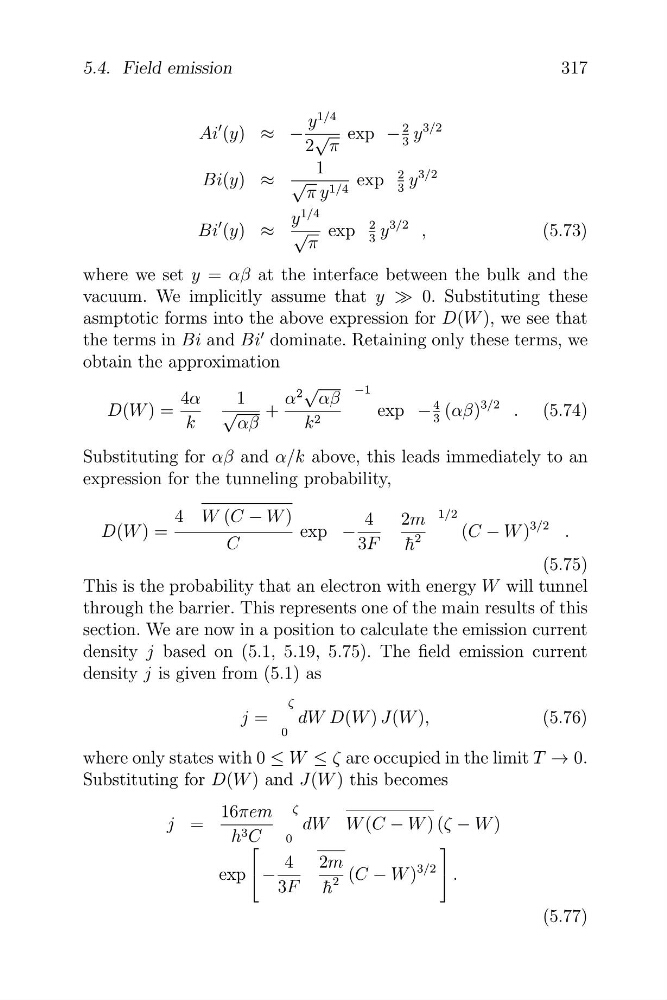
where we set y = αβ at the interface between the bulk and the
vacuum. We implicitly assume that y � 0. Substituting these
asmptotic forms into the above expression for D(W ), we see that
the terms in Bi and Bi
� dominate. Retaining only these terms, we
obtain the approximation
4α
1
α
2
√
αβ
−1
D(W ) =
√
+
exp −
4 (αβ)
3/2 . (5.74)
k
αβ
k 2
3
Substituting for αβ and α/k above, this leads immediately to an
expression for the tunneling probability,
4 W (C − W )
4
2m
1/2
D(W ) =
exp −
(C − W )
3/2 .
C
3F h ¯
2
(5.75)
This is the probability that an electron with energy W will tunnel
through the barrier. This represents one of the main results of this
section. We are now in a position to calculate the emission current
density j based on (5.1, 5.19, 5.75). The field emission current
density j is given from (5.1) as
ζ
j =
dW D(W ) J(W ),
(5.76)
0
where only states with 0 ≤ W ≤ ζ are occupied in the limit T → 0.
Substituting for D(W ) and J(W ) this becomes
ζ
16πem
j =
dW W (C − W ) (ζ − W )
h 3 C 0
⎡
⎤
exp ⎣ −
4 2m (C − W )
3/2
⎦ .
3F h ¯
2
(5.77)
317
5.4. Field emission
�
1/4
Ai
� (y) ≈ −
y
√ exp − 3
2 y
3/2
2 π
1
2 3/2
Bi(y) ≈ √
exp y
π y 1/4
3
1/4
2 3/2
Bi
� (y) ≈
y
√ exp 3 y
,
(5.73)
π
where we set y = αβ at the interface between the bulk and the
vacuum. We implicitly assume that y � 0. Substituting these
asmptotic forms into the above expression for D(W ), we see that
the terms in Bi and Bi
� dominate. Retaining only these terms, we
obtain the approximation
4α
1
α
2
√
αβ
−1
D(W ) =
√
+
exp −
4 (αβ)
3/2 . (5.74)
k
αβ
k 2
3
Substituting for αβ and α/k above, this leads immediately to an
expression for the tunneling probability,
4 W (C − W )
4
2m
1/2
D(W ) =
exp −
(C − W )
3/2 .
C
3F h ¯
2
(5.75)
This is the probability that an electron with energy W will tunnel
through the barrier. This represents one of the main results of this
section. We are now in a position to calculate the emission current
density j based on (5.1, 5.19, 5.75). The field emission current
density j is given from (5.1) as
ζ
j =
dW D(W ) J(W ),
(5.76)
0
where only states with 0 ≤ W ≤ ζ are occupied in the limit T → 0.
Substituting for D(W ) and J(W ) this becomes
ζ
16πem
j =
dW W (C − W ) (ζ − W )
h 3 C 0
⎡
⎤
exp ⎣ −
4 2m (C − W )
3/2
⎦ .
3F h ¯
2
(5.77)
317
5.4. Field emission