

�
285
4.9. Small angle plural scattering of fast electrons
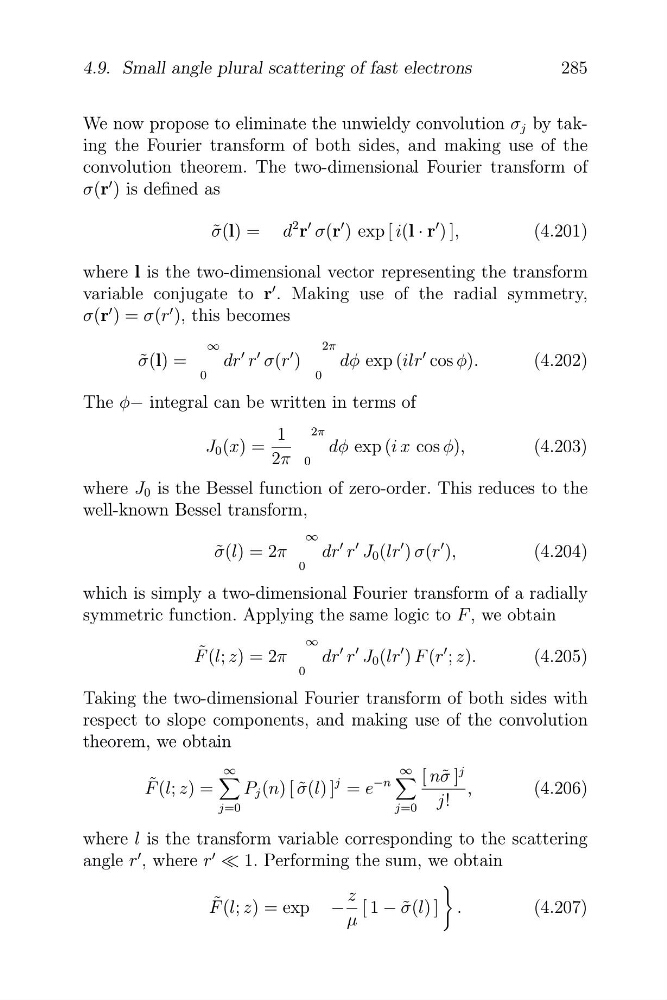
We now propose to eliminate the unwieldy convolution σ j by taking the Fourier transform of both sides, and making use of the
convolution theorem. The two-dimensional Fourier transform of
σ(r
� ) is defined as
σ ˜(l) = d
2 r
� σ(r
� ) exp [ i(l · r
� ) ],
(4.201)
where l is the two-dimensional vector representing the transform
variable conjugate to r
� . Making use of the radial symmetry,
σ(r
� ) = σ(r
� ), this becomes
∞
2π
σ ˜(l) =
dr
� r
� σ(r
� )
dφ exp (ilr
� cos φ).
(4.202)
0
0
The φ− integral can be written in terms of
2π
1
J 0 (x) =
dφ exp (i x cos φ),
(4.203)
2π 0
where J 0 is the Bessel function of zero-order. This reduces to the
well-known Bessel transform,
σ ˜(l) = 2π
∞
dr
� r
� J 0 (lr
� ) σ(r
� ),
(4.204)
0
which is simply a two-dimensional Fourier transform of a radially
symmetric function. Applying the same logic to F , we obtain
F ˜ (l; z) = 2π
∞
dr
� r
� J 0 (lr
� ) F (r
� ; z).
(4.205)
0
Taking the two-dimensional Fourier transform of both sides with
respect to slope components, and making use of the convolution
theorem, we obtain
∞
∞
˜
4
4 [ nσ ˜ ]
j
F (l; z) =
P j (n) [ ˜
σ(l) ]
j = e
−n
,
(4.206)
j!
j=0
j=0
where l is the transform variable corresponding to the scattering
angle r
� , where r
� « 1. Performing the sum, we obtain
z
˜
F (l; z) = exp − [ 1 − σ ˜(l) ] .
(4.207)
µ
285
4.9. Small angle plural scattering of fast electrons
We now propose to eliminate the unwieldy convolution σ j by taking the Fourier transform of both sides, and making use of the
convolution theorem. The two-dimensional Fourier transform of
σ(r
� ) is defined as
σ ˜(l) = d
2 r
� σ(r
� ) exp [ i(l · r
� ) ],
(4.201)
where l is the two-dimensional vector representing the transform
variable conjugate to r
� . Making use of the radial symmetry,
σ(r
� ) = σ(r
� ), this becomes
∞
2π
σ ˜(l) =
dr
� r
� σ(r
� )
dφ exp (ilr
� cos φ).
(4.202)
0
0
The φ− integral can be written in terms of
2π
1
J 0 (x) =
dφ exp (i x cos φ),
(4.203)
2π 0
where J 0 is the Bessel function of zero-order. This reduces to the
well-known Bessel transform,
σ ˜(l) = 2π
∞
dr
� r
� J 0 (lr
� ) σ(r
� ),
(4.204)
0
which is simply a two-dimensional Fourier transform of a radially
symmetric function. Applying the same logic to F , we obtain
F ˜ (l; z) = 2π
∞
dr
� r
� J 0 (lr
� ) F (r
� ; z).
(4.205)
0
Taking the two-dimensional Fourier transform of both sides with
respect to slope components, and making use of the convolution
theorem, we obtain
∞
∞
˜
4
4 [ nσ ˜ ]
j
F (l; z) =
P j (n) [ ˜
σ(l) ]
j = e
−n
,
(4.206)
j!
j=0
j=0
where l is the transform variable corresponding to the scattering
angle r
� , where r
� « 1. Performing the sum, we obtain
z
˜
F (l; z) = exp − [ 1 − σ ˜(l) ] .
(4.207)
µ