

�
�
�
�
�
�
�
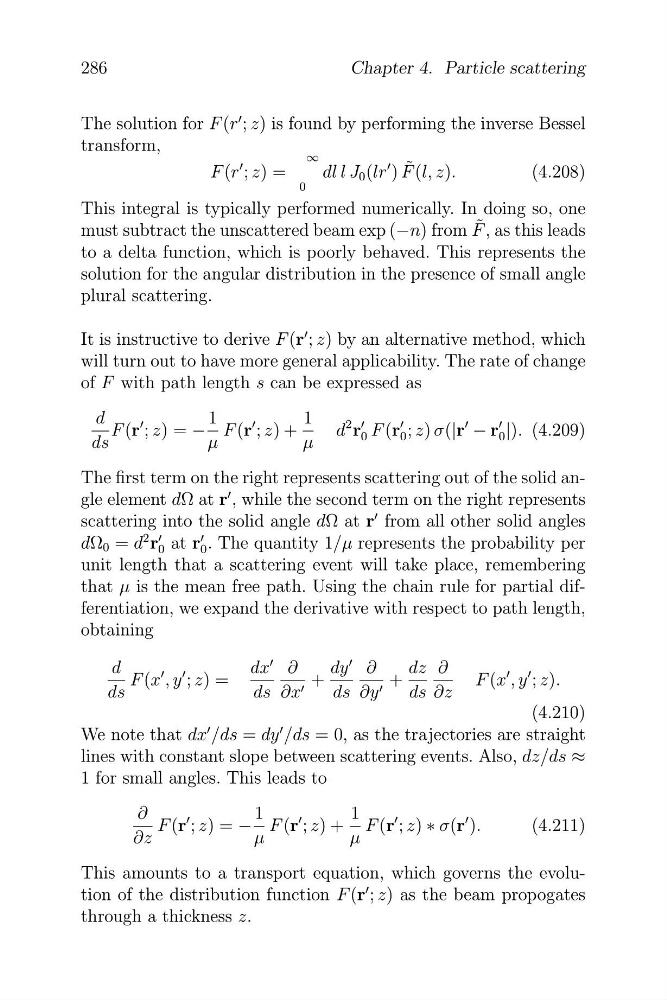
The solution for F (r
� ; z) is found by performing the inverse Bessel
transform,
F (r
� ; z) =
∞
dl l J 0 (lr
� ) F ˜ (l, z).
(4.208)
0
This integral is typically performed numerically. In doing so, one
must subtract the unscattered beam exp (−n) from F ˜ , as this leads
to a delta function, which is poorly behaved. This represents the
solution for the angular distribution in the presence of small angle
plural scattering.
It is instructive to derive F (r
� ; z) by an alternative method, which
will turn out to have more general applicability. The rate of change
of F with path length s can be expressed as
d
1
1 d
2
F (r ; z) = − F (r ; z) +
r F (r 0 ; z) σ(|r
� − r |). (4.209)
ds
µ
µ
0
0
The first term on the right represents scattering out of the solid angle element dΩ at r
� , while the second term on the right represents
scattering into the solid angle dΩ at r
� from all other solid angles
dΩ 0 = d
2 r 0
� at r 0
� . The quantity 1/µ represents the probability per
unit length that a scattering event will take place, remembering
that µ is the mean free path. Using the chain rule for partial differentiation, we expand the derivative with respect to path length,
obtaining
d
ds
F (x
� , y
� ; z) =
dx
�
ds
∂
∂x � +
dy
�
ds
∂
∂y � +
dz
ds
∂
∂z
F (x
� , y
� ; z).
(4.210)
We note that dx
� /ds = dy
� /ds = 0, as the trajectories are straight
lines with constant slope between scattering events. Also, dz/ds ≈
1 for small angles. This leads to
∂
1
1
F (r
� ; z) = − F (r
� ; z) + F (r
� ; z) ∗ σ(r
� ).
(4.211)
∂z
µ
µ
This amounts to a transport equation, which governs the evolution of the distribution function F (r
� ; z) as the beam propogates
through a thickness z.
286
Chapter 4. Particle scattering
�
�
�
�
�
�
The solution for F (r
� ; z) is found by performing the inverse Bessel
transform,
F (r
� ; z) =
∞
dl l J 0 (lr
� ) F ˜ (l, z).
(4.208)
0
This integral is typically performed numerically. In doing so, one
must subtract the unscattered beam exp (−n) from F ˜ , as this leads
to a delta function, which is poorly behaved. This represents the
solution for the angular distribution in the presence of small angle
plural scattering.
It is instructive to derive F (r
� ; z) by an alternative method, which
will turn out to have more general applicability. The rate of change
of F with path length s can be expressed as
d
1
1 d
2
F (r ; z) = − F (r ; z) +
r F (r 0 ; z) σ(|r
� − r |). (4.209)
ds
µ
µ
0
0
The first term on the right represents scattering out of the solid angle element dΩ at r
� , while the second term on the right represents
scattering into the solid angle dΩ at r
� from all other solid angles
dΩ 0 = d
2 r 0
� at r 0
� . The quantity 1/µ represents the probability per
unit length that a scattering event will take place, remembering
that µ is the mean free path. Using the chain rule for partial differentiation, we expand the derivative with respect to path length,
obtaining
d
ds
F (x
� , y
� ; z) =
dx
�
ds
∂
∂x � +
dy
�
ds
∂
∂y � +
dz
ds
∂
∂z
F (x
� , y
� ; z).
(4.210)
We note that dx
� /ds = dy
� /ds = 0, as the trajectories are straight
lines with constant slope between scattering events. Also, dz/ds ≈
1 for small angles. This leads to
∂
1
1
F (r
� ; z) = − F (r
� ; z) + F (r
� ; z) ∗ σ(r
� ).
(4.211)
∂z
µ
µ
This amounts to a transport equation, which governs the evolution of the distribution function F (r
� ; z) as the beam propogates
through a thickness z.
286
Chapter 4. Particle scattering