

�
�
�
We assume the elastic scattering is axially symmetric. This implies
that spin polarization is unimportant, and the scattering medium
is isotropic. We further assume that scattering angles associated
with inelastic scattering are negligible on average, and can be ignored for the present purpose.
We will find it useful in the following to regard the scattering
angle as a two-dimensional vector r
� with components (x
� , y
� ),
where x
� = dx/dz is the slope with respect to the transverse
x−coordinate, and y
� = dy/dz is the slope with respect to the
transverse y−coordinate. The magnitude of the scattering angle ϑ
is given for small angles by
�2
ϑ ≈ |r
� | = x �2 + y .
(4.197)
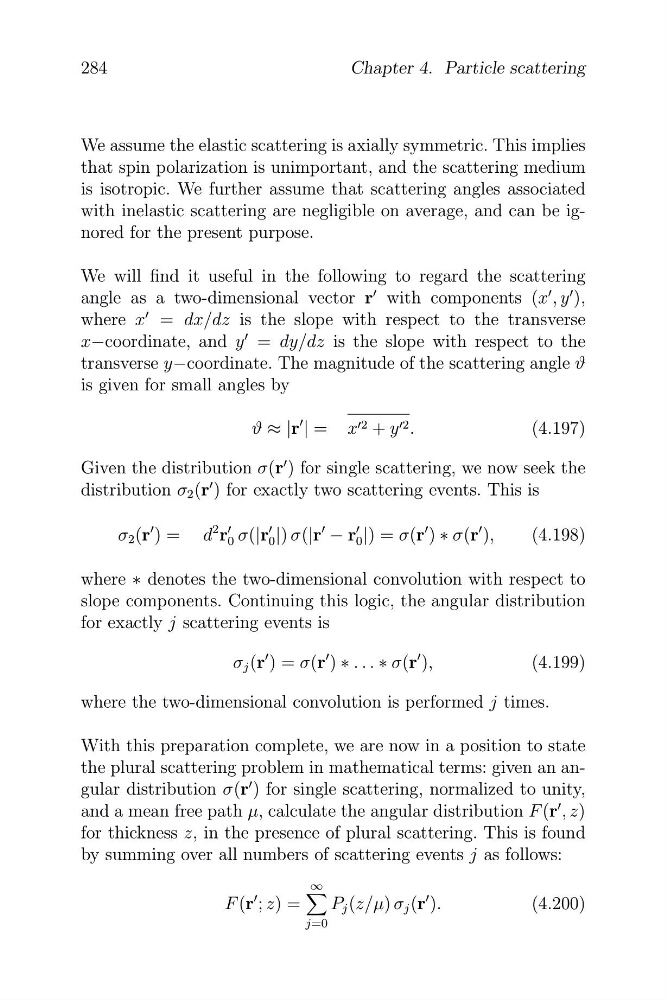
Given the distribution σ(r
� ) for single scattering, we now seek the
distribution σ 2 (r
� ) for exactly two scattering events. This is
σ 2 (r
� ) = d
2 r 0 σ(|r |) σ(|r
� − r |) = σ(r
� ) ∗ σ(r
� ),
(4.198)
0
0
where ∗ denotes the two-dimensional convolution with respect to
slope components. Continuing this logic, the angular distribution
for exactly j scattering events is
σ j (r
� ) = σ(r
� ) ∗ . . . ∗ σ(r
� ),
(4.199)
where the two-dimensional convolution is performed j times.
With this preparation complete, we are now in a position to state
the plural scattering problem in mathematical terms: given an angular distribution σ(r
� ) for single scattering, normalized to unity,
and a mean free path µ, calculate the angular distribution F (r
� , z)
for thickness z, in the presence of plural scattering. This is found
by summing over all numbers of scattering events j as follows:
∞
4
F (r
� ; z) =
P j (z/µ) σ j (r
� ).
(4.200)
j=0
284
Chapter 4. Particle scattering
�
�
We assume the elastic scattering is axially symmetric. This implies
that spin polarization is unimportant, and the scattering medium
is isotropic. We further assume that scattering angles associated
with inelastic scattering are negligible on average, and can be ignored for the present purpose.
We will find it useful in the following to regard the scattering
angle as a two-dimensional vector r
� with components (x
� , y
� ),
where x
� = dx/dz is the slope with respect to the transverse
x−coordinate, and y
� = dy/dz is the slope with respect to the
transverse y−coordinate. The magnitude of the scattering angle ϑ
is given for small angles by
�2
ϑ ≈ |r
� | = x �2 + y .
(4.197)
Given the distribution σ(r
� ) for single scattering, we now seek the
distribution σ 2 (r
� ) for exactly two scattering events. This is
σ 2 (r
� ) = d
2 r 0 σ(|r |) σ(|r
� − r |) = σ(r
� ) ∗ σ(r
� ),
(4.198)
0
0
where ∗ denotes the two-dimensional convolution with respect to
slope components. Continuing this logic, the angular distribution
for exactly j scattering events is
σ j (r
� ) = σ(r
� ) ∗ . . . ∗ σ(r
� ),
(4.199)
where the two-dimensional convolution is performed j times.
With this preparation complete, we are now in a position to state
the plural scattering problem in mathematical terms: given an angular distribution σ(r
� ) for single scattering, normalized to unity,
and a mean free path µ, calculate the angular distribution F (r
� , z)
for thickness z, in the presence of plural scattering. This is found
by summing over all numbers of scattering events j as follows:
∞
4
F (r
� ; z) =
P j (z/µ) σ j (r
� ).
(4.200)
j=0
284
Chapter 4. Particle scattering