

4π
∞
σ(ϑ) dΩ ≈ 2π
σ(ϑ) ϑ dϑ = 1,
(4.195)
0
0
where dΩ is the element of solid angle. Equivalently, σ(ϑ) is the
differential elastic scattering cross section divided by the total elastic cross section in the limit of small angles ϑ « 1. We could use
the screened Coulomb scattering result (4.116),
ϑ
2
σ(ϑ) =
W
,
(4.196)
π (ϑ 2 + ϑ
2
W ) 2
283
4.9. Small angle plural scattering of fast electrons
This can be appreciated by calculating the expectation value of
the number of scattering events j for a given reduced thickness n.
It is
∞
∞
j−1
4
4 n
¯ j =
j P j (n) = n e
−n
= n.
(4.194)
(j − 1)!
j=0
j=1
The reduced thickness n is just the average number of scattering
events. In this study we confine the discussion to small values of
n, between zero and twenty, where diffusion has not yet set in.
Fast electrons incident on a thin film or bulk material undergo
elastic scattering by the screened Coulomb potential of a target
nucleus, and inelastic scattering by the electrons of the target material. As the nucleus is much more massive than the incident
electron, classical kinematics dictates that the energy transfer is
negligible, hence the designation of elastic scattering. There is
appreciable momentum transfer, however. This is related to the
scattering angle ϑ by (4.100). The angular distribution for elastic
scattering is proportional to the differential cross section for small
angles. The small angle approximation is justified for small values
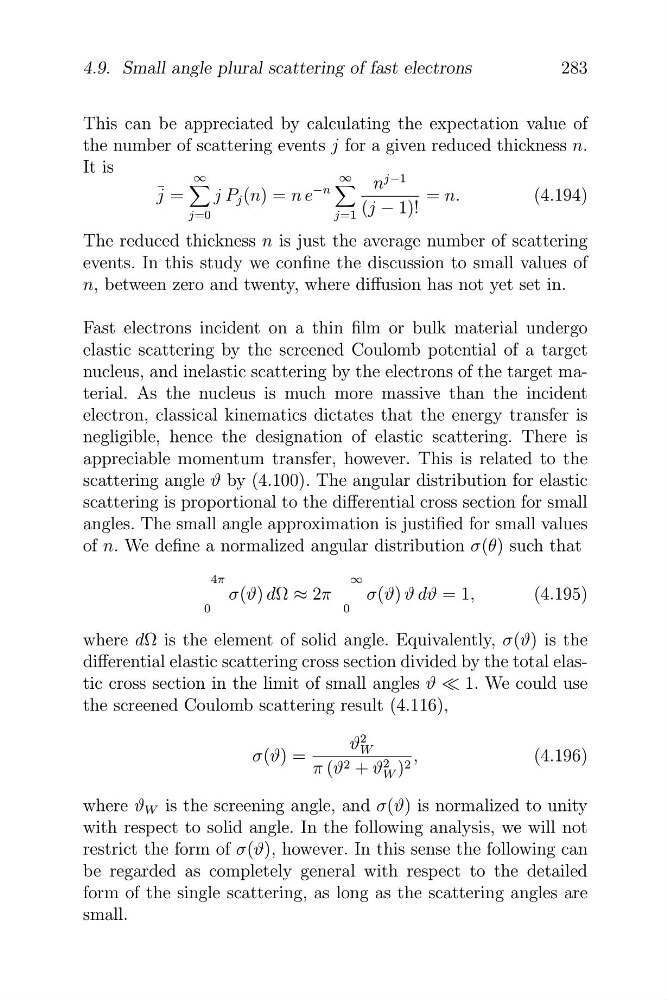
of n. We define a normalized angular distribution σ(θ) such that
where ϑ W is the screening angle, and σ(ϑ) is normalized to unity
with respect to solid angle. In the following analysis, we will not
restrict the form of σ(ϑ), however. In this sense the following can
be regarded as completely general with respect to the detailed
form of the single scattering, as long as the scattering angles are
small.
∞
σ(ϑ) dΩ ≈ 2π
σ(ϑ) ϑ dϑ = 1,
(4.195)
0
0
where dΩ is the element of solid angle. Equivalently, σ(ϑ) is the
differential elastic scattering cross section divided by the total elastic cross section in the limit of small angles ϑ « 1. We could use
the screened Coulomb scattering result (4.116),
ϑ
2
σ(ϑ) =
W
,
(4.196)
π (ϑ 2 + ϑ
2
W ) 2
283
4.9. Small angle plural scattering of fast electrons
This can be appreciated by calculating the expectation value of
the number of scattering events j for a given reduced thickness n.
It is
∞
∞
j−1
4
4 n
¯ j =
j P j (n) = n e
−n
= n.
(4.194)
(j − 1)!
j=0
j=1
The reduced thickness n is just the average number of scattering
events. In this study we confine the discussion to small values of
n, between zero and twenty, where diffusion has not yet set in.
Fast electrons incident on a thin film or bulk material undergo
elastic scattering by the screened Coulomb potential of a target
nucleus, and inelastic scattering by the electrons of the target material. As the nucleus is much more massive than the incident
electron, classical kinematics dictates that the energy transfer is
negligible, hence the designation of elastic scattering. There is
appreciable momentum transfer, however. This is related to the
scattering angle ϑ by (4.100). The angular distribution for elastic
scattering is proportional to the differential cross section for small
angles. The small angle approximation is justified for small values
of n. We define a normalized angular distribution σ(θ) such that
where ϑ W is the screening angle, and σ(ϑ) is normalized to unity
with respect to solid angle. In the following analysis, we will not
restrict the form of σ(ϑ), however. In this sense the following can
be regarded as completely general with respect to the detailed
form of the single scattering, as long as the scattering angles are
small.