

�
�
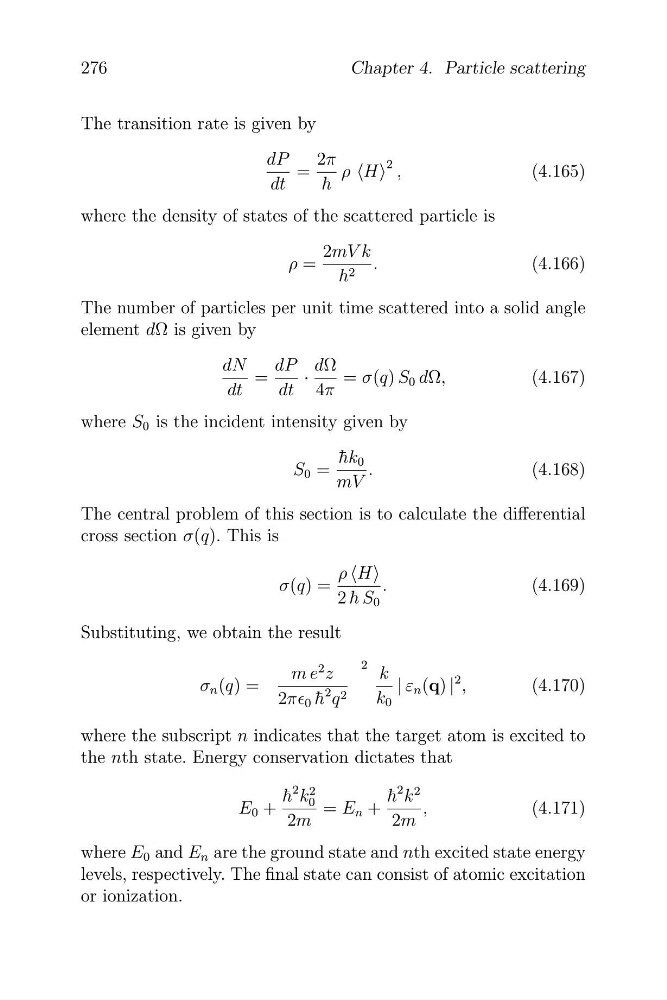
The transition rate is given by
dP
2π
=
ρ (H)
2 ,
(4.165)
dt
h ¯
where the density of states of the scattered particle is
2mV k
ρ =
.
(4.166)
h 2
The number of particles per unit time scattered into a solid angle
element dΩ is given by
dN
dP dΩ
=
·
= σ(q) S 0 dΩ,
(4.167)
dt
dt 4π
where S 0 is the incident intensity given by
¯
hk 0
S 0 =
.
(4.168)
mV
The central problem of this section is to calculate the differential
cross section σ(q). This is
ρ (H)
σ(q) =
.
(4.169)
2 ¯
h S 0
Substituting, we obtain the result
2
2
m e z
k
σ n (q) =
| ε n (q) |
2 ,
(4.170)
2πf 0 h ¯
2 q 2
k 0
where the subscript n indicates that the target atom is excited to
the nth state. Energy conservation dictates that
h
2 k
2
h
2 k
2
¯
¯
E 0 +
0 = E n +
,
(4.171)
2m
2m
where E 0 and E n are the ground state and nth excited state energy
levels, respectively. The final state can consist of atomic excitation
or ionization.
276
Chapter 4. Particle scattering
�
The transition rate is given by
dP
2π
=
ρ (H)
2 ,
(4.165)
dt
h ¯
where the density of states of the scattered particle is
2mV k
ρ =
.
(4.166)
h 2
The number of particles per unit time scattered into a solid angle
element dΩ is given by
dN
dP dΩ
=
·
= σ(q) S 0 dΩ,
(4.167)
dt
dt 4π
where S 0 is the incident intensity given by
¯
hk 0
S 0 =
.
(4.168)
mV
The central problem of this section is to calculate the differential
cross section σ(q). This is
ρ (H)
σ(q) =
.
(4.169)
2 ¯
h S 0
Substituting, we obtain the result
2
2
m e z
k
σ n (q) =
| ε n (q) |
2 ,
(4.170)
2πf 0 h ¯
2 q 2
k 0
where the subscript n indicates that the target atom is excited to
the nth state. Energy conservation dictates that
h
2 k
2
h
2 k
2
¯
¯
E 0 +
0 = E n +
,
(4.171)
2m
2m
where E 0 and E n are the ground state and nth excited state energy
levels, respectively. The final state can consist of atomic excitation
or ionization.
276
Chapter 4. Particle scattering