

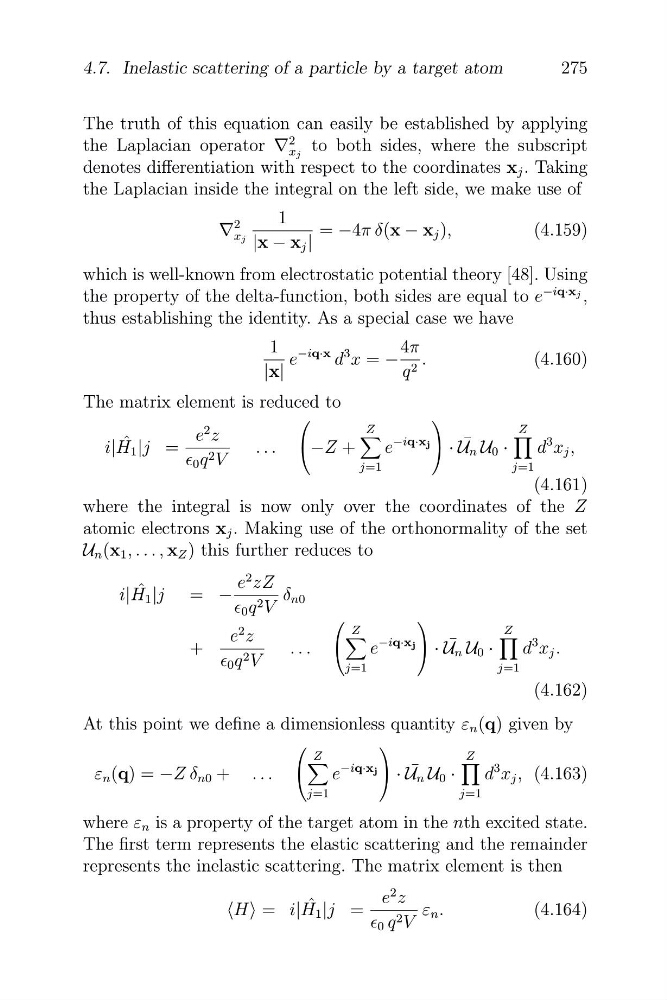
The truth of this equation can easily be established by applying
the Laplacian operator v x
2
j
to both sides, where the subscript
denotes differentiation with respect to the coordinates x j . Taking
the Laplacian inside the integral on the left side, we make use of
1
v x
2
j
= −4π δ(x − x j ),
(4.159)
|x − x j |
which is well-known from electrostatic potential theory [48]. Using
−iq·x j
the property of the delta-function, both sides are equal to e
,
thus establishing the identity. As a special case we have
1
4π
−iq·x d
3
e
x = − 2 .
(4.160)
|x|
q
The matrix element is reduced to
⎛
⎞
2
Z
Z
4
N
e z
−iq·x j
¯
d
3
i|H ˆ 1 |j =
. . . ⎝ −Z +
e
⎠ · U n U 0 ·
x j ,
f 0 q 2 V
j=1
j=1
(4.161)
where the integral is now only over the coordinates of the Z
atomic electrons x j . Making use of the orthonormality of the set
U n (x 1 , . . . , x Z ) this further reduces to
e
2 zZ
i|H ˆ 1 |j = −
δ n0
f 0 q 2 V
⎛
⎞
2
Z
Z
4
N
e z
+
. . . ⎝ e
−iq·x j
⎠ · U ¯ n U 0 ·
d
3 x j .
f 0 q 2 V
j=1
j=1
(4.162)
At this point we define a dimensionless quantity ε n (q) given by
⎛
⎞
Z
Z
4
N
ε n (q) = −Z δ n0 + . . . ⎝ e
−iq·x j
⎠ · U ¯ n U 0 ·
d
3 x j , (4.163)
j=1
j=1
where ε n is a property of the target atom in the nth excited state.
The first term represents the elastic scattering and the remainder
represents the inelastic scattering. The matrix element is then
2
e z
(H) = i|H ˆ 1 |j =
ε n .
(4.164)
f 0 q 2 V
275
4.7. Inelastic scattering of a particle by a target atom
the Laplacian operator v x
2
j
to both sides, where the subscript
denotes differentiation with respect to the coordinates x j . Taking
the Laplacian inside the integral on the left side, we make use of
1
v x
2
j
= −4π δ(x − x j ),
(4.159)
|x − x j |
which is well-known from electrostatic potential theory [48]. Using
−iq·x j
the property of the delta-function, both sides are equal to e
,
thus establishing the identity. As a special case we have
1
4π
−iq·x d
3
e
x = − 2 .
(4.160)
|x|
q
The matrix element is reduced to
⎛
⎞
2
Z
Z
4
N
e z
−iq·x j
¯
d
3
i|H ˆ 1 |j =
. . . ⎝ −Z +
e
⎠ · U n U 0 ·
x j ,
f 0 q 2 V
j=1
j=1
(4.161)
where the integral is now only over the coordinates of the Z
atomic electrons x j . Making use of the orthonormality of the set
U n (x 1 , . . . , x Z ) this further reduces to
e
2 zZ
i|H ˆ 1 |j = −
δ n0
f 0 q 2 V
⎛
⎞
2
Z
Z
4
N
e z
+
. . . ⎝ e
−iq·x j
⎠ · U ¯ n U 0 ·
d
3 x j .
f 0 q 2 V
j=1
j=1
(4.162)
At this point we define a dimensionless quantity ε n (q) given by
⎛
⎞
Z
Z
4
N
ε n (q) = −Z δ n0 + . . . ⎝ e
−iq·x j
⎠ · U ¯ n U 0 ·
d
3 x j , (4.163)
j=1
j=1
where ε n is a property of the target atom in the nth excited state.
The first term represents the elastic scattering and the remainder
represents the inelastic scattering. The matrix element is then
2
e z
(H) = i|H ˆ 1 |j =
ε n .
(4.164)
f 0 q 2 V
275
4.7. Inelastic scattering of a particle by a target atom