

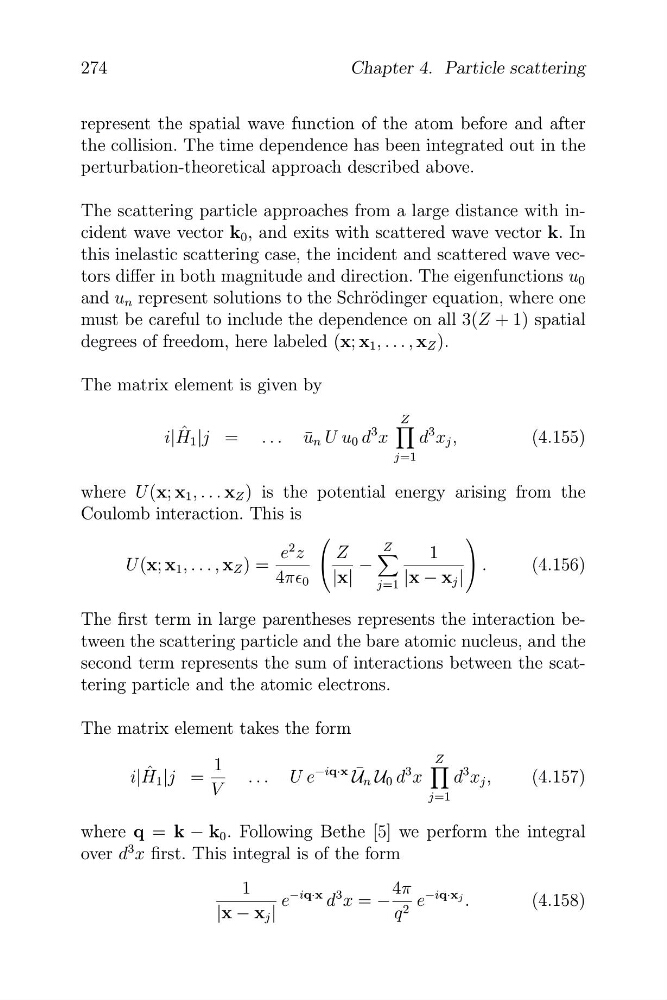
The matrix element is given by
Z
N
d
3
i|H ˆ 1 |j = . . . u ¯ n U u 0 d
3 x
x j ,
(4.155)
j=1
where U (x; x 1 , . . . x Z ) is the potential energy arising from the
Coulomb interaction. This is
⎛
⎞
2
Z
4
e z
Z
1
U (x; x 1 , . . . , x Z ) =
⎝
−
⎠ .
(4.156)
4πf 0 |x|
|x − x j |
j=1
The first term in large parentheses represents the interaction between the scattering particle and the bare atomic nucleus, and the
second term represents the sum of interactions between the scattering particle and the atomic electrons.
The matrix element takes the form
Z
N
1
i|H ˆ 1 |j =
. . . U e
−iq·x U ¯ n U 0 d
3 x
d
3 x j ,
(4.157)
V
j=1
where q = k − k 0 . Following Bethe [5] we perform the integral
over d
3 x first. This integral is of the form
1
4π
−iq·x d
3
−iq·x j
e
x = − e
.
(4.158)
|x − x j |
q 2
274
Chapter 4. Particle scattering
represent the spatial wave function of the atom before and after
the collision. The time dependence has been integrated out in the
perturbation-theoretical approach described above.
The scattering particle approaches from a large distance with incident wave vector k 0 , and exits with scattered wave vector k. In
this inelastic scattering case, the incident and scattered wave vectors differ in both magnitude and direction. The eigenfunctions u 0
and u n represent solutions to the Schr¨ odinger equation, where one
must be careful to include the dependence on all 3(Z + 1) spatial
degrees of freedom, here labeled (x; x 1 , . . . , x Z ).
Z
N
d
3
i|H ˆ 1 |j = . . . u ¯ n U u 0 d
3 x
x j ,
(4.155)
j=1
where U (x; x 1 , . . . x Z ) is the potential energy arising from the
Coulomb interaction. This is
⎛
⎞
2
Z
4
e z
Z
1
U (x; x 1 , . . . , x Z ) =
⎝
−
⎠ .
(4.156)
4πf 0 |x|
|x − x j |
j=1
The first term in large parentheses represents the interaction between the scattering particle and the bare atomic nucleus, and the
second term represents the sum of interactions between the scattering particle and the atomic electrons.
The matrix element takes the form
Z
N
1
i|H ˆ 1 |j =
. . . U e
−iq·x U ¯ n U 0 d
3 x
d
3 x j ,
(4.157)
V
j=1
where q = k − k 0 . Following Bethe [5] we perform the integral
over d
3 x first. This integral is of the form
1
4π
−iq·x d
3
−iq·x j
e
x = − e
.
(4.158)
|x − x j |
q 2
274
Chapter 4. Particle scattering
represent the spatial wave function of the atom before and after
the collision. The time dependence has been integrated out in the
perturbation-theoretical approach described above.
The scattering particle approaches from a large distance with incident wave vector k 0 , and exits with scattered wave vector k. In
this inelastic scattering case, the incident and scattered wave vectors differ in both magnitude and direction. The eigenfunctions u 0
and u n represent solutions to the Schr¨ odinger equation, where one
must be careful to include the dependence on all 3(Z + 1) spatial
degrees of freedom, here labeled (x; x 1 , . . . , x Z ).