

�
�
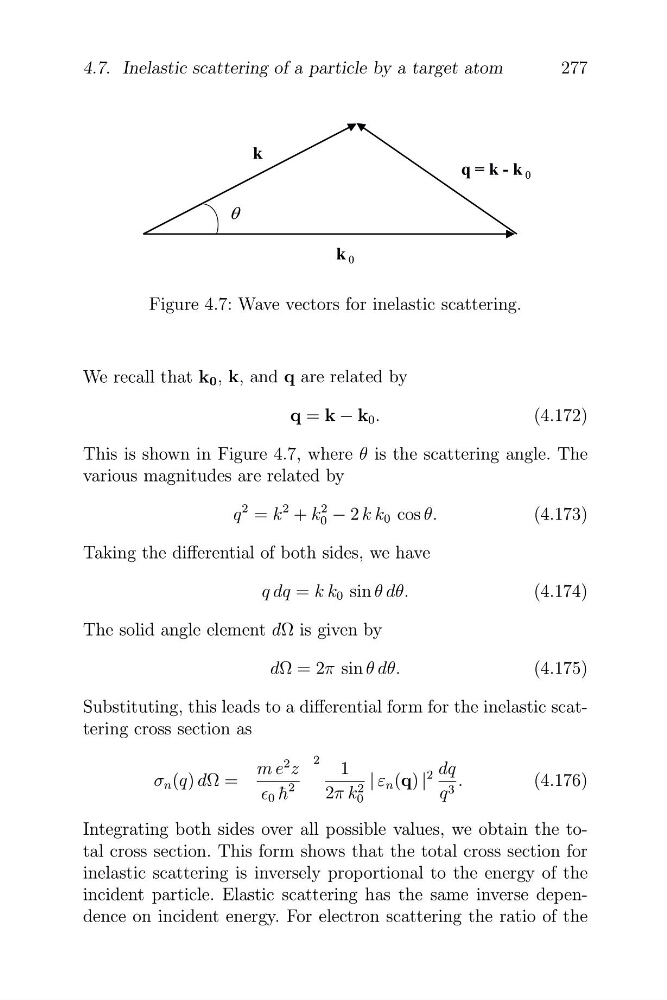
We recall that k 0 , k, and q are related by
q = k − k 0 .
(4.172)
This is shown in Figure 4.7, where θ is the scattering angle. The
various magnitudes are related by
2 = k
2
q
+ k 0
2 − 2 k k 0 cos θ.
(4.173)
Taking the differential of both sides, we have
q dq = k k 0 sin θ dθ.
(4.174)
The solid angle element dΩ is given by
dΩ = 2π sin θ dθ.
(4.175)
Substituting, this leads to a differential form for the inelastic scattering cross section as
m e
2 z
2
1
dq
σ n (q) dΩ =
h
2
| ε n (q) |
2
3
.
(4.176)
f 0 ¯
2π k 0
2
q
Integrating both sides over all possible values, we obtain the total cross section. This form shows that the total cross section for
inelastic scattering is inversely proportional to the energy of the
incident particle. Elastic scattering has the same inverse dependence on incident energy. For electron scattering the ratio of the
277
4.7. Inelastic scattering of a particle by a target atom
N
T
N
T N N
Figure 4.7: Wave vectors for inelastic scattering.
�
We recall that k 0 , k, and q are related by
q = k − k 0 .
(4.172)
This is shown in Figure 4.7, where θ is the scattering angle. The
various magnitudes are related by
2 = k
2
q
+ k 0
2 − 2 k k 0 cos θ.
(4.173)
Taking the differential of both sides, we have
q dq = k k 0 sin θ dθ.
(4.174)
The solid angle element dΩ is given by
dΩ = 2π sin θ dθ.
(4.175)
Substituting, this leads to a differential form for the inelastic scattering cross section as
m e
2 z
2
1
dq
σ n (q) dΩ =
h
2
| ε n (q) |
2
3
.
(4.176)
f 0 ¯
2π k 0
2
q
Integrating both sides over all possible values, we obtain the total cross section. This form shows that the total cross section for
inelastic scattering is inversely proportional to the energy of the
incident particle. Elastic scattering has the same inverse dependence on incident energy. For electron scattering the ratio of the
277
4.7. Inelastic scattering of a particle by a target atom
N
T
N
T N N
Figure 4.7: Wave vectors for inelastic scattering.