

�
�
�
�
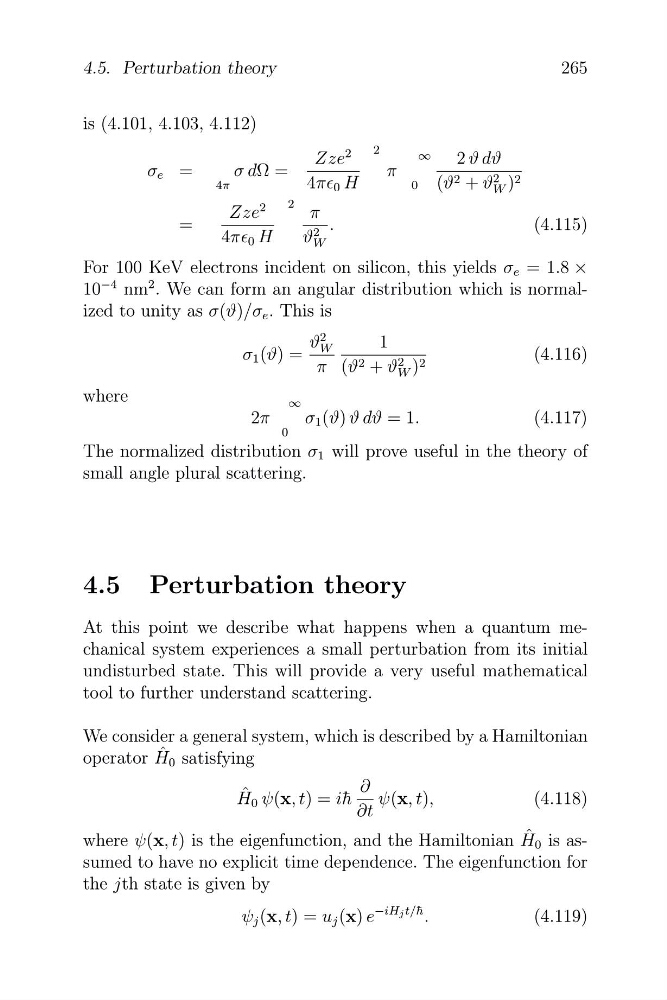
is (4.101, 4.103, 4.112)
∞
Zze
2
2
2 ϑ dϑ
σ e =
σ dΩ =
π
W ) 2
4π
4πf 0 H
0
(ϑ 2 + ϑ
2
Zze
2
2 π
=
.
(4.115)
4πf 0 H
ϑ
2
W
For 100 KeV electrons incident on silicon, this yields σ e = 1.8 ×
10
−4 nm
2 . We can form an angular distribution which is normalized to unity as σ(ϑ)/σ e . This is
ϑ
2
1
σ 1 (ϑ) =
W
(4.116)
π (ϑ 2 + ϑ W
2 ) 2
where
∞
2π
σ 1 (ϑ) ϑ dϑ = 1.
(4.117)
0
The normalized distribution σ 1 will prove useful in the theory of
small angle plural scattering.
265
4.5. Perturbation theory
4.5 Perturbation theory
At this point we describe what happens when a quantum mechanical system experiences a small perturbation from its initial
undisturbed state. This will provide a very useful mathematical
tool to further understand scattering.
We consider a general system, which is described by a Hamiltonian
ˆ
operator H 0 satisfying
∂
ˆ
H 0 ψ(x, t) = ih ¯
ψ(x, t),
(4.118)
∂t
ˆ
where ψ(x, t) is the eigenfunction, and the Hamiltonian H 0 is assumed to have no explicit time dependence. The eigenfunction for
the jth state is given by
−iH j t/¯ h
ψ j (x, t) = u j (x) e
.
(4.119)
�
�
�
is (4.101, 4.103, 4.112)
∞
Zze
2
2
2 ϑ dϑ
σ e =
σ dΩ =
π
W ) 2
4π
4πf 0 H
0
(ϑ 2 + ϑ
2
Zze
2
2 π
=
.
(4.115)
4πf 0 H
ϑ
2
W
For 100 KeV electrons incident on silicon, this yields σ e = 1.8 ×
10
−4 nm
2 . We can form an angular distribution which is normalized to unity as σ(ϑ)/σ e . This is
ϑ
2
1
σ 1 (ϑ) =
W
(4.116)
π (ϑ 2 + ϑ W
2 ) 2
where
∞
2π
σ 1 (ϑ) ϑ dϑ = 1.
(4.117)
0
The normalized distribution σ 1 will prove useful in the theory of
small angle plural scattering.
265
4.5. Perturbation theory
4.5 Perturbation theory
At this point we describe what happens when a quantum mechanical system experiences a small perturbation from its initial
undisturbed state. This will provide a very useful mathematical
tool to further understand scattering.
We consider a general system, which is described by a Hamiltonian
ˆ
operator H 0 satisfying
∂
ˆ
H 0 ψ(x, t) = ih ¯
ψ(x, t),
(4.118)
∂t
ˆ
where ψ(x, t) is the eigenfunction, and the Hamiltonian H 0 is assumed to have no explicit time dependence. The eigenfunction for
the jth state is given by
−iH j t/¯ h
ψ j (x, t) = u j (x) e
.
(4.119)