

�
�
264
Chapter 4. Particle scattering
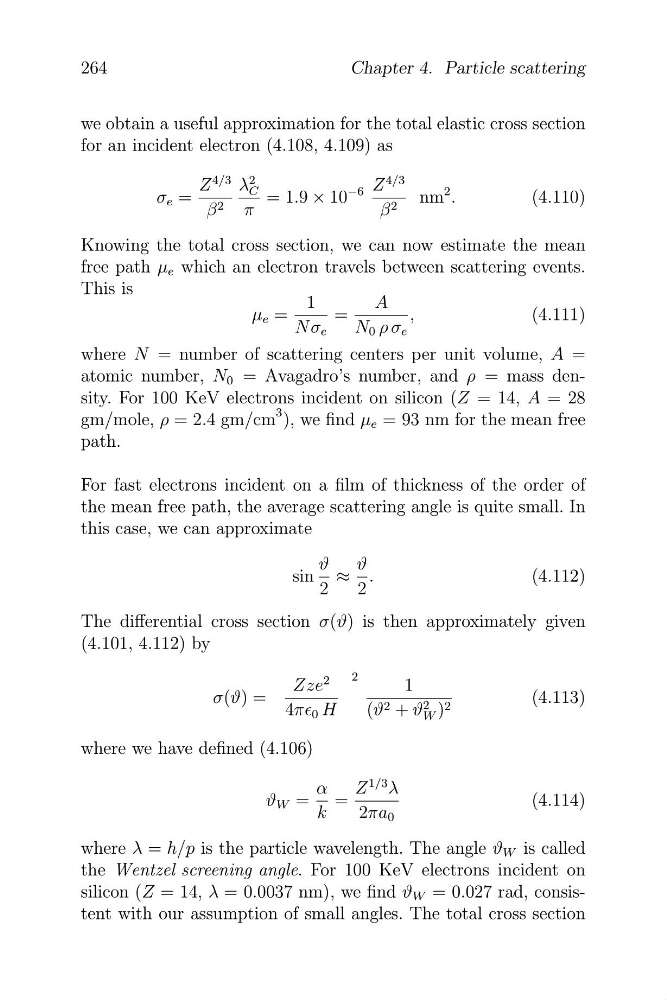
we obtain a useful approximation for the total elastic cross section
for an incident electron (4.108, 4.109) as
Z
4/3 λ
2
Z
4/3
σ e =
C = 1.9 × 10
−6
nm
2 .
(4.110)
β 2 π
β 2
Knowing the total cross section, we can now estimate the mean
free path µ e which an electron travels between scattering events.
This is
1
A
µ e =
=
,
(4.111)
N σ e
N 0 ρ σ e
where N = number of scattering centers per unit volume, A =
atomic number, N 0 = Avagadro’s number, and ρ = mass density. For 100 KeV electrons incident on silicon (Z = 14, A = 28
gm/mole, ρ = 2.4 gm/cm
3 ), we find µ e = 93 nm for the mean free
path.
For fast electrons incident on a film of thickness of the order of
the mean free path, the average scattering angle is quite small. In
this case, we can approximate
ϑ
ϑ
sin ≈ .
(4.112)
2
2
The differential cross section σ(ϑ) is then approximately given
(4.101, 4.112) by
Zze
2
2
1
σ(ϑ) =
(4.113)
W ) 2
4πf 0 H
(ϑ 2 + ϑ
2
where we have defined (4.106)
Z
1/3 λ
α
ϑ W = =
(4.114)
k
2πa 0
where λ = h/p is the particle wavelength. The angle ϑ W is called
the Wentzel screening angle. For 100 KeV electrons incident on
silicon (Z = 14, λ = 0.0037 nm), we find ϑ W = 0.027 rad, consistent with our assumption of small angles. The total cross section
�
264
Chapter 4. Particle scattering
we obtain a useful approximation for the total elastic cross section
for an incident electron (4.108, 4.109) as
Z
4/3 λ
2
Z
4/3
σ e =
C = 1.9 × 10
−6
nm
2 .
(4.110)
β 2 π
β 2
Knowing the total cross section, we can now estimate the mean
free path µ e which an electron travels between scattering events.
This is
1
A
µ e =
=
,
(4.111)
N σ e
N 0 ρ σ e
where N = number of scattering centers per unit volume, A =
atomic number, N 0 = Avagadro’s number, and ρ = mass density. For 100 KeV electrons incident on silicon (Z = 14, A = 28
gm/mole, ρ = 2.4 gm/cm
3 ), we find µ e = 93 nm for the mean free
path.
For fast electrons incident on a film of thickness of the order of
the mean free path, the average scattering angle is quite small. In
this case, we can approximate
ϑ
ϑ
sin ≈ .
(4.112)
2
2
The differential cross section σ(ϑ) is then approximately given
(4.101, 4.112) by
Zze
2
2
1
σ(ϑ) =
(4.113)
W ) 2
4πf 0 H
(ϑ 2 + ϑ
2
where we have defined (4.106)
Z
1/3 λ
α
ϑ W = =
(4.114)
k
2πa 0
where λ = h/p is the particle wavelength. The angle ϑ W is called
the Wentzel screening angle. For 100 KeV electrons incident on
silicon (Z = 14, λ = 0.0037 nm), we find ϑ W = 0.027 rad, consistent with our assumption of small angles. The total cross section