

260
Chapter 4. Particle scattering
of elastic scattering, including high energy particle physics, and
electron microscopy, to name just two.
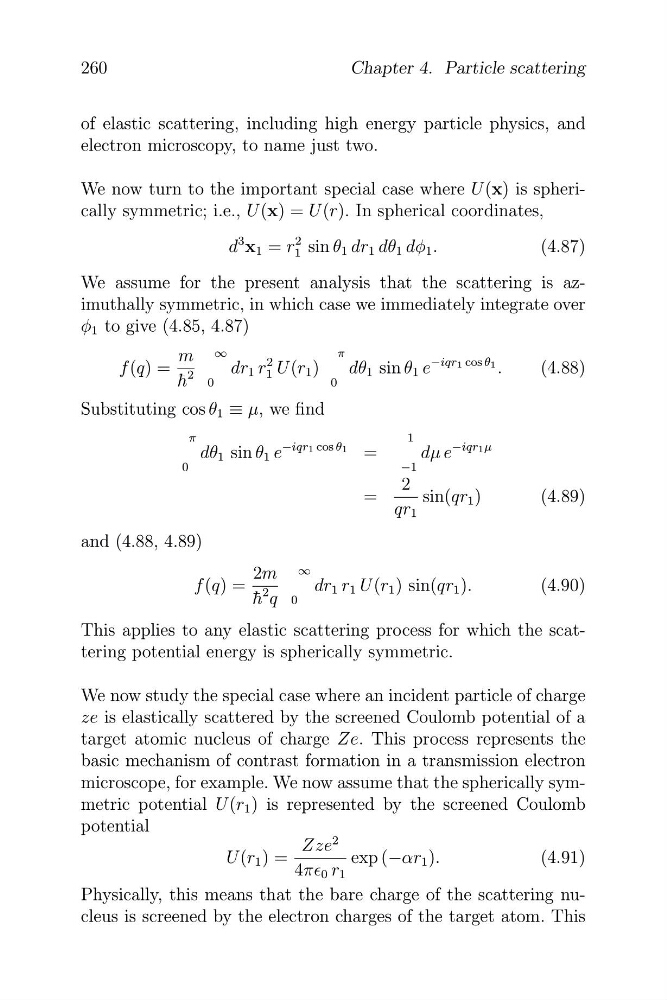
We now turn to the important special case where U (x) is spherically symmetric; i.e., U (x) = U (r). In spherical coordinates,
d
3
2
x 1 = r 1 sin θ 1 dr 1 dθ 1 dφ 1 .
(4.87)
We assume for the present analysis that the scattering is azimuthally symmetric, in which case we immediately integrate over
φ 1 to give (4.85, 4.87)
∞
π
m
2
−iqr 1 cos θ 1
f (q) =
dr 1 r 1 U (r 1 )
dθ 1 sin θ 1 e
.
(4.88)
h
2
¯ 0
0
Substituting cos θ 1 ≡ µ, we find
π
1
−iqr 1 cos θ 1
dθ 1 sin θ 1 e
=
dµ e
−iqr 1 µ
0
−1
2
=
sin(qr 1 )
(4.89)
qr 1
and (4.88, 4.89)
∞
2m
f (q) =
dr 1 r 1 U (r 1 ) sin(qr 1 ).
(4.90)
h ¯
2 q 0
This applies to any elastic scattering process for which the scattering potential energy is spherically symmetric.
We now study the special case where an incident particle of charge
ze is elastically scattered by the screened Coulomb potential of a
target atomic nucleus of charge Ze. This process represents the
basic mechanism of contrast formation in a transmission electron
microscope, for example. We now assume that the spherically symmetric potential U (r 1 ) is represented by the screened Coulomb
potential
Zze
2
U (r 1 ) =
exp (−αr 1 ).
(4.91)
4πf 0 r 1
Physically, this means that the bare charge of the scattering nucleus is screened by the electron charges of the target atom. This
Chapter 4. Particle scattering
of elastic scattering, including high energy particle physics, and
electron microscopy, to name just two.
We now turn to the important special case where U (x) is spherically symmetric; i.e., U (x) = U (r). In spherical coordinates,
d
3
2
x 1 = r 1 sin θ 1 dr 1 dθ 1 dφ 1 .
(4.87)
We assume for the present analysis that the scattering is azimuthally symmetric, in which case we immediately integrate over
φ 1 to give (4.85, 4.87)
∞
π
m
2
−iqr 1 cos θ 1
f (q) =
dr 1 r 1 U (r 1 )
dθ 1 sin θ 1 e
.
(4.88)
h
2
¯ 0
0
Substituting cos θ 1 ≡ µ, we find
π
1
−iqr 1 cos θ 1
dθ 1 sin θ 1 e
=
dµ e
−iqr 1 µ
0
−1
2
=
sin(qr 1 )
(4.89)
qr 1
and (4.88, 4.89)
∞
2m
f (q) =
dr 1 r 1 U (r 1 ) sin(qr 1 ).
(4.90)
h ¯
2 q 0
This applies to any elastic scattering process for which the scattering potential energy is spherically symmetric.
We now study the special case where an incident particle of charge
ze is elastically scattered by the screened Coulomb potential of a
target atomic nucleus of charge Ze. This process represents the
basic mechanism of contrast formation in a transmission electron
microscope, for example. We now assume that the spherically symmetric potential U (r 1 ) is represented by the screened Coulomb
potential
Zze
2
U (r 1 ) =
exp (−αr 1 ).
(4.91)
4πf 0 r 1
Physically, this means that the bare charge of the scattering nucleus is screened by the electron charges of the target atom. This