

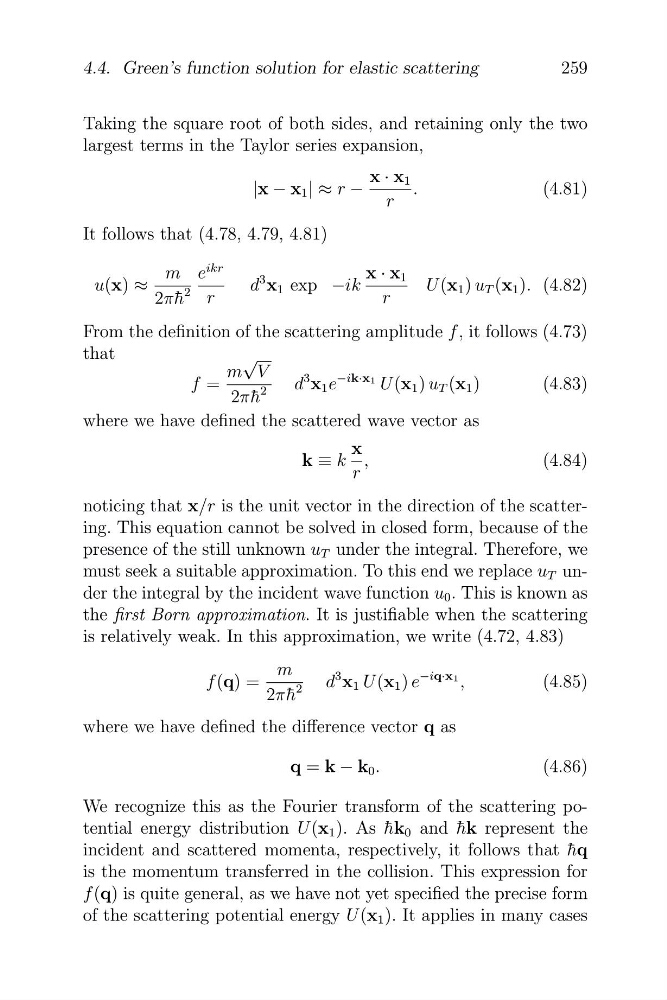
Taking the square root of both sides, and retaining only the two
largest terms in the Taylor series expansion,
x · x 1
|x − x 1 | ≈ r −
.
(4.81)
r
It follows that (4.78, 4.79, 4.81)
ikr
m e
x · x 1
u(x) ≈
d
3 x 1 exp −ik
U (x 1 ) u T (x 1 ). (4.82)
2πh ¯
2 r
r
From the definition of the scattering amplitude f , it follows (4.73)
that
√
f =
m V d
3 x 1 e
−ik·x 1 U (x 1 ) u T (x 1 )
(4.83)
h
2
2π¯
where we have defined the scattered wave vector as
x
k ≡ k ,
(4.84)
r
noticing that x/r is the unit vector in the direction of the scattering. This equation cannot be solved in closed form, because of the
presence of the still unknown u T under the integral. Therefore, we
must seek a suitable approximation. To this end we replace u T under the integral by the incident wave function u 0 . This is known as
the first Born approximation. It is justifiable when the scattering
is relatively weak. In this approximation, we write (4.72, 4.83)
m
f (q) =
2π¯ h
2
d
3 x 1 U (x 1 ) e
−iq·x 1 ,
(4.85)
where we have defined the difference vector q as
q = k − k 0 .
(4.86)
We recognize this as the Fourier transform of the scattering potential energy distribution U (x 1 ). As h ¯k 0 and h ¯k represent the
incident and scattered momenta, respectively, it follows that ¯
hq
is the momentum transferred in the collision. This expression for
f (q) is quite general, as we have not yet specified the precise form
of the scattering potential energy U (x 1 ). It applies in many cases
259
4.4. Green’s function solution for elastic scattering
largest terms in the Taylor series expansion,
x · x 1
|x − x 1 | ≈ r −
.
(4.81)
r
It follows that (4.78, 4.79, 4.81)
ikr
m e
x · x 1
u(x) ≈
d
3 x 1 exp −ik
U (x 1 ) u T (x 1 ). (4.82)
2πh ¯
2 r
r
From the definition of the scattering amplitude f , it follows (4.73)
that
√
f =
m V d
3 x 1 e
−ik·x 1 U (x 1 ) u T (x 1 )
(4.83)
h
2
2π¯
where we have defined the scattered wave vector as
x
k ≡ k ,
(4.84)
r
noticing that x/r is the unit vector in the direction of the scattering. This equation cannot be solved in closed form, because of the
presence of the still unknown u T under the integral. Therefore, we
must seek a suitable approximation. To this end we replace u T under the integral by the incident wave function u 0 . This is known as
the first Born approximation. It is justifiable when the scattering
is relatively weak. In this approximation, we write (4.72, 4.83)
m
f (q) =
2π¯ h
2
d
3 x 1 U (x 1 ) e
−iq·x 1 ,
(4.85)
where we have defined the difference vector q as
q = k − k 0 .
(4.86)
We recognize this as the Fourier transform of the scattering potential energy distribution U (x 1 ). As h ¯k 0 and h ¯k represent the
incident and scattered momenta, respectively, it follows that ¯
hq
is the momentum transferred in the collision. This expression for
f (q) is quite general, as we have not yet specified the precise form
of the scattering potential energy U (x 1 ). It applies in many cases
259
4.4. Green’s function solution for elastic scattering