

258
Chapter 4. Particle scattering
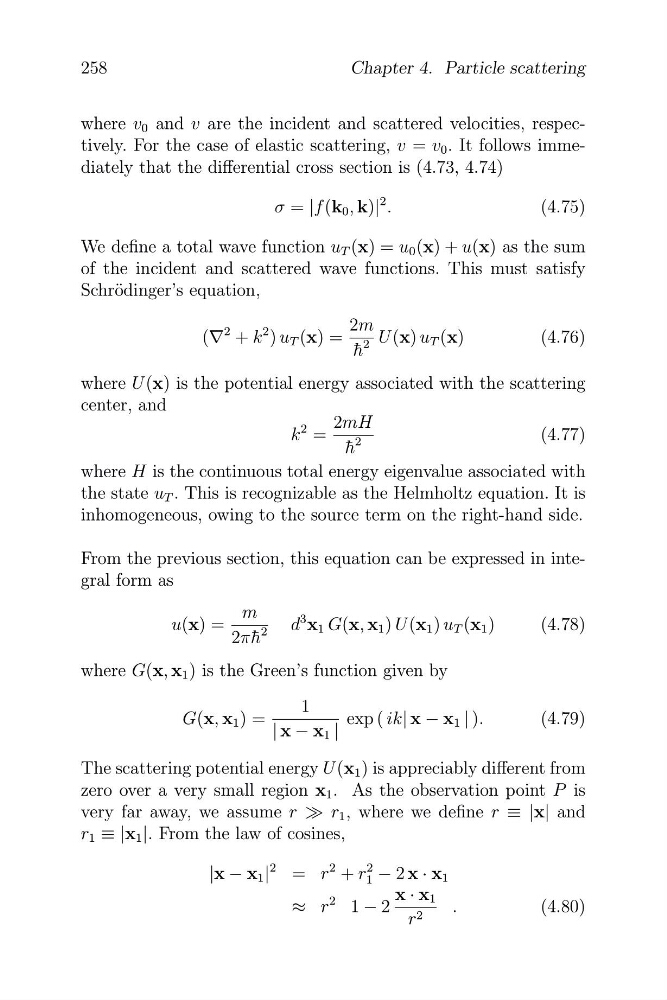
where v 0 and v are the incident and scattered velocities, respectively. For the case of elastic scattering, v = v 0 . It follows immediately that the differential cross section is (4.73, 4.74)
σ = |f (k 0 , k)|
2 .
(4.75)
We define a total wave function u T (x) = u 0 (x) + u(x) as the sum
of the incident and scattered wave functions. This must satisfy
Schr¨ odinger’s equation,
(v
2 + k
2 ) u T (x) =
2m U (x) u T (x)
(4.76)
h
2
¯
where U (x) is the potential energy associated with the scattering
center, and
2mH
k
2 =
(4.77)
h
2
¯
where H is the continuous total energy eigenvalue associated with
the state u T . This is recognizable as the Helmholtz equation. It is
inhomogeneous, owing to the source term on the right-hand side.
From the previous section, this equation can be expressed in integral form as
m
d
3
u(x) =
x 1 G(x, x 1 ) U (x 1 ) u T (x 1 )
(4.78)
h
2
2π¯
where G(x, x 1 ) is the Green’s function given by
1
G(x, x 1 ) =
exp ( ik| x − x 1 | ).
(4.79)
| x − x 1 |
The scattering potential energy U (x 1 ) is appreciably different from
zero over a very small region x 1 . As the observation point P is
very far away, we assume r � r 1 , where we define r ≡ |x| and
r 1 ≡ |x 1 |. From the law of cosines,
|x − x 1 |
2 = r
2 + r
2
1 − 2 x · x 1
x · x 1
≈ r
2 1 − 2
.
(4.80)
r 2
Chapter 4. Particle scattering
where v 0 and v are the incident and scattered velocities, respectively. For the case of elastic scattering, v = v 0 . It follows immediately that the differential cross section is (4.73, 4.74)
σ = |f (k 0 , k)|
2 .
(4.75)
We define a total wave function u T (x) = u 0 (x) + u(x) as the sum
of the incident and scattered wave functions. This must satisfy
Schr¨ odinger’s equation,
(v
2 + k
2 ) u T (x) =
2m U (x) u T (x)
(4.76)
h
2
¯
where U (x) is the potential energy associated with the scattering
center, and
2mH
k
2 =
(4.77)
h
2
¯
where H is the continuous total energy eigenvalue associated with
the state u T . This is recognizable as the Helmholtz equation. It is
inhomogeneous, owing to the source term on the right-hand side.
From the previous section, this equation can be expressed in integral form as
m
d
3
u(x) =
x 1 G(x, x 1 ) U (x 1 ) u T (x 1 )
(4.78)
h
2
2π¯
where G(x, x 1 ) is the Green’s function given by
1
G(x, x 1 ) =
exp ( ik| x − x 1 | ).
(4.79)
| x − x 1 |
The scattering potential energy U (x 1 ) is appreciably different from
zero over a very small region x 1 . As the observation point P is
very far away, we assume r � r 1 , where we define r ≡ |x| and
r 1 ≡ |x 1 |. From the law of cosines,
|x − x 1 |
2 = r
2 + r
2
1 − 2 x · x 1
x · x 1
≈ r
2 1 − 2
.
(4.80)
r 2