

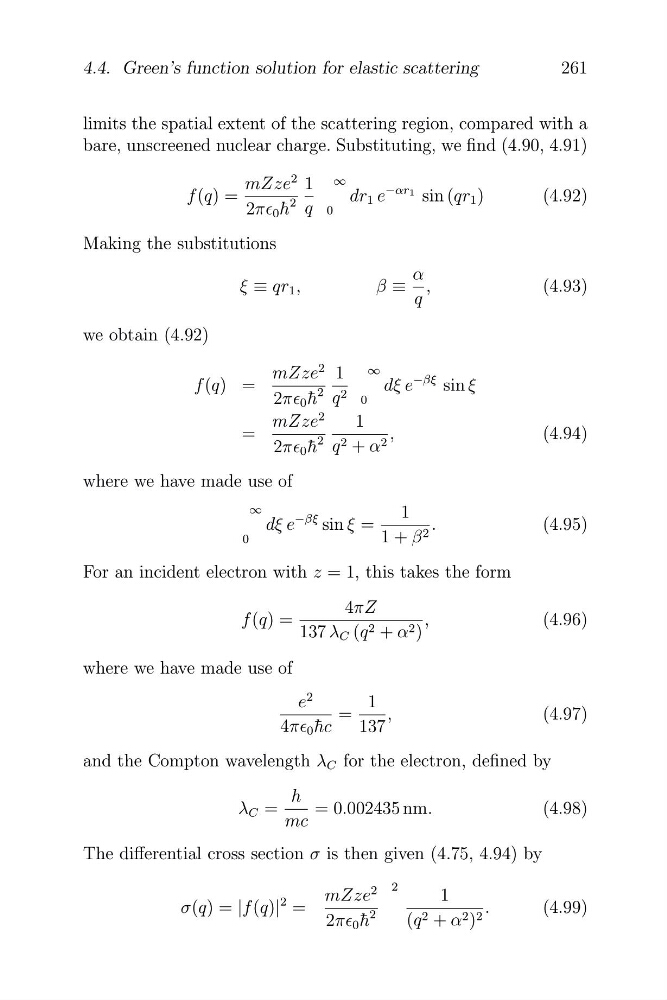
�
�
261
4.4. Green’s function solution for elastic scattering
limits the spatial extent of the scattering region, compared with a
bare, unscreened nuclear charge. Substituting, we find (4.90, 4.91)
∞
mZze
2 1
−αr 1
f (q) =
dr 1 e
sin (qr 1 )
(4.92)
h
2
2πf 0 ¯ q 0
Making the substitutions
α
ξ ≡ qr 1 ,
β ≡ ,
(4.93)
q
we obtain (4.92)
mZze
2 1
f (q) =
∞
dξ e
−βξ sin ξ
h
2 2
2πf 0 ¯ q 0
mZze
2
1
=
,
(4.94)
2πf 0 h ¯
2 q 2 + α 2
where we have made use of
∞
dξ e
−βξ sin ξ =
1 .
(4.95)
0
1 + β 2
For an incident electron with z = 1, this takes the form
4πZ
f (q) =
,
(4.96)
137 λ C (q 2 + α 2 )
where we have made use of
2
e
1
=
,
(4.97)
4πf 0 ¯
137
hc
and the Compton wavelength λ C for the electron, defined by
h
λ C =
= 0.002435 nm.
(4.98)
mc
The differential cross section σ is then given (4.75, 4.94) by
mZze
2 2
1
σ(q) = |f (q)|
2 =
.
(4.99)
2πf 0 h ¯
2
(q 2 + α 2 ) 2
�
261
4.4. Green’s function solution for elastic scattering
limits the spatial extent of the scattering region, compared with a
bare, unscreened nuclear charge. Substituting, we find (4.90, 4.91)
∞
mZze
2 1
−αr 1
f (q) =
dr 1 e
sin (qr 1 )
(4.92)
h
2
2πf 0 ¯ q 0
Making the substitutions
α
ξ ≡ qr 1 ,
β ≡ ,
(4.93)
q
we obtain (4.92)
mZze
2 1
f (q) =
∞
dξ e
−βξ sin ξ
h
2 2
2πf 0 ¯ q 0
mZze
2
1
=
,
(4.94)
2πf 0 h ¯
2 q 2 + α 2
where we have made use of
∞
dξ e
−βξ sin ξ =
1 .
(4.95)
0
1 + β 2
For an incident electron with z = 1, this takes the form
4πZ
f (q) =
,
(4.96)
137 λ C (q 2 + α 2 )
where we have made use of
2
e
1
=
,
(4.97)
4πf 0 ¯
137
hc
and the Compton wavelength λ C for the electron, defined by
h
λ C =
= 0.002435 nm.
(4.98)
mc
The differential cross section σ is then given (4.75, 4.94) by
mZze
2 2
1
σ(q) = |f (q)|
2 =
.
(4.99)
2πf 0 h ¯
2
(q 2 + α 2 ) 2