

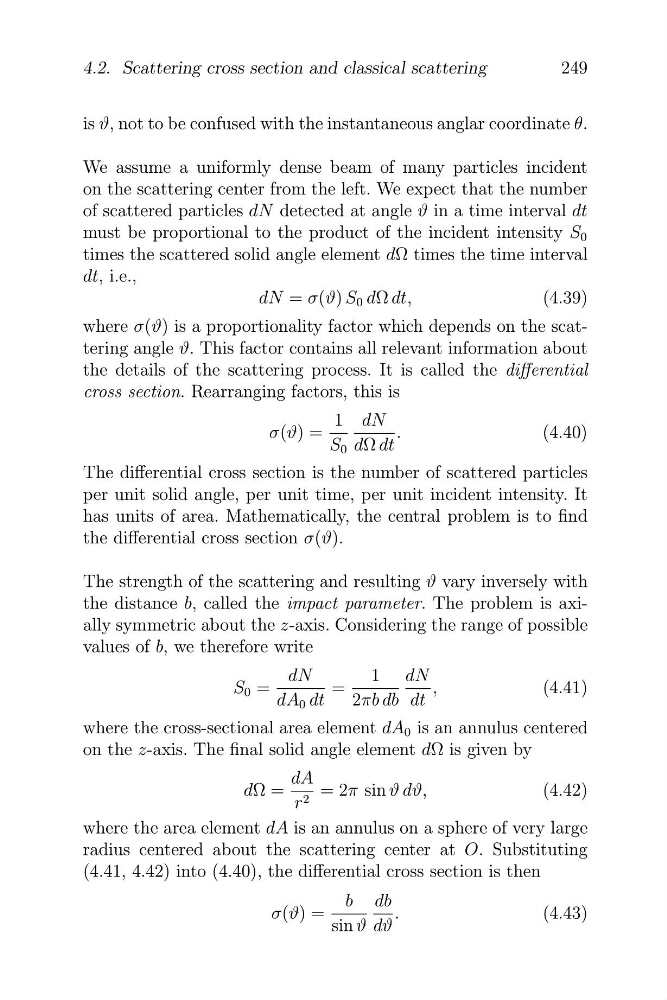
is ϑ, not to be confused with the instantaneous anglar coordinate θ.
We assume a uniformly dense beam of many particles incident
on the scattering center from the left. We expect that the number
of scattered particles dN detected at angle ϑ in a time interval dt
must be proportional to the product of the incident intensity S 0
times the scattered solid angle element dΩ times the time interval
dt, i.e.,
dN = σ(ϑ) S 0 dΩ dt,
(4.39)
where σ(ϑ) is a proportionality factor which depends on the scattering angle ϑ. This factor contains all relevant information about
the details of the scattering process. It is called the differential
cross section. Rearranging factors, this is
1 dN
σ(ϑ) =
.
(4.40)
S 0 dΩ dt
The differential cross section is the number of scattered particles
per unit solid angle, per unit time, per unit incident intensity. It
has units of area. Mathematically, the central problem is to find
the differential cross section σ(ϑ).
The strength of the scattering and resulting ϑ vary inversely with
the distance b, called the impact parameter. The problem is axially symmetric about the z-axis. Considering the range of possible
values of b, we therefore write
dN
1 dN
S 0 = dA 0 dt
= 2πb db dt
,
(4.41)
where the cross-sectional area element dA 0 is an annulus centered
on the z-axis. The final solid angle element dΩ is given by
dA
dΩ = 2 = 2π sin ϑ dϑ,
(4.42)
r
where the area element dA is an annulus on a sphere of very large
radius centered about the scattering center at O. Substituting
(4.41, 4.42) into (4.40), the differential cross section is then
b db
σ(ϑ) =
.
(4.43)
sin ϑ dϑ
249
4.2. Scattering cross section and classical scattering
We assume a uniformly dense beam of many particles incident
on the scattering center from the left. We expect that the number
of scattered particles dN detected at angle ϑ in a time interval dt
must be proportional to the product of the incident intensity S 0
times the scattered solid angle element dΩ times the time interval
dt, i.e.,
dN = σ(ϑ) S 0 dΩ dt,
(4.39)
where σ(ϑ) is a proportionality factor which depends on the scattering angle ϑ. This factor contains all relevant information about
the details of the scattering process. It is called the differential
cross section. Rearranging factors, this is
1 dN
σ(ϑ) =
.
(4.40)
S 0 dΩ dt
The differential cross section is the number of scattered particles
per unit solid angle, per unit time, per unit incident intensity. It
has units of area. Mathematically, the central problem is to find
the differential cross section σ(ϑ).
The strength of the scattering and resulting ϑ vary inversely with
the distance b, called the impact parameter. The problem is axially symmetric about the z-axis. Considering the range of possible
values of b, we therefore write
dN
1 dN
S 0 = dA 0 dt
= 2πb db dt
,
(4.41)
where the cross-sectional area element dA 0 is an annulus centered
on the z-axis. The final solid angle element dΩ is given by
dA
dΩ = 2 = 2π sin ϑ dϑ,
(4.42)
r
where the area element dA is an annulus on a sphere of very large
radius centered about the scattering center at O. Substituting
(4.41, 4.42) into (4.40), the differential cross section is then
b db
σ(ϑ) =
.
(4.43)
sin ϑ dϑ
249
4.2. Scattering cross section and classical scattering