

248
Chapter 4. Particle scattering
4.2 Scattering cross section and classical scattering
Having obtained the reduction to the equivalent one-body problem, we are now in a position to address our central problem,
namely, calculation of the scattered intensity as a function of scattering angle. For simplicity of notation in the following, we make
the substitution
ϑ ≡ θ
�
(4.38)
for the scattering angle in the CM frame. From the preceding
analysis, this is equivalent to the scattering angle of the reduced
mass M from the fixed scattering center in the CM frame.
It is instructive to first study elastic scattering in the context of
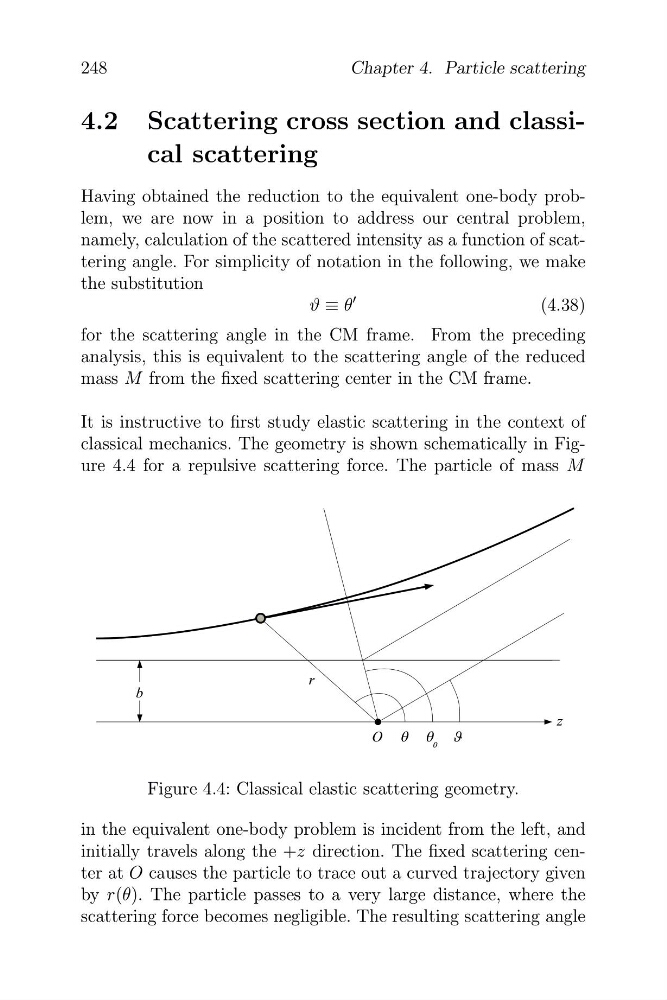
classical mechanics. The geometry is shown schematically in Figure 4.4 for a repulsive scattering force. The particle of mass M
Figure 4.4: Classical elastic scattering geometry.
in the equivalent one-body problem is incident from the left, and
initially travels along the +z direction. The fixed scattering center at O causes the particle to trace out a curved trajectory given
by r(θ). The particle passes to a very large distance, where the
scattering force becomes negligible. The resulting scattering angle
Chapter 4. Particle scattering
4.2 Scattering cross section and classical scattering
Having obtained the reduction to the equivalent one-body problem, we are now in a position to address our central problem,
namely, calculation of the scattered intensity as a function of scattering angle. For simplicity of notation in the following, we make
the substitution
ϑ ≡ θ
�
(4.38)
for the scattering angle in the CM frame. From the preceding
analysis, this is equivalent to the scattering angle of the reduced
mass M from the fixed scattering center in the CM frame.
It is instructive to first study elastic scattering in the context of
classical mechanics. The geometry is shown schematically in Figure 4.4 for a repulsive scattering force. The particle of mass M
Figure 4.4: Classical elastic scattering geometry.
in the equivalent one-body problem is incident from the left, and
initially travels along the +z direction. The fixed scattering center at O causes the particle to trace out a curved trajectory given
by r(θ). The particle passes to a very large distance, where the
scattering force becomes negligible. The resulting scattering angle