

Δp 1x = −
pm 2
sin θ
�
m 1 + m 2
Δp 1z = −
pm 2 (cos θ
� − 1).
(4.35)
m 1 + m 2
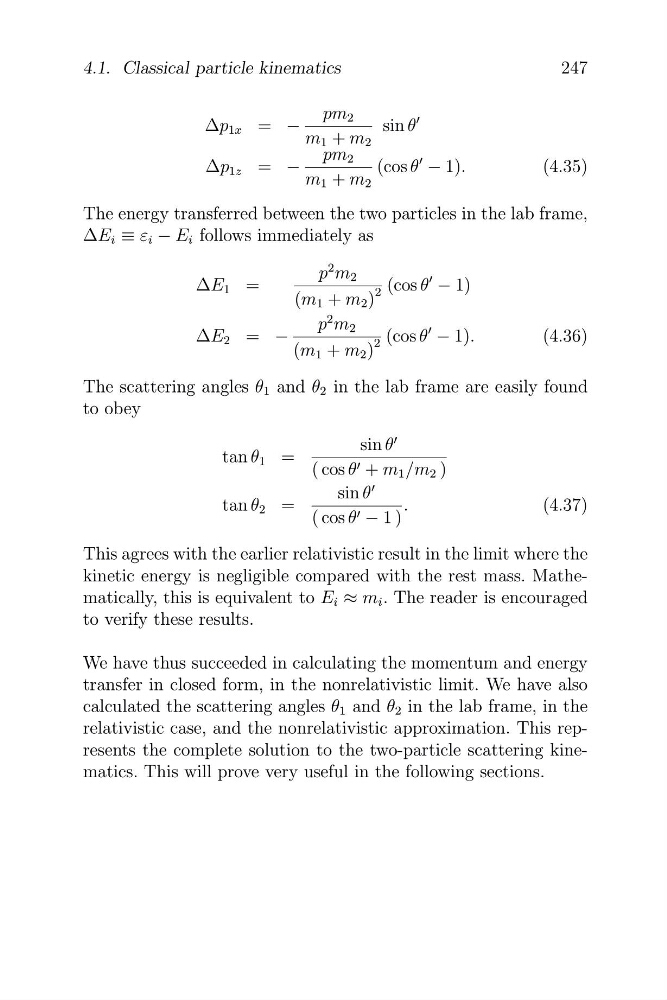
The energy transferred between the two particles in the lab frame,
ΔE i ≡ ε i − E i follows immediately as
2 m 2
ΔE 1 =
p
2 (cos θ
� − 1)
(m 1 + m 2 )
2
ΔE 2 = −
p m 2
2 (cos θ
� − 1).
(4.36)
(m 1 + m 2 )
The scattering angles θ 1 and θ 2 in the lab frame are easily found
to obey
sin θ
�
tan θ 1 = ( cos θ � + m 1 /m 2 )
sin θ
�
tan θ 2 =
.
(4.37)
( cos θ � − 1 )
This agrees with the earlier relativistic result in the limit where the
kinetic energy is negligible compared with the rest mass. Mathematically, this is equivalent to E i ≈ m i . The reader is encouraged
to verify these results.
We have thus succeeded in calculating the momentum and energy
transfer in closed form, in the nonrelativistic limit. We have also
calculated the scattering angles θ 1 and θ 2 in the lab frame, in the
relativistic case, and the nonrelativistic approximation. This represents the complete solution to the two-particle scattering kinematics. This will prove very useful in the following sections.
247
4.1. Classical particle kinematics
pm 2
sin θ
�
m 1 + m 2
Δp 1z = −
pm 2 (cos θ
� − 1).
(4.35)
m 1 + m 2
The energy transferred between the two particles in the lab frame,
ΔE i ≡ ε i − E i follows immediately as
2 m 2
ΔE 1 =
p
2 (cos θ
� − 1)
(m 1 + m 2 )
2
ΔE 2 = −
p m 2
2 (cos θ
� − 1).
(4.36)
(m 1 + m 2 )
The scattering angles θ 1 and θ 2 in the lab frame are easily found
to obey
sin θ
�
tan θ 1 = ( cos θ � + m 1 /m 2 )
sin θ
�
tan θ 2 =
.
(4.37)
( cos θ � − 1 )
This agrees with the earlier relativistic result in the limit where the
kinetic energy is negligible compared with the rest mass. Mathematically, this is equivalent to E i ≈ m i . The reader is encouraged
to verify these results.
We have thus succeeded in calculating the momentum and energy
transfer in closed form, in the nonrelativistic limit. We have also
calculated the scattering angles θ 1 and θ 2 in the lab frame, in the
relativistic case, and the nonrelativistic approximation. This represents the complete solution to the two-particle scattering kinematics. This will prove very useful in the following sections.
247
4.1. Classical particle kinematics