

�
�
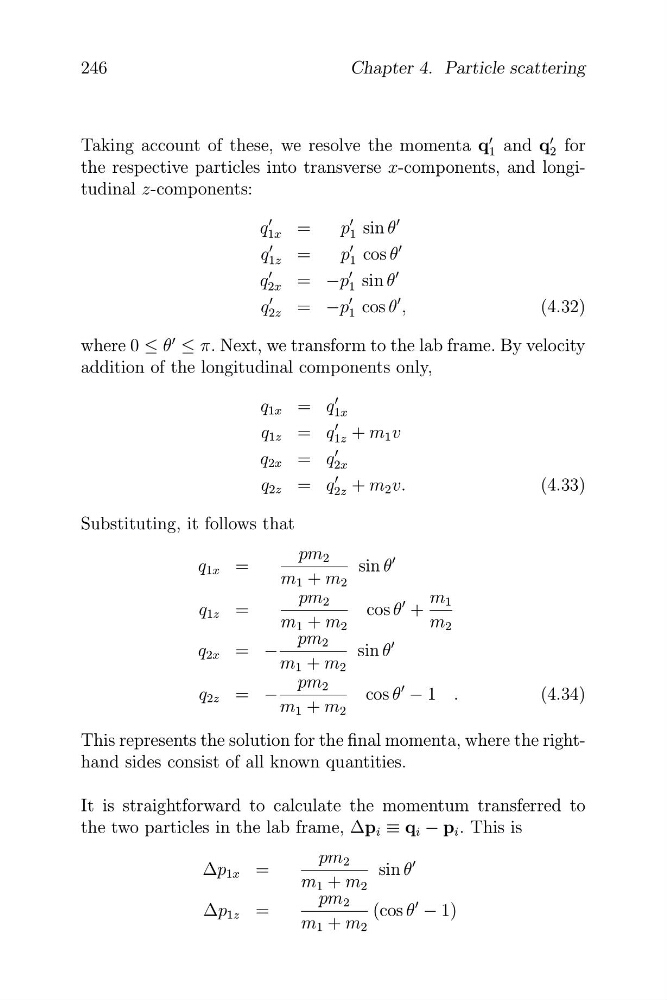
Taking account of these, we resolve the momenta q 1
� and q 2
� for
the respective particles into transverse x-components, and longitudinal z-components:
q
�
1x =
p
�
1 sin θ
�
q
�
1z =
p
�
1 cos θ
�
q
�
2x = −p
�
1 sin θ
�
q
�
2z = −p
�
1 cos θ
� ,
(4.32)
where 0 ≤ θ
� ≤ π. Next, we transform to the lab frame. By velocity
addition of the longitudinal components only,
q 1x = q 1x
q 1z = q 1
�
z + m 1 v
q 2x = q 2x
q 2z = q 2
�
z + m 2 v.
(4.33)
Substituting, it follows that
q 1x =
pm 2
sin θ
�
m 1 + m 2
pm 2
m 1
q 1z =
cos θ
� +
m 1 + m 2
m 2
q 2x = −
pm 2
sin θ
�
m 1 + m 2
q 2z = −
pm 2
cos θ
� − 1 .
(4.34)
m 1 + m 2
This represents the solution for the final momenta, where the righthand sides consist of all known quantities.
It is straightforward to calculate the momentum transferred to
the two particles in the lab frame, Δp i ≡ q i − p i . This is
pm 2
Δp 1x =
sin θ
�
m 1 + m 2
Δp 1z =
pm 2 (cos θ
� − 1)
m 1 + m 2
246
Chapter 4. Particle scattering
�
Taking account of these, we resolve the momenta q 1
� and q 2
� for
the respective particles into transverse x-components, and longitudinal z-components:
q
�
1x =
p
�
1 sin θ
�
q
�
1z =
p
�
1 cos θ
�
q
�
2x = −p
�
1 sin θ
�
q
�
2z = −p
�
1 cos θ
� ,
(4.32)
where 0 ≤ θ
� ≤ π. Next, we transform to the lab frame. By velocity
addition of the longitudinal components only,
q 1x = q 1x
q 1z = q 1
�
z + m 1 v
q 2x = q 2x
q 2z = q 2
�
z + m 2 v.
(4.33)
Substituting, it follows that
q 1x =
pm 2
sin θ
�
m 1 + m 2
pm 2
m 1
q 1z =
cos θ
� +
m 1 + m 2
m 2
q 2x = −
pm 2
sin θ
�
m 1 + m 2
q 2z = −
pm 2
cos θ
� − 1 .
(4.34)
m 1 + m 2
This represents the solution for the final momenta, where the righthand sides consist of all known quantities.
It is straightforward to calculate the momentum transferred to
the two particles in the lab frame, Δp i ≡ q i − p i . This is
pm 2
Δp 1x =
sin θ
�
m 1 + m 2
Δp 1z =
pm 2 (cos θ
� − 1)
m 1 + m 2
246
Chapter 4. Particle scattering