

�
�
�
�
�
�
�
�
�
�
�
�
�
1
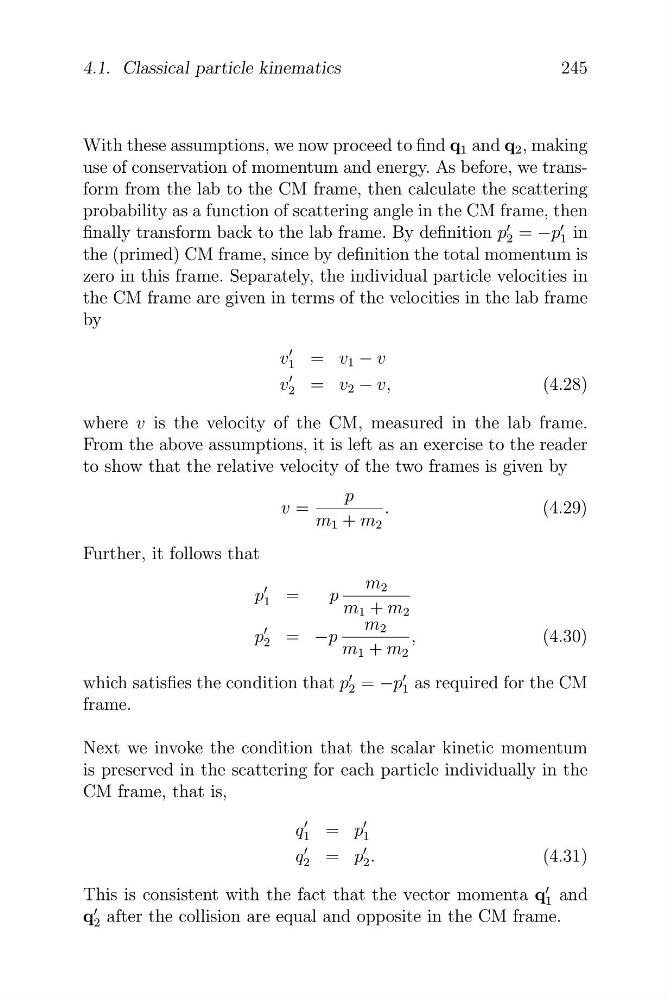
With these assumptions, we now proceed to find q 1 and q 2 , making
use of conservation of momentum and energy. As before, we transform from the lab to the CM frame, then calculate the scattering
probability as a function of scattering angle in the CM frame, then
finally transform back to the lab frame. By definition p
2 = −p
in
the (primed) CM frame, since by definition the total momentum is
zero in this frame. Separately, the individual particle velocities in
the CM frame are given in terms of the velocities in the lab frame
by
v =
1
v 1 − v
v
�
2 =
v 2 − v,
(4.28)
where v is the velocity of the CM, measured in the lab frame.
From the above assumptions, it is left as an exercise to the reader
to show that the relative velocity of the two frames is given by
p
v =
.
(4.29)
m 1 + m 2
Further, it follows that
m 2
p =
p
1
m 1 + m 2
m 2
−p
,
(4.30)
p =
2
m 1 + m 2
1 as required for the CM
frame.
Next we invoke the condition that the scalar kinetic momentum
is preserved in the scattering for each particle individually in the
CM frame, that is,
which satisfies the condition that p
= −p
2
q = p
1
1
q = p 2 .
2
(4.31)
This is consistent with the fact that the vector momenta q
1 and
q
after the collision are equal and opposite in the CM frame.
2
245
4.1. Classical particle kinematics
�
�
�
�
�
�
�
�
�
�
�
�
1
With these assumptions, we now proceed to find q 1 and q 2 , making
use of conservation of momentum and energy. As before, we transform from the lab to the CM frame, then calculate the scattering
probability as a function of scattering angle in the CM frame, then
finally transform back to the lab frame. By definition p
2 = −p
in
the (primed) CM frame, since by definition the total momentum is
zero in this frame. Separately, the individual particle velocities in
the CM frame are given in terms of the velocities in the lab frame
by
v =
1
v 1 − v
v
�
2 =
v 2 − v,
(4.28)
where v is the velocity of the CM, measured in the lab frame.
From the above assumptions, it is left as an exercise to the reader
to show that the relative velocity of the two frames is given by
p
v =
.
(4.29)
m 1 + m 2
Further, it follows that
m 2
p =
p
1
m 1 + m 2
m 2
−p
,
(4.30)
p =
2
m 1 + m 2
1 as required for the CM
frame.
Next we invoke the condition that the scalar kinetic momentum
is preserved in the scattering for each particle individually in the
CM frame, that is,
which satisfies the condition that p
= −p
2
q = p
1
1
q = p 2 .
2
(4.31)
This is consistent with the fact that the vector momenta q
1 and
q
after the collision are equal and opposite in the CM frame.
2
245
4.1. Classical particle kinematics