

244
Chapter 4. Particle scattering
x-axis. It is straightforward, but quite tedious to calculate the momentum and energy transfer. It is left as an exercise to the reader
to set up the algebra, based on the above analysis. Indeed, an ambitious reader could carry this through to a closed-form solution.
The problem becomes greatly simpler in the nonrelativistic approximation. This approximation is relevant to a large variety of
charged particle instruments, which operate at low energy, where
the kinetic energy is small relative to the particle rest-mass energy.
This approximation also provides significant intuitive insight into
the scattering process.
We continue to use the same notation for the initial state in the lab
frame, namely, we assume that particle 1 (the incident particle)
has rest mass m 1 , vector kinetic momentum p 1 , and total energy
E 1 . We assume that particle 2 (the target particle) has rest mass
m 2 , vector kinetic momentum p 2 , and total energy E 2 .
We also continue to use the same notation for the final state after
scattering, namely, we assume that particle 1 has rest mass m 1 ,
vector kinetic momentum q 1 , and total energy ε 1 . We assume that
particle 2 has rest mass m 2 , vector kinetic momentum q 2 , and total energy ε 2 .
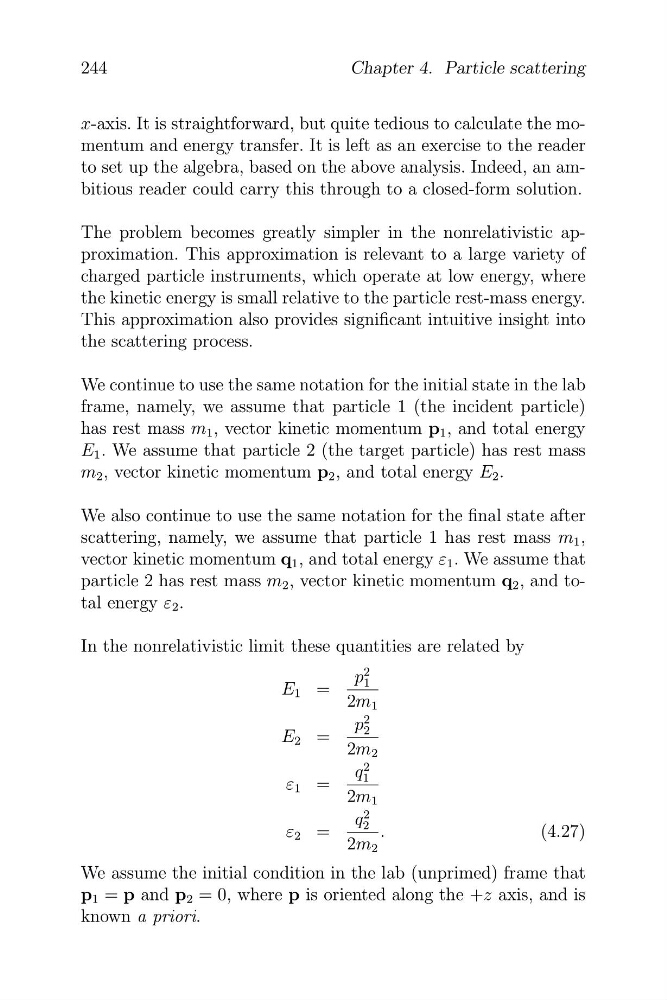
In the nonrelativistic limit these quantities are related by
2
E 1 =
p 1
2m 1
2
p
E 2 =
2
2m 2
2
q
ε 1 =
1
2m 1
2
ε 2 =
q 2 .
(4.27)
2m 2
We assume the initial condition in the lab (unprimed) frame that
p 1 = p and p 2 = 0, where p is oriented along the +z axis, and is
known a priori.
Chapter 4. Particle scattering
x-axis. It is straightforward, but quite tedious to calculate the momentum and energy transfer. It is left as an exercise to the reader
to set up the algebra, based on the above analysis. Indeed, an ambitious reader could carry this through to a closed-form solution.
The problem becomes greatly simpler in the nonrelativistic approximation. This approximation is relevant to a large variety of
charged particle instruments, which operate at low energy, where
the kinetic energy is small relative to the particle rest-mass energy.
This approximation also provides significant intuitive insight into
the scattering process.
We continue to use the same notation for the initial state in the lab
frame, namely, we assume that particle 1 (the incident particle)
has rest mass m 1 , vector kinetic momentum p 1 , and total energy
E 1 . We assume that particle 2 (the target particle) has rest mass
m 2 , vector kinetic momentum p 2 , and total energy E 2 .
We also continue to use the same notation for the final state after
scattering, namely, we assume that particle 1 has rest mass m 1 ,
vector kinetic momentum q 1 , and total energy ε 1 . We assume that
particle 2 has rest mass m 2 , vector kinetic momentum q 2 , and total energy ε 2 .
In the nonrelativistic limit these quantities are related by
2
E 1 =
p 1
2m 1
2
p
E 2 =
2
2m 2
2
q
ε 1 =
1
2m 1
2
ε 2 =
q 2 .
(4.27)
2m 2
We assume the initial condition in the lab (unprimed) frame that
p 1 = p and p 2 = 0, where p is oriented along the +z axis, and is
known a priori.