

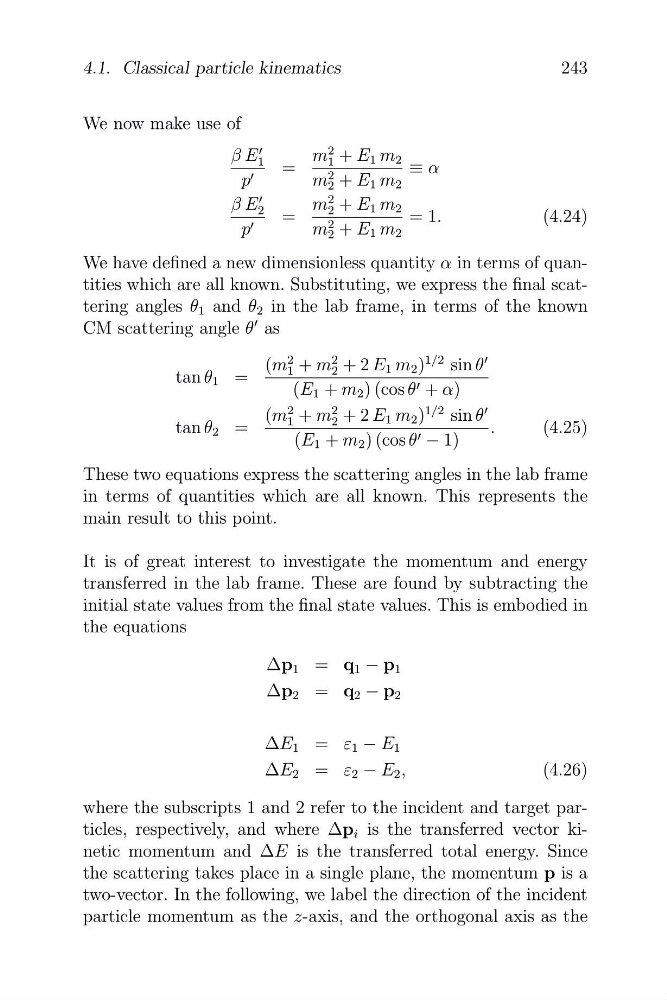
We now make use of
β E 1
�
m 1
2 + E 1 m 2
=
≡ α
p �
m 2
2 + E 1 m 2
β E 2
�
m 2
2 + E 1 m 2
=
= 1.
(4.24)
p �
m 2
2 + E 1 m 2
We have defined a new dimensionless quantity α in terms of quantities which are all known. Substituting, we express the final scattering angles θ 1 and θ 2 in the lab frame, in terms of the known
CM scattering angle θ
� as
(m 1
2 + m
2 + 2 E 1 m 2 )
1/2 sin θ
�
tan θ 1 =
2
(E 1 + m 2 ) (cos θ � + α)
(m 1
2 + m
2 + 2 E 1 m 2 )
1/2 sin θ
�
tan θ 2 =
2
.
(4.25)
(E 1 + m 2 ) (cos θ � − 1)
These two equations express the scattering angles in the lab frame
in terms of quantities which are all known. This represents the
main result to this point.
It is of great interest to investigate the momentum and energy
transferred in the lab frame. These are found by subtracting the
initial state values from the final state values. This is embodied in
the equations
Δp 1 = q 1 − p 1
Δp 2 = q 2 − p 2
ΔE 1 = ε 1 − E 1
ΔE 2 = ε 2 − E 2 ,
(4.26)
where the subscripts 1 and 2 refer to the incident and target particles, respectively, and where Δp i is the transferred vector kinetic momentum and ΔE is the transferred total energy. Since
the scattering takes place in a single plane, the momentum p is a
two-vector. In the following, we label the direction of the incident
particle momentum as the z-axis, and the orthogonal axis as the
243
4.1. Classical particle kinematics
β E 1
�
m 1
2 + E 1 m 2
=
≡ α
p �
m 2
2 + E 1 m 2
β E 2
�
m 2
2 + E 1 m 2
=
= 1.
(4.24)
p �
m 2
2 + E 1 m 2
We have defined a new dimensionless quantity α in terms of quantities which are all known. Substituting, we express the final scattering angles θ 1 and θ 2 in the lab frame, in terms of the known
CM scattering angle θ
� as
(m 1
2 + m
2 + 2 E 1 m 2 )
1/2 sin θ
�
tan θ 1 =
2
(E 1 + m 2 ) (cos θ � + α)
(m 1
2 + m
2 + 2 E 1 m 2 )
1/2 sin θ
�
tan θ 2 =
2
.
(4.25)
(E 1 + m 2 ) (cos θ � − 1)
These two equations express the scattering angles in the lab frame
in terms of quantities which are all known. This represents the
main result to this point.
It is of great interest to investigate the momentum and energy
transferred in the lab frame. These are found by subtracting the
initial state values from the final state values. This is embodied in
the equations
Δp 1 = q 1 − p 1
Δp 2 = q 2 − p 2
ΔE 1 = ε 1 − E 1
ΔE 2 = ε 2 − E 2 ,
(4.26)
where the subscripts 1 and 2 refer to the incident and target particles, respectively, and where Δp i is the transferred vector kinetic momentum and ΔE is the transferred total energy. Since
the scattering takes place in a single plane, the momentum p is a
two-vector. In the following, we label the direction of the incident
particle momentum as the z-axis, and the orthogonal axis as the
243
4.1. Classical particle kinematics