

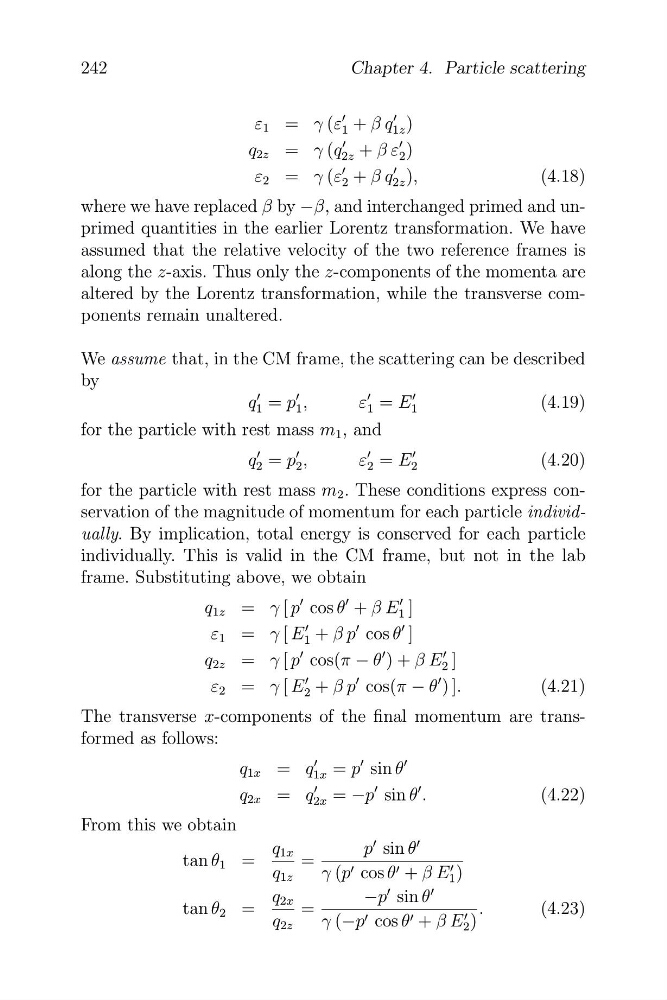
ε 1 = γ (ε
�
1 + β q 1
�
z )
q 2z = γ (q 2
�
z + β ε 2
� )
ε 2 = γ (ε 2
� + β q 2
�
z ),
(4.18)
where we have replaced β by −β, and interchanged primed and unprimed quantities in the earlier Lorentz transformation. We have
assumed that the relative velocity of the two reference frames is
along the z-axis. Thus only the z-components of the momenta are
altered by the Lorentz transformation, while the transverse components remain unaltered.
We assume that, in the CM frame, the scattering can be described
by
q
� = p
�
ε
� = E
�
(4.19)
1
1 ,
1
1
for the particle with rest mass m 1 , and
�
�
ε
�
q = p 2 ,
= E
�
(4.20)
2
2
2
for the particle with rest mass m 2 . These conditions express conservation of the magnitude of momentum for each particle individually. By implication, total energy is conserved for each particle
individually. This is valid in the CM frame, but not in the lab
frame. Substituting above, we obtain
q 1z = γ [ p
� cos θ
� + β E 1
� ]
ε 1 = γ [ E 1
� + β p
� cos θ
� ]
q 2z = γ [ p
� cos(π − θ
� ) + β E 2
� ]
ε 2 = γ [ E 2
� + β p
� cos(π − θ
� ) ].
(4.21)
The transverse x-components of the final momentum are transformed as follows:
q 1x = q 1
�
x = p
� sin θ
�
q 2x = q 2
�
x = −p
� sin θ
� .
(4.22)
From this we obtain
q 1x
p
� sin θ
�
tan θ 1 =
=
q 1z
γ (p � cos θ � + β E 1
� )
q 2x
−p
� sin θ
�
tan θ 2 =
=
.
(4.23)
q 2z
γ (−p � cos θ � + β E 2
� )
242
Chapter 4. Particle scattering
�
1 + β q 1
�
z )
q 2z = γ (q 2
�
z + β ε 2
� )
ε 2 = γ (ε 2
� + β q 2
�
z ),
(4.18)
where we have replaced β by −β, and interchanged primed and unprimed quantities in the earlier Lorentz transformation. We have
assumed that the relative velocity of the two reference frames is
along the z-axis. Thus only the z-components of the momenta are
altered by the Lorentz transformation, while the transverse components remain unaltered.
We assume that, in the CM frame, the scattering can be described
by
q
� = p
�
ε
� = E
�
(4.19)
1
1 ,
1
1
for the particle with rest mass m 1 , and
�
�
ε
�
q = p 2 ,
= E
�
(4.20)
2
2
2
for the particle with rest mass m 2 . These conditions express conservation of the magnitude of momentum for each particle individually. By implication, total energy is conserved for each particle
individually. This is valid in the CM frame, but not in the lab
frame. Substituting above, we obtain
q 1z = γ [ p
� cos θ
� + β E 1
� ]
ε 1 = γ [ E 1
� + β p
� cos θ
� ]
q 2z = γ [ p
� cos(π − θ
� ) + β E 2
� ]
ε 2 = γ [ E 2
� + β p
� cos(π − θ
� ) ].
(4.21)
The transverse x-components of the final momentum are transformed as follows:
q 1x = q 1
�
x = p
� sin θ
�
q 2x = q 2
�
x = −p
� sin θ
� .
(4.22)
From this we obtain
q 1x
p
� sin θ
�
tan θ 1 =
=
q 1z
γ (p � cos θ � + β E 1
� )
q 2x
−p
� sin θ
�
tan θ 2 =
=
.
(4.23)
q 2z
γ (−p � cos θ � + β E 2
� )
242
Chapter 4. Particle scattering