

�
�
�
�
�
�
�
�
�
�
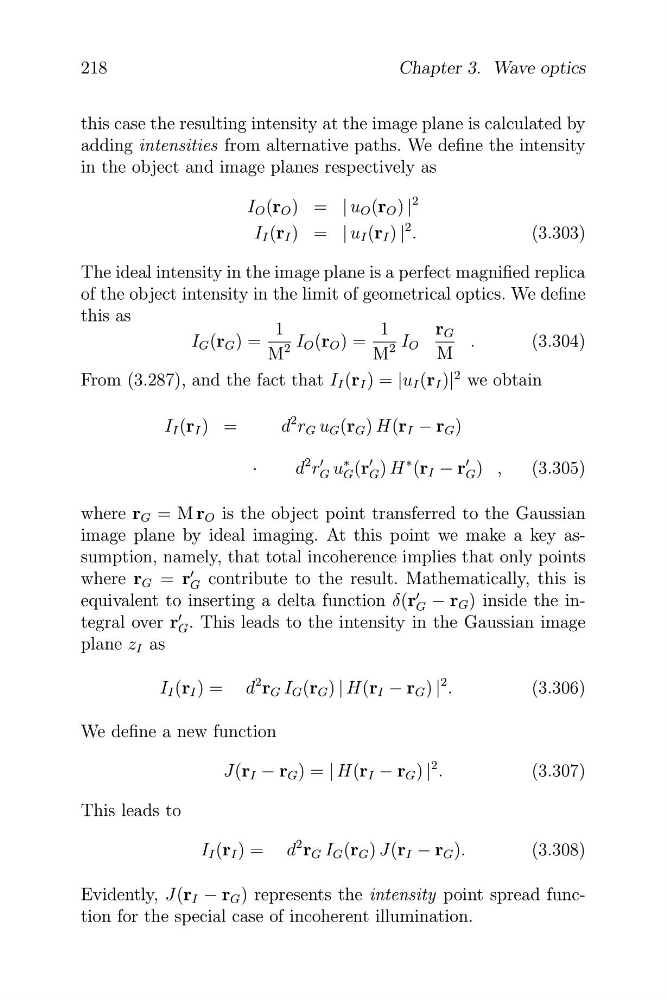
this case the resulting intensity at the image plane is calculated by
adding intensities from alternative paths. We define the intensity
in the object and image planes respectively as
I O (r O ) = | u O (r O ) |
2
I I (r I ) = | u I (r I ) |
2 .
(3.303)
The ideal intensity in the image plane is a perfect magnified replica
of the object intensity in the limit of geometrical optics. We define
this as
1
1
r G
I G (r G ) =
I O (r O ) =
I O
.
(3.304)
M
2
M
2
M
From (3.287), and the fact that I I (r I ) = |u I (r I )|
2 we obtain
d
2
I I (r I ) =
r G u G (r G ) H(r I − r G )
·
d
2
G (r G ) H
∗ (r I − r G )
∗
,
(3.305)
r G u
where r G = M r O is the object point transferred to the Gaussian
image plane by ideal imaging. At this point we make a key assumption, namely, that total incoherence implies that only points
where r G = r
G contribute to the result. Mathematically, this is
equivalent to inserting a delta function δ(r
G − r G ) inside the integral over r
G . This leads to the intensity in the Gaussian image
plane z I as
d
2
I I (r I ) =
r G I G (r G ) | H(r I − r G ) |
2 .
(3.306)
We define a new function
J(r I − r G ) = | H(r I − r G ) |
2 .
(3.307)
This leads to
I I (r I ) = d
2 r G I G (r G ) J(r I − r G ).
(3.308)
Evidently, J(r I − r G ) represents the intensity point spread function for the special case of incoherent illumination.
218
Chapter 3. Wave optics
�
�
�
�
�
�
�
�
�
this case the resulting intensity at the image plane is calculated by
adding intensities from alternative paths. We define the intensity
in the object and image planes respectively as
I O (r O ) = | u O (r O ) |
2
I I (r I ) = | u I (r I ) |
2 .
(3.303)
The ideal intensity in the image plane is a perfect magnified replica
of the object intensity in the limit of geometrical optics. We define
this as
1
1
r G
I G (r G ) =
I O (r O ) =
I O
.
(3.304)
M
2
M
2
M
From (3.287), and the fact that I I (r I ) = |u I (r I )|
2 we obtain
d
2
I I (r I ) =
r G u G (r G ) H(r I − r G )
·
d
2
G (r G ) H
∗ (r I − r G )
∗
,
(3.305)
r G u
where r G = M r O is the object point transferred to the Gaussian
image plane by ideal imaging. At this point we make a key assumption, namely, that total incoherence implies that only points
where r G = r
G contribute to the result. Mathematically, this is
equivalent to inserting a delta function δ(r
G − r G ) inside the integral over r
G . This leads to the intensity in the Gaussian image
plane z I as
d
2
I I (r I ) =
r G I G (r G ) | H(r I − r G ) |
2 .
(3.306)
We define a new function
J(r I − r G ) = | H(r I − r G ) |
2 .
(3.307)
This leads to
I I (r I ) = d
2 r G I G (r G ) J(r I − r G ).
(3.308)
Evidently, J(r I − r G ) represents the intensity point spread function for the special case of incoherent illumination.
218
Chapter 3. Wave optics