

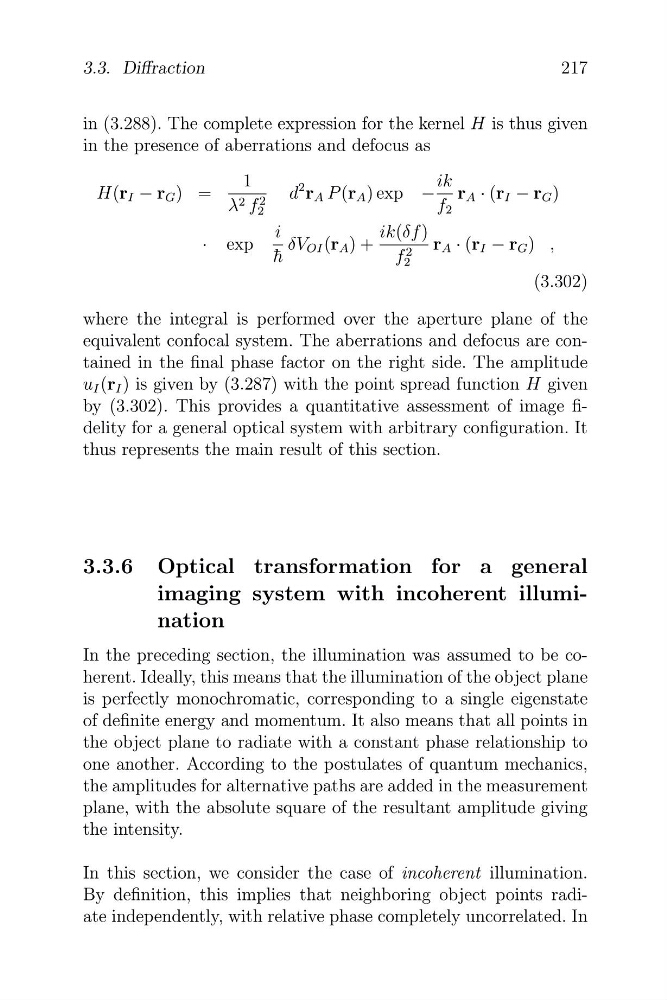
in (3.288). The complete expression for the kernel H is thus given
in the presence of aberrations and defocus as
1
ik
d
2
H(r I − r G ) =
r A P (r A ) exp − r A · (r I − r G )
λ 2 f
2
2
f 2
i
ik(δf )
· exp
δV OI (r A ) +
r A · (r I − r G ) ,
h ¯
f 2
2
(3.302)
217
3.3. Diffraction
where the integral is performed over the aperture plane of the
equivalent confocal system. The aberrations and defocus are contained in the final phase factor on the right side. The amplitude
u I (r I ) is given by (3.287) with the point spread function H given
by (3.302). This provides a quantitative assessment of image fidelity for a general optical system with arbitrary configuration. It
thus represents the main result of this section.
3.3.6 Optical transformation for a general
imaging system with incoherent illumination
In the preceding section, the illumination was assumed to be coherent. Ideally, this means that the illumination of the object plane
is perfectly monochromatic, corresponding to a single eigenstate
of definite energy and momentum. It also means that all points in
the object plane to radiate with a constant phase relationship to
one another. According to the postulates of quantum mechanics,
the amplitudes for alternative paths are added in the measurement
plane, with the absolute square of the resultant amplitude giving
the intensity.
In this section, we consider the case of incoherent illumination.
By definition, this implies that neighboring object points radiate independently, with relative phase completely uncorrelated. In
in the presence of aberrations and defocus as
1
ik
d
2
H(r I − r G ) =
r A P (r A ) exp − r A · (r I − r G )
λ 2 f
2
2
f 2
i
ik(δf )
· exp
δV OI (r A ) +
r A · (r I − r G ) ,
h ¯
f 2
2
(3.302)
217
3.3. Diffraction
where the integral is performed over the aperture plane of the
equivalent confocal system. The aberrations and defocus are contained in the final phase factor on the right side. The amplitude
u I (r I ) is given by (3.287) with the point spread function H given
by (3.302). This provides a quantitative assessment of image fidelity for a general optical system with arbitrary configuration. It
thus represents the main result of this section.
3.3.6 Optical transformation for a general
imaging system with incoherent illumination
In the preceding section, the illumination was assumed to be coherent. Ideally, this means that the illumination of the object plane
is perfectly monochromatic, corresponding to a single eigenstate
of definite energy and momentum. It also means that all points in
the object plane to radiate with a constant phase relationship to
one another. According to the postulates of quantum mechanics,
the amplitudes for alternative paths are added in the measurement
plane, with the absolute square of the resultant amplitude giving
the intensity.
In this section, we consider the case of incoherent illumination.
By definition, this implies that neighboring object points radiate independently, with relative phase completely uncorrelated. In