

�
�
�
�
�
�
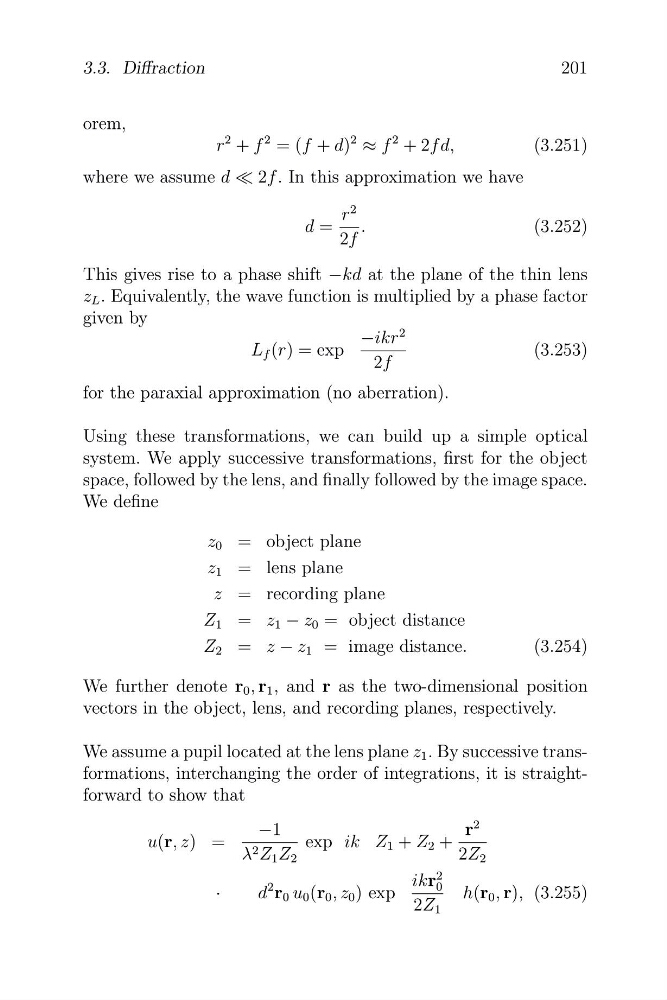
orem,
r
2 + f
2 = (f + d)
2 ≈ f
2 + 2f d,
(3.251)
where we assume d « 2f . In this approximation we have
2
r
d =
.
(3.252)
2f
This gives rise to a phase shift −kd at the plane of the thin lens
z L . Equivalently, the wave function is multiplied by a phase factor
given by
−ikr
2
L f (r) = exp
(3.253)
2f
for the paraxial approximation (no aberration).
Using these transformations, we can build up a simple optical
system. We apply successive transformations, first for the object
space, followed by the lens, and finally followed by the image space.
We define
z 0 = object plane
z 1 = lens plane
z = recording plane
Z 1 = z 1 − z 0 = object distance
Z 2 = z − z 1 = image distance.
(3.254)
We further denote r 0 , r 1 , and r as the two-dimensional position
vectors in the object, lens, and recording planes, respectively.
We assume a pupil located at the lens plane z 1 . By successive transformations, interchanging the order of integrations, it is straightforward to show that
−1
r
2
u(r, z) =
exp ik Z 1 + Z 2 +
λ 2 Z 1 Z 2
2Z 2
2
ikr
·
d
2 r 0 u 0 (r 0 , z 0 ) exp
0
h(r 0 , r), (3.255)
2Z 1
201
3.3. Diffraction
�
�
�
�
�
orem,
r
2 + f
2 = (f + d)
2 ≈ f
2 + 2f d,
(3.251)
where we assume d « 2f . In this approximation we have
2
r
d =
.
(3.252)
2f
This gives rise to a phase shift −kd at the plane of the thin lens
z L . Equivalently, the wave function is multiplied by a phase factor
given by
−ikr
2
L f (r) = exp
(3.253)
2f
for the paraxial approximation (no aberration).
Using these transformations, we can build up a simple optical
system. We apply successive transformations, first for the object
space, followed by the lens, and finally followed by the image space.
We define
z 0 = object plane
z 1 = lens plane
z = recording plane
Z 1 = z 1 − z 0 = object distance
Z 2 = z − z 1 = image distance.
(3.254)
We further denote r 0 , r 1 , and r as the two-dimensional position
vectors in the object, lens, and recording planes, respectively.
We assume a pupil located at the lens plane z 1 . By successive transformations, interchanging the order of integrations, it is straightforward to show that
−1
r
2
u(r, z) =
exp ik Z 1 + Z 2 +
λ 2 Z 1 Z 2
2Z 2
2
ikr
·
d
2 r 0 u 0 (r 0 , z 0 ) exp
0
h(r 0 , r), (3.255)
2Z 1
201
3.3. Diffraction