

�
�
�
�
�
�
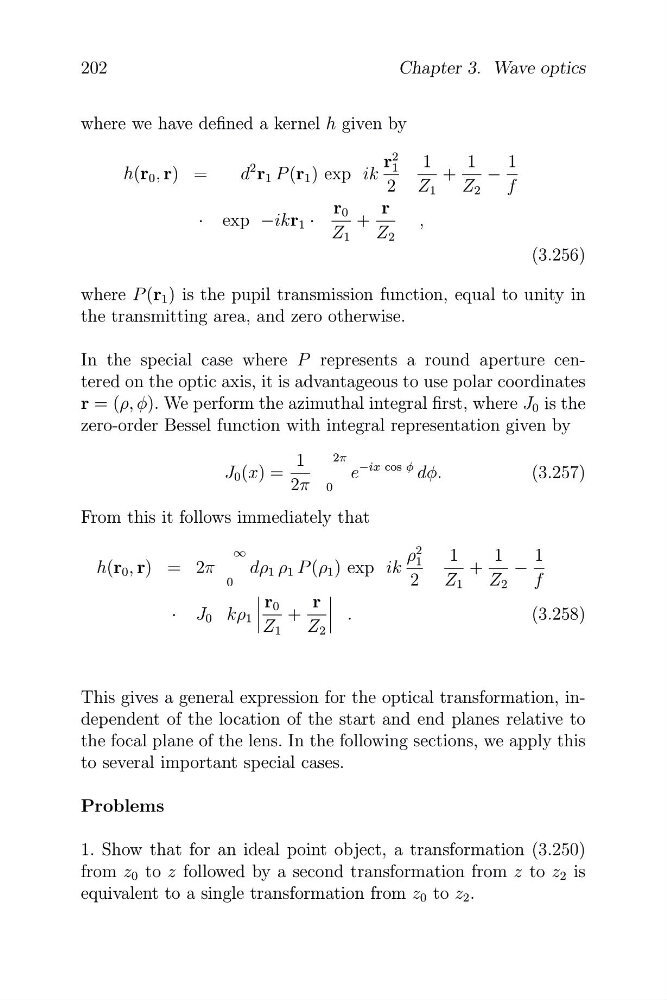
where we have defined a kernel h given by
2
r
1
1
1
h(r 0 , r) =
d
2 r 1 P (r 1 ) exp ik
1
+
−
2 Z 1 Z 2 f
r 0
r
· exp −ikr 1 ·
+
,
Z 1 Z 2
(3.256)
where P (r 1 ) is the pupil transmission function, equal to unity in
the transmitting area, and zero otherwise.
In the special case where P represents a round aperture centered on the optic axis, it is advantageous to use polar coordinates
r = (ρ, φ). We perform the azimuthal integral first, where J 0 is the
zero-order Bessel function with integral representation given by
2π
1
−ix cos φ dφ.
J 0 (x) =
e
(3.257)
2π 0
From this it follows immediately that
∞
ρ
2
1
1
1
1
h(r 0 , r) = 2π
dρ 1 ρ 1 P (ρ 1 ) exp ik
+
−
0
2 Z 1 Z 2 f
·
J 0 kρ 1
r 0
r
+
Z 1 Z 2
.
(3.258)
202
Chapter 3. Wave optics
This gives a general expression for the optical transformation, independent of the location of the start and end planes relative to
the focal plane of the lens. In the following sections, we apply this
to several important special cases.
Problems
1. Show that for an ideal point object, a transformation (3.250)
from z 0 to z followed by a second transformation from z to z 2 is
equivalent to a single transformation from z 0 to z 2 .
�
�
�
�
�
where we have defined a kernel h given by
2
r
1
1
1
h(r 0 , r) =
d
2 r 1 P (r 1 ) exp ik
1
+
−
2 Z 1 Z 2 f
r 0
r
· exp −ikr 1 ·
+
,
Z 1 Z 2
(3.256)
where P (r 1 ) is the pupil transmission function, equal to unity in
the transmitting area, and zero otherwise.
In the special case where P represents a round aperture centered on the optic axis, it is advantageous to use polar coordinates
r = (ρ, φ). We perform the azimuthal integral first, where J 0 is the
zero-order Bessel function with integral representation given by
2π
1
−ix cos φ dφ.
J 0 (x) =
e
(3.257)
2π 0
From this it follows immediately that
∞
ρ
2
1
1
1
1
h(r 0 , r) = 2π
dρ 1 ρ 1 P (ρ 1 ) exp ik
+
−
0
2 Z 1 Z 2 f
·
J 0 kρ 1
r 0
r
+
Z 1 Z 2
.
(3.258)
202
Chapter 3. Wave optics
This gives a general expression for the optical transformation, independent of the location of the start and end planes relative to
the focal plane of the lens. In the following sections, we apply this
to several important special cases.
Problems
1. Show that for an ideal point object, a transformation (3.250)
from z 0 to z followed by a second transformation from z to z 2 is
equivalent to a single transformation from z 0 to z 2 .