

200
Chapter 3. Wave optics
to the intensity, but not the amplitude.
We have derived a transformation of the wave function u(r, z)
between successive planes in the drift length of an optical system. To this point we have not assumed any particular symmetry,
Cartesian, axial, or otherwise. In the following, we will assume axial symmetry. This simplifying assumption is applicable to many
practical systems.
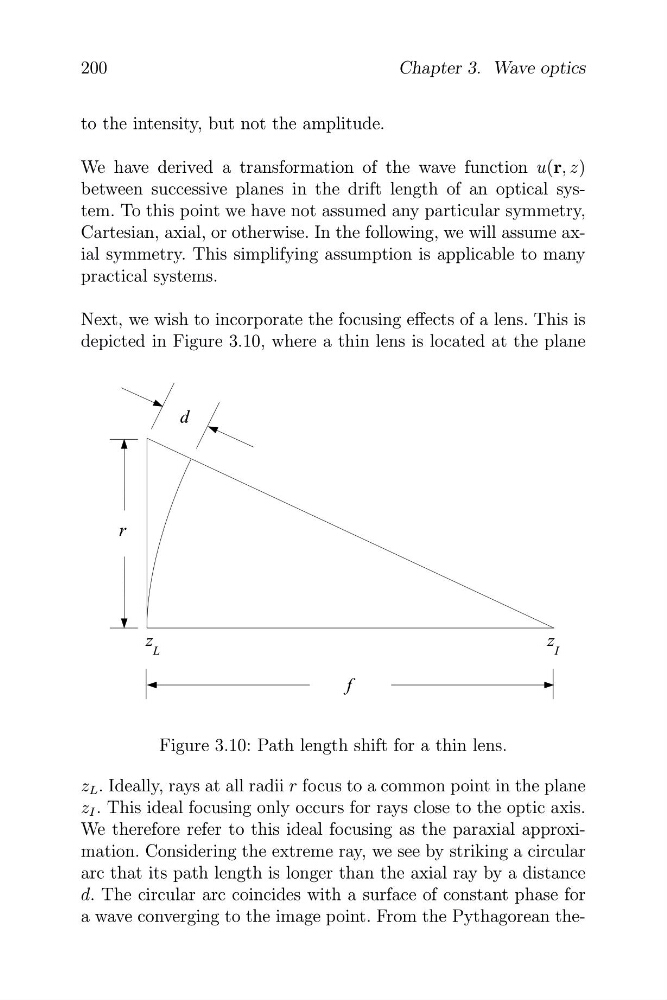
Next, we wish to incorporate the focusing effects of a lens. This is
depicted in Figure 3.10, where a thin lens is located at the plane
Figure 3.10: Path length shift for a thin lens.
z L . Ideally, rays at all radii r focus to a common point in the plane
z I . This ideal focusing only occurs for rays close to the optic axis.
We therefore refer to this ideal focusing as the paraxial approximation. Considering the extreme ray, we see by striking a circular
arc that its path length is longer than the axial ray by a distance
d. The circular arc coincides with a surface of constant phase for
a wave converging to the image point. From the Pythagorean the
Chapter 3. Wave optics
to the intensity, but not the amplitude.
We have derived a transformation of the wave function u(r, z)
between successive planes in the drift length of an optical system. To this point we have not assumed any particular symmetry,
Cartesian, axial, or otherwise. In the following, we will assume axial symmetry. This simplifying assumption is applicable to many
practical systems.
Next, we wish to incorporate the focusing effects of a lens. This is
depicted in Figure 3.10, where a thin lens is located at the plane
Figure 3.10: Path length shift for a thin lens.
z L . Ideally, rays at all radii r focus to a common point in the plane
z I . This ideal focusing only occurs for rays close to the optic axis.
We therefore refer to this ideal focusing as the paraxial approximation. Considering the extreme ray, we see by striking a circular
arc that its path length is longer than the axial ray by a distance
d. The circular arc coincides with a surface of constant phase for
a wave converging to the image point. From the Pythagorean the