

�
�
�
�
This is known as the Fresnel approximation.
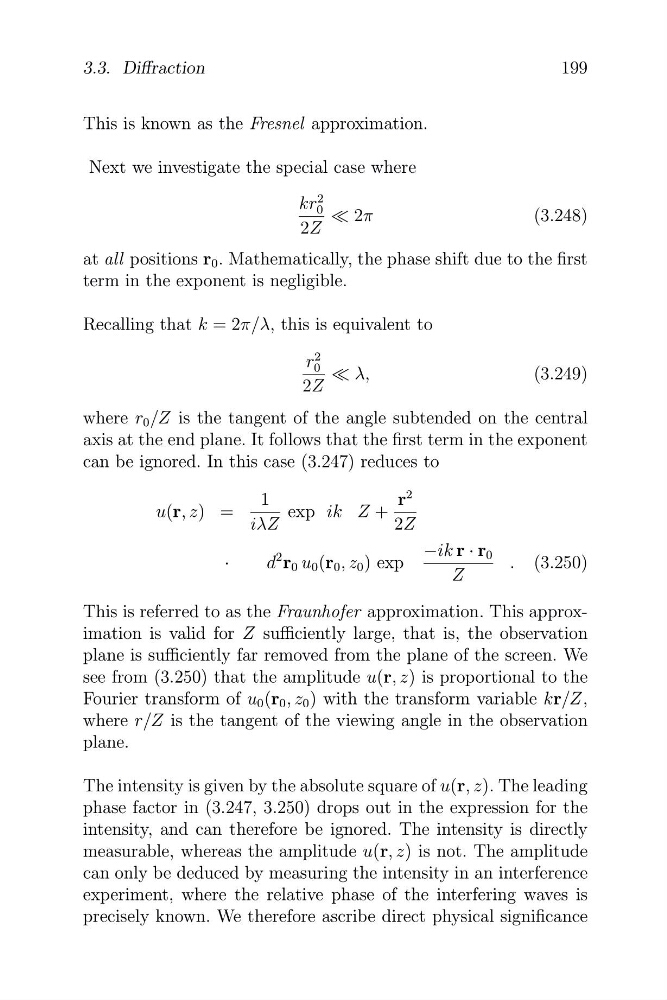
Next we investigate the special case where
kr 0
2
« 2π
(3.248)
2Z
at all positions r 0 . Mathematically, the phase shift due to the first
term in the exponent is negligible.
Recalling that k = 2π/λ, this is equivalent to
2
r 0 « λ,
(3.249)
2Z
where r 0 /Z is the tangent of the angle subtended on the central
axis at the end plane. It follows that the first term in the exponent
can be ignored. In this case (3.247) reduces to
2
1
r
u(r, z) =
exp ik Z +
iλZ
2Z
−ik r · r 0
d
2
·
r 0 u 0 (r 0 , z 0 ) exp
. (3.250)
Z
199
3.3. Diffraction
This is referred to as the Fraunhofer approximation. This approximation is valid for Z sufficiently large, that is, the observation
plane is sufficiently far removed from the plane of the screen. We
see from (3.250) that the amplitude u(r, z) is proportional to the
Fourier transform of u 0 (r 0 , z 0 ) with the transform variable kr/Z,
where r/Z is the tangent of the viewing angle in the observation
plane.
The intensity is given by the absolute square of u(r, z). The leading
phase factor in (3.247, 3.250) drops out in the expression for the
intensity, and can therefore be ignored. The intensity is directly
measurable, whereas the amplitude u(r, z) is not. The amplitude
can only be deduced by measuring the intensity in an interference
experiment, where the relative phase of the interfering waves is
precisely known. We therefore ascribe direct physical significance
�
�
�
This is known as the Fresnel approximation.
Next we investigate the special case where
kr 0
2
« 2π
(3.248)
2Z
at all positions r 0 . Mathematically, the phase shift due to the first
term in the exponent is negligible.
Recalling that k = 2π/λ, this is equivalent to
2
r 0 « λ,
(3.249)
2Z
where r 0 /Z is the tangent of the angle subtended on the central
axis at the end plane. It follows that the first term in the exponent
can be ignored. In this case (3.247) reduces to
2
1
r
u(r, z) =
exp ik Z +
iλZ
2Z
−ik r · r 0
d
2
·
r 0 u 0 (r 0 , z 0 ) exp
. (3.250)
Z
199
3.3. Diffraction
This is referred to as the Fraunhofer approximation. This approximation is valid for Z sufficiently large, that is, the observation
plane is sufficiently far removed from the plane of the screen. We
see from (3.250) that the amplitude u(r, z) is proportional to the
Fourier transform of u 0 (r 0 , z 0 ) with the transform variable kr/Z,
where r/Z is the tangent of the viewing angle in the observation
plane.
The intensity is given by the absolute square of u(r, z). The leading
phase factor in (3.247, 3.250) drops out in the expression for the
intensity, and can therefore be ignored. The intensity is directly
measurable, whereas the amplitude u(r, z) is not. The amplitude
can only be deduced by measuring the intensity in an interference
experiment, where the relative phase of the interfering waves is
precisely known. We therefore ascribe direct physical significance