

�
�
�
�
198
Chapter 3. Wave optics
Problem
Show by direct substitution that the solution (3.244) satisfies the
time-independent wave equation (3.230).
3.3.2 The Fresnel and Fraunhofer approximations
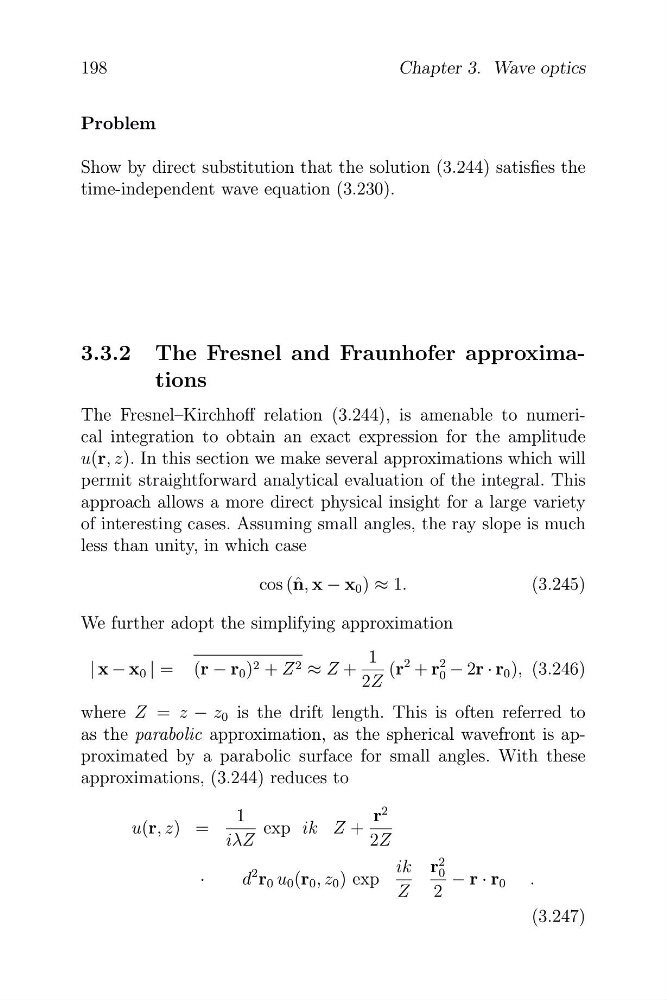
The Fresnel–Kirchhoff relation (3.244), is amenable to numerical integration to obtain an exact expression for the amplitude
u(r, z). In this section we make several approximations which will
permit straightforward analytical evaluation of the integral. This
approach allows a more direct physical insight for a large variety
of interesting cases. Assuming small angles, the ray slope is much
less than unity, in which case
cos (n ˆ, x − x 0 ) ≈ 1.
(3.245)
We further adopt the simplifying approximation
1
| x − x 0 | = (r − r 0 ) 2 + Z 2 ≈ Z +
(r
2 + r
2 − 2r · r 0 ), (3.246)
0
2Z
where Z = z − z 0 is the drift length. This is often referred to
as the parabolic approximation, as the spherical wavefront is approximated by a parabolic surface for small angles. With these
approximations, (3.244) reduces to
2
1
r
u(r, z) =
exp ik Z +
iλZ
2Z
2
ik r
d
2
0
·
r 0 u 0 (r 0 , z 0 ) exp
− r · r 0 .
Z 2
(3.247)
�
�
�
198
Chapter 3. Wave optics
Problem
Show by direct substitution that the solution (3.244) satisfies the
time-independent wave equation (3.230).
3.3.2 The Fresnel and Fraunhofer approximations
The Fresnel–Kirchhoff relation (3.244), is amenable to numerical integration to obtain an exact expression for the amplitude
u(r, z). In this section we make several approximations which will
permit straightforward analytical evaluation of the integral. This
approach allows a more direct physical insight for a large variety
of interesting cases. Assuming small angles, the ray slope is much
less than unity, in which case
cos (n ˆ, x − x 0 ) ≈ 1.
(3.245)
We further adopt the simplifying approximation
1
| x − x 0 | = (r − r 0 ) 2 + Z 2 ≈ Z +
(r
2 + r
2 − 2r · r 0 ), (3.246)
0
2Z
where Z = z − z 0 is the drift length. This is often referred to
as the parabolic approximation, as the spherical wavefront is approximated by a parabolic surface for small angles. With these
approximations, (3.244) reduces to
2
1
r
u(r, z) =
exp ik Z +
iλZ
2Z
2
ik r
d
2
0
·
r 0 u 0 (r 0 , z 0 ) exp
− r · r 0 .
Z 2
(3.247)