

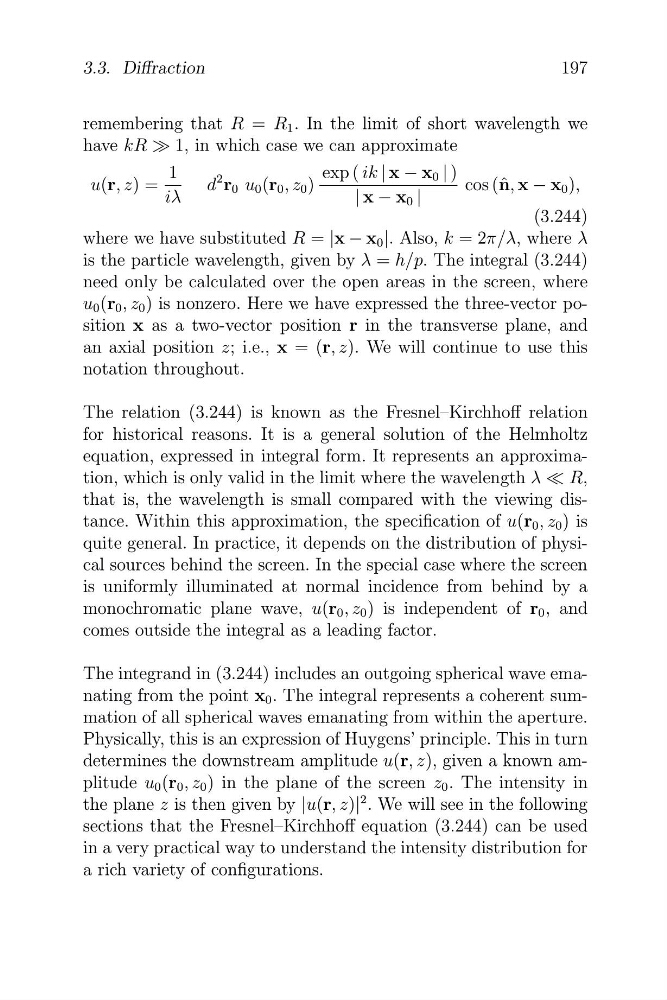
remembering that R = R 1 . In the limit of short wavelength we
have kR � 1, in which case we can approximate
1
exp ( ik | x − x 0 | )
d
2
u(r, z) =
r 0 u 0 (r 0 , z 0 )
cos (n ˆ, x − x 0 ),
iλ
| x − x 0 |
(3.244)
where we have substituted R = |x − x 0 |. Also, k = 2π/λ, where λ
is the particle wavelength, given by λ = h/p. The integral (3.244)
need only be calculated over the open areas in the screen, where
u 0 (r 0 , z 0 ) is nonzero. Here we have expressed the three-vector position x as a two-vector position r in the transverse plane, and
an axial position z; i.e., x = (r, z). We will continue to use this
notation throughout.
197
3.3. Diffraction
The relation (3.244) is known as the Fresnel–Kirchhoff relation
for historical reasons. It is a general solution of the Helmholtz
equation, expressed in integral form. It represents an approximation, which is only valid in the limit where the wavelength λ « R,
that is, the wavelength is small compared with the viewing distance. Within this approximation, the specification of u(r 0 , z 0 ) is
quite general. In practice, it depends on the distribution of physical sources behind the screen. In the special case where the screen
is uniformly illuminated at normal incidence from behind by a
monochromatic plane wave, u(r 0 , z 0 ) is independent of r 0 , and
comes outside the integral as a leading factor.
The integrand in (3.244) includes an outgoing spherical wave emanating from the point x 0 . The integral represents a coherent summation of all spherical waves emanating from within the aperture.
Physically, this is an expression of Huygens’ principle. This in turn
determines the downstream amplitude u(r, z), given a known amplitude u 0 (r 0 , z 0 ) in the plane of the screen z 0 . The intensity in
the plane z is then given by |u(r, z)|
2 . We will see in the following
sections that the Fresnel–Kirchhoff equation (3.244) can be used
in a very practical way to understand the intensity distribution for
a rich variety of configurations.
have kR � 1, in which case we can approximate
1
exp ( ik | x − x 0 | )
d
2
u(r, z) =
r 0 u 0 (r 0 , z 0 )
cos (n ˆ, x − x 0 ),
iλ
| x − x 0 |
(3.244)
where we have substituted R = |x − x 0 |. Also, k = 2π/λ, where λ
is the particle wavelength, given by λ = h/p. The integral (3.244)
need only be calculated over the open areas in the screen, where
u 0 (r 0 , z 0 ) is nonzero. Here we have expressed the three-vector position x as a two-vector position r in the transverse plane, and
an axial position z; i.e., x = (r, z). We will continue to use this
notation throughout.
197
3.3. Diffraction
The relation (3.244) is known as the Fresnel–Kirchhoff relation
for historical reasons. It is a general solution of the Helmholtz
equation, expressed in integral form. It represents an approximation, which is only valid in the limit where the wavelength λ « R,
that is, the wavelength is small compared with the viewing distance. Within this approximation, the specification of u(r 0 , z 0 ) is
quite general. In practice, it depends on the distribution of physical sources behind the screen. In the special case where the screen
is uniformly illuminated at normal incidence from behind by a
monochromatic plane wave, u(r 0 , z 0 ) is independent of r 0 , and
comes outside the integral as a leading factor.
The integrand in (3.244) includes an outgoing spherical wave emanating from the point x 0 . The integral represents a coherent summation of all spherical waves emanating from within the aperture.
Physically, this is an expression of Huygens’ principle. This in turn
determines the downstream amplitude u(r, z), given a known amplitude u 0 (r 0 , z 0 ) in the plane of the screen z 0 . The intensity in
the plane z is then given by |u(r, z)|
2 . We will see in the following
sections that the Fresnel–Kirchhoff equation (3.244) can be used
in a very practical way to understand the intensity distribution for
a rich variety of configurations.