

∂
∂
u(x)
G(x, x 0 ) − G(x, x 0 )
u(x) dS → −4πu(x)
S 2
∂n
∂n
(3.241)
in the limit f → 0.
∂
4πu(x) = −
dS 0 u(x 0 )
G(x, x 0 ),
(3.242)
S 0
∂n
where
∂G
∂G ∂R
∂G ∂R 1
=
+
∂n
∂R ∂n ∂R 1 ∂n
ikR − 1
= 2 cos(n, R)
exp(ikR)
(3.243)
R 2
196
Chapter 3. Wave optics
as R → ∞. This is, in fact, the case for a purely outgoing spherical wave. This is known as the Sommerfeld radiation condition.
The surface integral over the hemispherical surface S 1 at infinity is
zero. Thus, it makes no contribution to the overall surface integral
over S, which is the right side of (3.238).
Next, we consider the small spherical surface S 2 of radius f about
P . As f → 0, the integrand on the right side of (3.238) becomes dominated by the first term in the expression (3.236) for
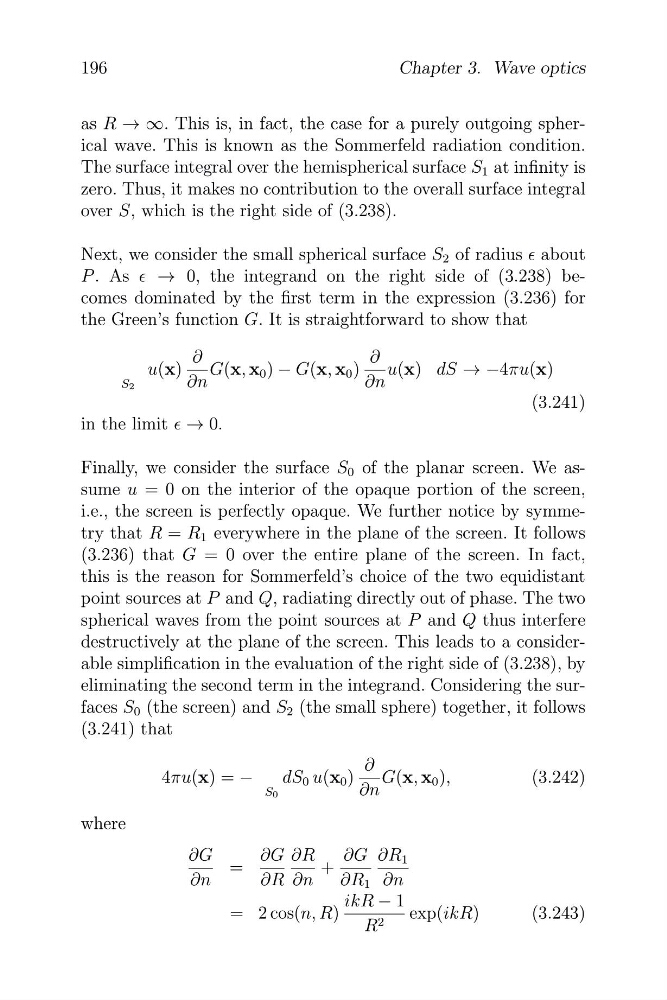
the Green’s function G. It is straightforward to show that
Finally, we consider the surface S 0 of the planar screen. We assume u = 0 on the interior of the opaque portion of the screen,
i.e., the screen is perfectly opaque. We further notice by symmetry that R = R 1 everywhere in the plane of the screen. It follows
(3.236) that G = 0 over the entire plane of the screen. In fact,
this is the reason for Sommerfeld’s choice of the two equidistant
point sources at P and Q, radiating directly out of phase. The two
spherical waves from the point sources at P and Q thus interfere
destructively at the plane of the screen. This leads to a considerable simplification in the evaluation of the right side of (3.238), by
eliminating the second term in the integrand. Considering the surfaces S 0 (the screen) and S 2 (the small sphere) together, it follows
(3.241) that
∂
u(x)
G(x, x 0 ) − G(x, x 0 )
u(x) dS → −4πu(x)
S 2
∂n
∂n
(3.241)
in the limit f → 0.
∂
4πu(x) = −
dS 0 u(x 0 )
G(x, x 0 ),
(3.242)
S 0
∂n
where
∂G
∂G ∂R
∂G ∂R 1
=
+
∂n
∂R ∂n ∂R 1 ∂n
ikR − 1
= 2 cos(n, R)
exp(ikR)
(3.243)
R 2
196
Chapter 3. Wave optics
as R → ∞. This is, in fact, the case for a purely outgoing spherical wave. This is known as the Sommerfeld radiation condition.
The surface integral over the hemispherical surface S 1 at infinity is
zero. Thus, it makes no contribution to the overall surface integral
over S, which is the right side of (3.238).
Next, we consider the small spherical surface S 2 of radius f about
P . As f → 0, the integrand on the right side of (3.238) becomes dominated by the first term in the expression (3.236) for
the Green’s function G. It is straightforward to show that
Finally, we consider the surface S 0 of the planar screen. We assume u = 0 on the interior of the opaque portion of the screen,
i.e., the screen is perfectly opaque. We further notice by symmetry that R = R 1 everywhere in the plane of the screen. It follows
(3.236) that G = 0 over the entire plane of the screen. In fact,
this is the reason for Sommerfeld’s choice of the two equidistant
point sources at P and Q, radiating directly out of phase. The two
spherical waves from the point sources at P and Q thus interfere
destructively at the plane of the screen. This leads to a considerable simplification in the evaluation of the right side of (3.238), by
eliminating the second term in the integrand. Considering the surfaces S 0 (the screen) and S 2 (the small sphere) together, it follows
(3.241) that