

�
�
�
�
∂
∂
u(x)
G(x, x 0 ) − G(x, x 0 )
u(x) dS
S 1
∂n
∂n
→
iku −
∂u GR
2 dΩ,
(3.239)
S 1
∂n
where dΩ is the solid angle element. As GR is bounded as R → ∞,
it follows that the right side vanishes, as long as
∂u
R iku −
→ 0
(3.240)
∂n
195
3.3. Diffraction
have substituted u for U , and G for V . The volume τ is depicted
by the shaded area in the figure. A small sphere about the point
P is specifically excluded from τ , as G has a singularity at P .
The closed surface S includes the infinite planar screen, the small
sphere about P , and is closed by a hemispherical surface at infinity
in the lower half-space of the figure.
The function G defined in (3.236) is called the Green’s function
for this problem. The actual specification of G in (3.236) is not
unique, as any well-behaved function G would satisfy Green’s theorem (3.233). In practice, the choice of G, together with its boundary conditions, is intentionally made in a way which leads to a
simplification of the problem at hand, as the following will show.
Because both u and G satisfy the Helmholtz equation, it follows
immediately that the integrand on the left side of (3.238), and
hence the left side itself, is identically zero. It should also be added
that the sources at P and Q are not physical sources. Rather, they
are merely a mathematical construct to aid in solving for u.
The task remains to evaluate the surface integral over S on the
right side of (3.238). This is equal to the sum of three individual surface integrals over the hemispherical surface at infinity, the
small spherical surface of radius f, and the planar screen, respectively. Considering first the hemispherical surface S 1 at infinity, it
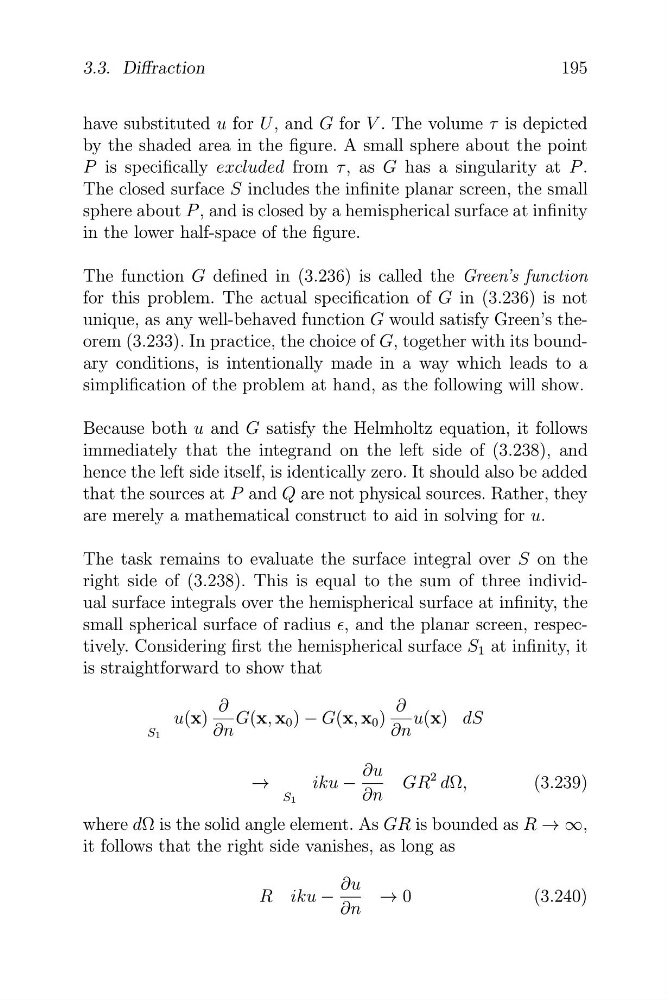
is straightforward to show that
�
�
�
∂
∂
u(x)
G(x, x 0 ) − G(x, x 0 )
u(x) dS
S 1
∂n
∂n
→
iku −
∂u GR
2 dΩ,
(3.239)
S 1
∂n
where dΩ is the solid angle element. As GR is bounded as R → ∞,
it follows that the right side vanishes, as long as
∂u
R iku −
→ 0
(3.240)
∂n
195
3.3. Diffraction
have substituted u for U , and G for V . The volume τ is depicted
by the shaded area in the figure. A small sphere about the point
P is specifically excluded from τ , as G has a singularity at P .
The closed surface S includes the infinite planar screen, the small
sphere about P , and is closed by a hemispherical surface at infinity
in the lower half-space of the figure.
The function G defined in (3.236) is called the Green’s function
for this problem. The actual specification of G in (3.236) is not
unique, as any well-behaved function G would satisfy Green’s theorem (3.233). In practice, the choice of G, together with its boundary conditions, is intentionally made in a way which leads to a
simplification of the problem at hand, as the following will show.
Because both u and G satisfy the Helmholtz equation, it follows
immediately that the integrand on the left side of (3.238), and
hence the left side itself, is identically zero. It should also be added
that the sources at P and Q are not physical sources. Rather, they
are merely a mathematical construct to aid in solving for u.
The task remains to evaluate the surface integral over S on the
right side of (3.238). This is equal to the sum of three individual surface integrals over the hemispherical surface at infinity, the
small spherical surface of radius f, and the planar screen, respectively. Considering first the hemispherical surface S 1 at infinity, it
is straightforward to show that