

�
�
�
� �
�
�
�
182
Chapter 3. Wave optics
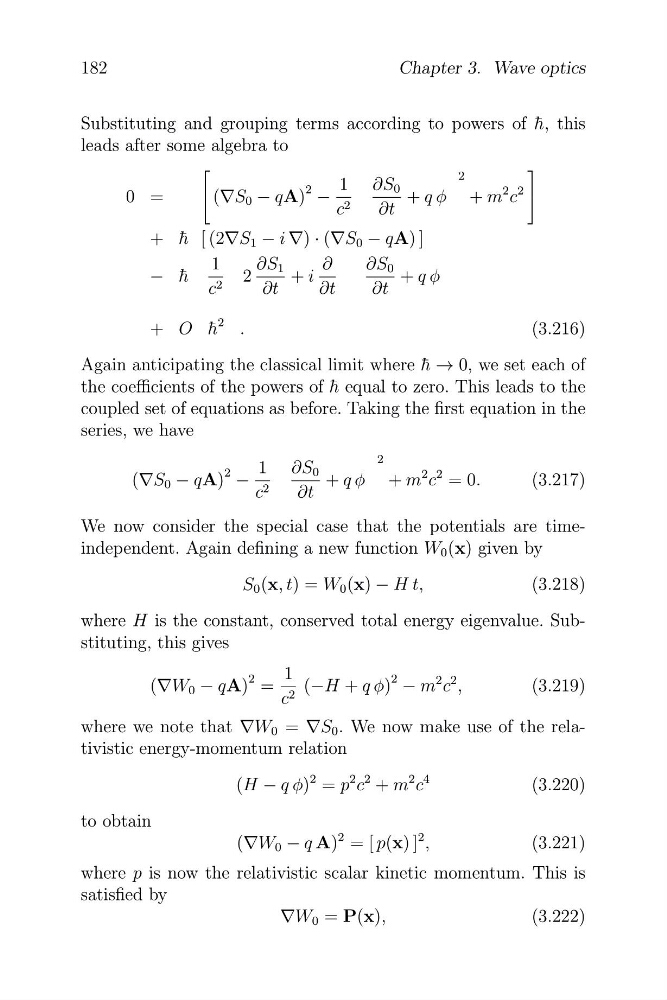
Substituting and grouping terms according to powers of h ¯, this
leads after some algebra to
⎡
⎤
2
1 ∂S 0
2
2 2
0 =
⎣ (vS 0 − qA) −
+ q φ + m c ⎦
2
c
∂t
+ h ¯ [ (2vS 1 − i v) · (vS 0 − qA) ]
1
∂S 1
∂
∂S 0
− h ¯
2
+ i
+ q φ
2
c
∂t
∂t
∂t
h
2
+ O ¯ .
(3.216)
Again anticipating the classical limit where ¯
h → 0, we set each of
the coefficients of the powers of ¯
h equal to zero. This leads to the
coupled set of equations as before. Taking the first equation in the
series, we have
2
2
1 ∂S 0
(vS 0 − qA) − 2
+ q φ + m
2 c
2 = 0.
(3.217)
c
∂t
We now consider the special case that the potentials are timeindependent. Again defining a new function W 0 (x) given by
S 0 (x, t) = W 0 (x) − H t,
(3.218)
where H is the constant, conserved total energy eigenvalue. Substituting, this gives
1
2
2
2 2
=
(−H + q φ) − m c ,
(3.219)
(vW 0 − qA)
2
c
where we note that vW 0 = vS 0 . We now make use of the relativistic energy-momentum relation
2 2
2 4
(H − q φ)
2 = p c + m c
(3.220)
to obtain
(vW 0 − q A)
2 = [ p(x) ]
2 ,
(3.221)
where p is now the relativistic scalar kinetic momentum. This is
satisfied by
vW 0 = P(x),
(3.222)
�
�
� �
�
�
�
182
Chapter 3. Wave optics
Substituting and grouping terms according to powers of h ¯, this
leads after some algebra to
⎡
⎤
2
1 ∂S 0
2
2 2
0 =
⎣ (vS 0 − qA) −
+ q φ + m c ⎦
2
c
∂t
+ h ¯ [ (2vS 1 − i v) · (vS 0 − qA) ]
1
∂S 1
∂
∂S 0
− h ¯
2
+ i
+ q φ
2
c
∂t
∂t
∂t
h
2
+ O ¯ .
(3.216)
Again anticipating the classical limit where ¯
h → 0, we set each of
the coefficients of the powers of ¯
h equal to zero. This leads to the
coupled set of equations as before. Taking the first equation in the
series, we have
2
2
1 ∂S 0
(vS 0 − qA) − 2
+ q φ + m
2 c
2 = 0.
(3.217)
c
∂t
We now consider the special case that the potentials are timeindependent. Again defining a new function W 0 (x) given by
S 0 (x, t) = W 0 (x) − H t,
(3.218)
where H is the constant, conserved total energy eigenvalue. Substituting, this gives
1
2
2
2 2
=
(−H + q φ) − m c ,
(3.219)
(vW 0 − qA)
2
c
where we note that vW 0 = vS 0 . We now make use of the relativistic energy-momentum relation
2 2
2 4
(H − q φ)
2 = p c + m c
(3.220)
to obtain
(vW 0 − q A)
2 = [ p(x) ]
2 ,
(3.221)
where p is now the relativistic scalar kinetic momentum. This is
satisfied by
vW 0 = P(x),
(3.222)